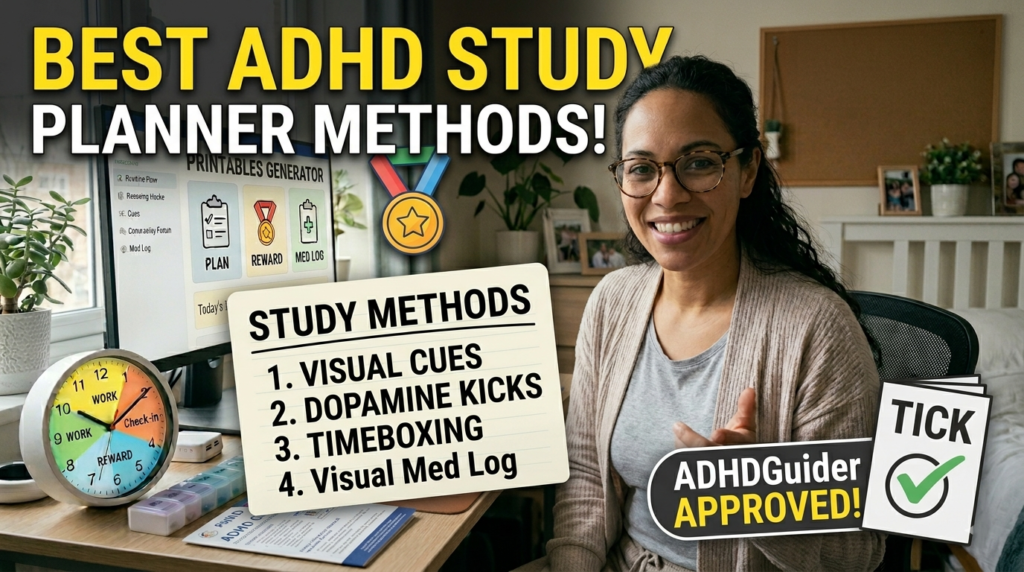
The Best ADHD Study Planner Methods for Students
Stop fighting your brain. Start working with it. Practical, science-backed study strategies designed specifically for how the ADHD mind learns.
Why ADHD Students Need a Different Approach
If you’ve ever stared at your textbook for an hour and retained almost nothing — or spent three hours “studying” and felt like you did zero actual work — you’re not lazy. You’re working against a brain that processes time, attention, and motivation very differently from neurotypical students.
ADHD affects the prefrontal cortex — the part of the brain responsible for planning, working memory, impulse control, and sustained attention. Research published in the Journal of Attention Disorders shows that students with ADHD experience significantly higher rates of academic underachievement not because of lack of intelligence, but because standard study methods simply weren’t designed for how their brains work.
(CDC, 2022)
(Barkley, 2015)
(Research estimate)
(CHADD)
The good news? When ADHD students use strategies tailored to how their brains actually function — strategies that leverage novelty, urgency, interest, and movement — the results can be dramatic. This guide is built around those strategies.
The Real Problem with Standard Study Advice
Most study advice assumes you can:
- Sit still for 2–3 hours at a time
- Keep track of where you are in a subject without visual cues
- Begin studying on time without external pressure
- Maintain motivation even when a topic isn’t inherently interesting
For neurotypical students, these are manageable asks. For someone with ADHD, each of these is a genuine neurological challenge — not a character flaw.
⚠️ The Cramming TrapCramming might work once or twice, but it’s one of the worst strategies for ADHD brains. It demands sustained attention over long periods, relies heavily on working memory (already impaired in ADHD), and leads to poor retention the moment the test-related urgency disappears. The stress spike it creates also worsens executive dysfunction.
Traditional advice like “just focus harder” or “remove all distractions” also misses the point. Many ADHD students actually need some level of stimulation to maintain alertness — total silence can make focus worse, not better.
So what actually works? Let’s get into the methods.
6 Best ADHD Study Planner Methods
These aren’t generic tips. Each method below is grounded in behavioral psychology and executive function research, adapted specifically for ADHD learners.
ADHD-Adapted Pomodoro
Shorter work sprints (15–20 min) with mandatory breaks. Prevents burnout and leverages the urgency of a ticking timer to spark focus.
Spaced Repetition
Review material across several days instead of one long session. Dramatically improves long-term memory without marathon study sessions.
Task Chunking
Break every assignment into the smallest possible steps. “Study biology” becomes “read page 45–52, then write 3 bullet points.”
Body Doubling
Study alongside someone else — in person or virtually. The presence of another person activates accountability and attention regulation.
Visual Planning
Use visual planners, color-coded calendars, and mind maps. ADHD brains respond strongly to visual cues that make abstract tasks concrete.
Active Recall
Test yourself instead of re-reading. Flashcards, practice questions, and self-quizzing produce far better results for ADHD learners than passive review.
The ADHD-Adapted Pomodoro Method
The classic Pomodoro Technique uses 25-minute work sessions and 5-minute breaks. For many ADHD students, 25 minutes is still too long. The ADHD-adapted version shortens sessions to 15–20 minutes to match the realistic attention window, with intentional, restorative breaks.
Here’s what a typical ADHD study hour looks like using this method:
🧠 Focus
20 min
☕ Break
5 min
🧠 Focus
20 min
☕ Break
5 min
🌿 Long Break — 20 min
🧠 Focus
20 min
Why the timer matters
ADHD affects time perception — a phenomenon Dr. Russell Barkley calls “time blindness.” Without an external timer, a 20-minute study block can feel like either 5 minutes or 2 hours. A visible countdown creates an artificial sense of urgency that ADHD brains respond to powerfully.
💡 Pro TipUse a physical timer — a sand timer or a cheap kitchen timer on your desk — rather than a phone app. The visual element helps ADHD brains track time more concretely. Phone apps tempt you to check notifications.
What to do during breaks
Breaks only work if they actually reset your brain. Scrolling social media does not count as a break — it actually extends cognitive load and makes re-entry harder. Instead:
- Walk around the room or outside for 5 minutes
- Do 10 jumping jacks or stretch
- Get water or a snack (avoid high sugar, which spikes and crashes energy)
- Doodle or listen to one song
- Do deep breathing for 60 seconds
🎯 Try the Free ADHD Study Planner
Build your personalized ADHD study schedule — break assignments into steps, set session timers, and track your progress.
Spaced Repetition: Study Less, Remember More
One of the most well-researched memory techniques in cognitive science is spaced repetition — reviewing material at gradually increasing intervals to cement it into long-term memory. For ADHD students who can’t sustain long study sessions, this is a game-changer.
Instead of re-reading your notes five times the night before an exam, you review the same material over five separate days — each session shorter and easier than the last.
| Day | Activity | Session Length | Effort Level |
|---|---|---|---|
| Day 1 | First study — read & take notes | 25–30 min | High |
| Day 2 | Review notes + self-quiz | 15–20 min | Medium |
| Day 4 | Flashcard review | 10–15 min | Low |
| Day 7 | Practice test or written summary | 15–20 min | Medium |
| Day 14 | Quick recall check | 5–10 min | Very Low |
Active recall vs. passive review
Don’t just re-read your notes. Re-reading creates a false sense of familiarity — you recognize the material on the page, but can’t actually retrieve it under test conditions. Active recall is harder but far more effective:
- Flashcards: Anki is free and uses a built-in spaced repetition algorithm.
- The blank page method: Close your notes and write down everything you remember about the topic. Then check what you missed.
- Teach it back: Explain the concept out loud as if teaching a friend. This technique — called the Feynman Method — reveals gaps in your understanding instantly.
- Practice questions: Past papers, textbook questions, or online quizzes.
“ADHD brains are activated by challenge and novelty. The mild struggle of active recall keeps the brain engaged in ways passive re-reading never will. Think of it as giving your brain a puzzle to solve — that’s where ADHD performance often shines.”
Setting Up Your ADHD Study Environment
Your environment is not a background detail — it is a core part of your study strategy. ADHD makes you more sensitive to environmental stimulation, which cuts both ways: the wrong environment tanks your focus, while the right one can support it powerfully.
✅ DO: Environment Supports
- Lo-fi music or brown noise
- Good desk lighting (not overhead glare)
- Clear, clutter-free workspace
- Water bottle within reach
- Physical timer visible on desk
- Library or café for body doubling effect
- Standing desk or fidget tools if needed
❌ AVOID: Environment Killers
- Phone notifications on or nearby
- Social media tabs open
- Studying in bed (sleep association)
- TV on in background
- Cluttered, visually noisy desks
- No natural light for long periods
- Skipping meals before sessions
Sound: The ADHD nuance
Silence is not always golden for ADHD brains. Many students with ADHD report that complete silence feels too empty, which causes the brain to create its own stimulation through distraction. Moderate ambient noise — research suggests around 65–70 dB — can provide just enough background stimulation to help sustain focus without becoming a distraction itself.
Try: Lo-fi hip hop playlists, brown noise, Noisli, or Coffitivity (café sounds). Avoid music with lyrics for language-heavy tasks like writing essays.
Movement during study
ADHD brains are often movement-hungry. Forcing complete stillness can actually increase restlessness and reduce focus. Consider:
- Fidget tools: Spinners, fidget cubes, or stress balls used discretely don’t hurt focus and can help regulate sensory arousal.
- Standing desk: Alternating sitting and standing reduces restlessness significantly.
- Walking while reviewing: For memorization tasks like flashcards, walking while reviewing has been shown to improve recall in some learners.
Your Weekly ADHD Study Planner Checklist
Use this checklist to set up each study week. Tap each item to mark it complete.
📋 Weekly Study Setup Checklist
Body Doubling & Accountability for ADHD Students
Body doubling is one of the most underrated ADHD productivity strategies — and one of the most effective. The simple act of being in the physical or virtual presence of another person while working can dramatically improve focus and task initiation for ADHD individuals.
Nobody fully understands why it works, but the leading theory is that the presence of another person provides a low-level form of social accountability that activates the parts of the prefrontal cortex responsible for task-directed attention. Even if the other person isn’t watching you or doing the same task — just being there is enough.
How to use body doubling as a student
- Library sessions: Work in a public space with other people present. Many ADHD students report their best study sessions happen here.
- Study groups: Even if you’re working on different subjects, being in the same room as other students creates productive social pressure.
- Virtual co-working: Platforms like Focusmate pair you with a stranger for a 50-minute video call where you both work silently. The accountability effect still kicks in online.
- Study with a friend on a call: Turn on video, work in silence, and check in at the end. Simple and surprisingly effective.
- Study cafés: Coffee shops provide ambient noise, social presence, and a change of scenery that can jumpstart motivation.
📌 Real-World ExampleMaria, a college junior with ADHD, spent months struggling to start her weekly assignments. She began booking 2-hour library sessions every Tuesday and Thursday with a classmate — they didn’t even study the same subjects. Within two weeks, her assignment completion rate improved dramatically. The external structure of the environment and the presence of another person was all she needed.
Accountability partners
Beyond body doubling, having a regular accountability partner — someone you check in with weekly about your goals — adds another layer of external structure. This can be a friend, sibling, tutor, or ADHD coach. At the start of each week, share your three study goals. At the end of the week, report back. Simple, but powerful.
Tools That Actually Help ADHD Students Study
The right tools reduce friction — they make starting easier, staying on track less effortful, and finishing more satisfying. Here are tools that align with ADHD needs:
For planning & organizing
- ADHDGuider Study Planner — Purpose-built for ADHD, free, and designed to break down assignments into steps with session scheduling.
- Notion or Trello — Visual, flexible project boards where you can see all your tasks at once. Great for students who hyperfocus on setup.
- Google Calendar — Color-code subjects and set study block reminders. Sync with your phone for persistent visibility.
- Physical planner or whiteboard — Don’t underestimate analog. A visible, physical weekly layout can outperform digital tools for many ADHD students.
For focus & timing
- Forest app — A focus timer that grows a virtual tree while you work. Cutting the session short kills the tree — a surprisingly effective motivator.
- Be Focused (iOS) — A Pomodoro timer designed for students. Tracks completed sessions.
- Physical sand timer or kitchen timer — Visible countdown without screen temptation.
- Freedom or Cold Turkey — Website blockers that remove the willpower equation from distraction avoidance.
For memory & review
- Anki — Free flashcard app with built-in spaced repetition algorithm. Used by medical students and language learners worldwide.
- Quizlet — More beginner-friendly than Anki, great for collaborative study sets.
- Notion AI or ChatGPT — Useful for generating practice quiz questions from your own notes. Not a replacement for studying, but a powerful supplement.
- Voice memos — Record yourself summarizing a topic and replay during a walk or commute. Multimodal review for ADHD brains.
For managing ADHD-specific challenges
- Time Timer — A visual analog timer (also available as an app) that shows time disappearing as a colored arc. Excellent for time blindness.
- Focusmate — Virtual body doubling platform. Book a session, show up on video, work. Free tier available.
- Habitica — Gamifies your to-do list into an RPG. Completing tasks earns rewards for your character. Particularly effective for ADHD brains that respond to game-like reward structures.
Important: Tools only work if you actually use them consistently. Pick one or two tools that excite you, commit to them for two weeks, and evaluate. Don’t fall into the ADHD trap of spending hours setting up productivity systems instead of actually studying.
📚 Ready to Build Your ADHD Study Schedule?
Use our free tools to create a personalized plan — break assignments into steps, track progress, and build momentum.
Frequently Asked Questions
References & Sources
- Barkley, R. A. (2015). Attention-Deficit Hyperactivity Disorder: A Handbook for Diagnosis and Treatment (4th ed.). Guilford Press.
- Centers for Disease Control and Prevention. (2022). Data and Statistics on Children’s Mental Health. cdc.gov
- CHADD — Children and Adults with ADHD. (n.d.). ADHD and Education. chadd.org
- DuPaul, G. J., & Stoner, G. (2014). ADHD in the Schools: Assessment and Intervention Strategies (3rd ed.). Guilford Press.
- Cepeda, N. J., Pashler, H., Vul, E., Wixted, J. T., & Rohrer, D. (2006). Distributed practice in verbal recall tasks: A review and quantitative synthesis. Psychological Bulletin, 132(3), 354–380.
- Karpicke, J. D., & Roediger, H. L. (2008). The critical importance of retrieval for learning. Science, 319(5865), 966–968.
- National Institute of Mental Health. (2023). Attention-Deficit/Hyperactivity Disorder (ADHD). nimh.nih.gov
[…] a mild sense of urgency and makes the passage of time visual. If you are studying or working, the ADHD Study Planner is a great method for balancing intense focus intervals with structured […]