ADHD Daily Planner
Structure your day with time blocks, a top-three priority list, and a simple task area. Designed to stay readable when the page is full, so a busy day never turns into visual noise.
Open ToolBuild better routines, manage tasks, improve focus, and organise your day with simple ADHD-friendly tools built around how attention actually works — for adults, students, parents, and professionals. No account needed, nothing to install, and every tool works directly in your browser.
Practical, action-based tools that may help you focus, plan, and move forward — one small step at a time. Each one opens instantly and works on phone, tablet or desktop.
Structure your day with time blocks, a top-three priority list, and a simple task area. Designed to stay readable when the page is full, so a busy day never turns into visual noise.
Open ToolA customisable Pomodoro-style timer with adjustable work and break lengths. Shorter 15-minute sessions are often easier to start than the standard 25, so the interval is fully yours to set.
Open ToolBuilds a morning, afternoon, or evening routine from the tasks you actually need to repeat. Keeps sequences short and anchored to existing habits rather than to arbitrary clock times.
Open ToolSplits an overwhelming task into smaller, concrete steps until the first one is small enough to simply begin. Useful whenever a task has been sitting on a list for days without moving.
Open ToolOrganises revision into subject blocks with built-in breaks and a visible finish line. Helpful for exam weeks when everything feels equally urgent and nothing feels startable.
Open ToolTracks a small number of daily habits and shows streaks visually. Deliberately capped at a handful of habits, because tracking fifteen at once is the fastest way to abandon all of them.
Open ToolA visual planner that makes time feel concrete by showing how long each block actually occupies. Useful if hours regularly disappear without a clear sense of where they went.
Open ToolA practical self-reflection checklist covering planning, task initiation, working memory, and emotional regulation. Not a diagnostic test — a way to see which area to target first.
Open ToolMost planning systems fail because they ask for too much on day one. This sequence asks for about twenty minutes.
Choose the single biggest daily friction point — starting, timing, or remembering. Fixing everything at once is how systems collapse by Wednesday.
Trouble starting → Task Breakdown. Losing hours → Focus Timer. Forgetting steps → Daily Planner. One tool, not four.
Full-day plans rarely survive contact with a real day. Block out only the next three hours, in specific actions rather than vague categories.
Set a 15–25 minute block with a visible countdown, then take a genuine break away from the screen. One completed block beats a perfect plan.
Log it in the Habit Tracker. After seven days you'll know which parts fit your life and which were borrowed from someone else's routine.
Helpful ADHD guides, planning tips, routines, and productivity strategies — written to be read once and acted on the same day.
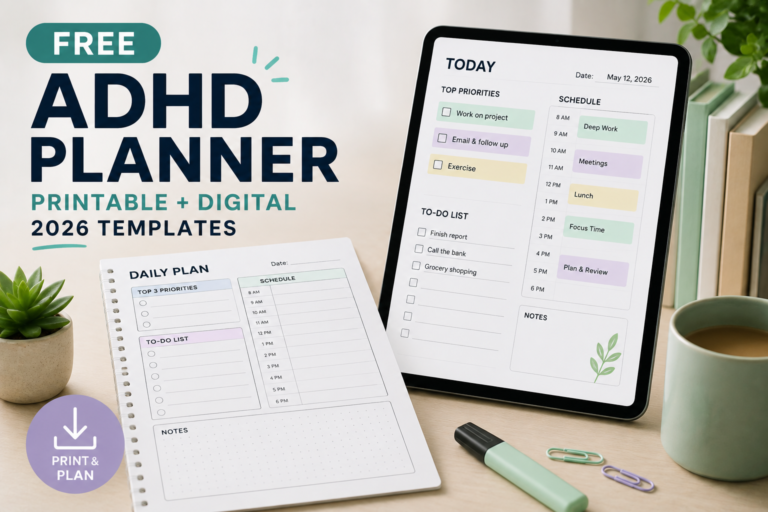
Free ADHD Planner: Printable + Digital (2026 Templates) This free ADHD planner comes in two versions — a printable PDF and a…
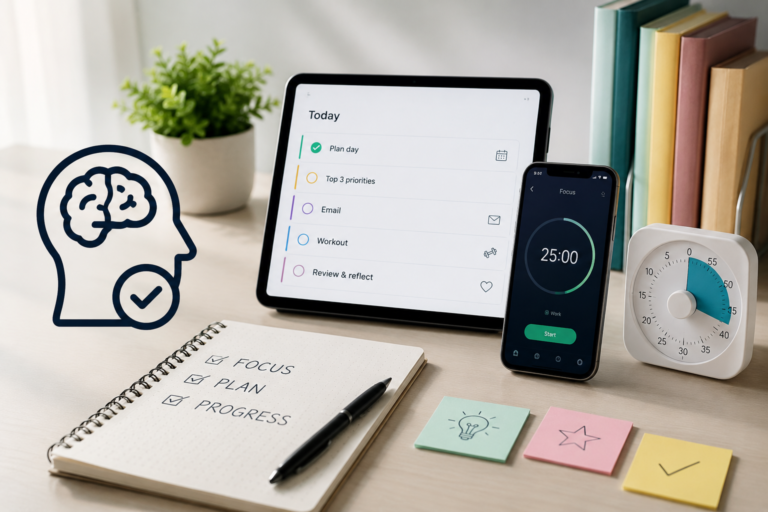
Best ADHD Organization Tools for Adults (2026 Comparison) ADHD organization tools only earn a place in your life if they survive contact…
App Comparison · ADHD Focus Tools What Is Body Doubling? Best Apps for ADHD Focus Why working alongside another person — even…
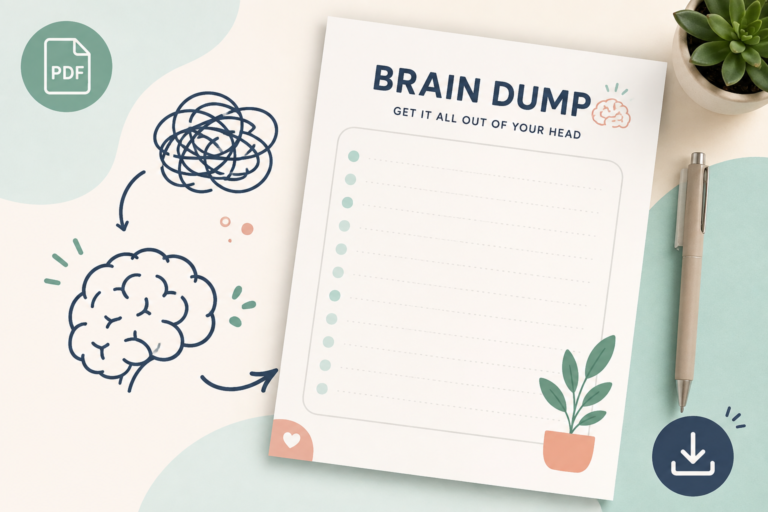
Free Printable · ADHD Tools ADHD Brain Dump Printable PDF (Free Download) A one-page printable that empties a racing ADHD brain onto…
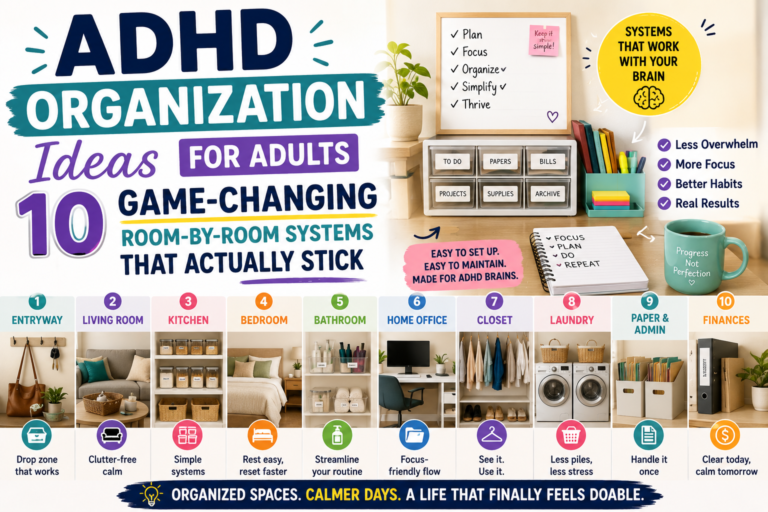
ADHD Organization Ideas for Adults: 10 Game-Changing Room-by-Room Systems That Actually Stick 🏠 Room-by-Room ADHD Organization Guide Why ADHD Organization Needs a…
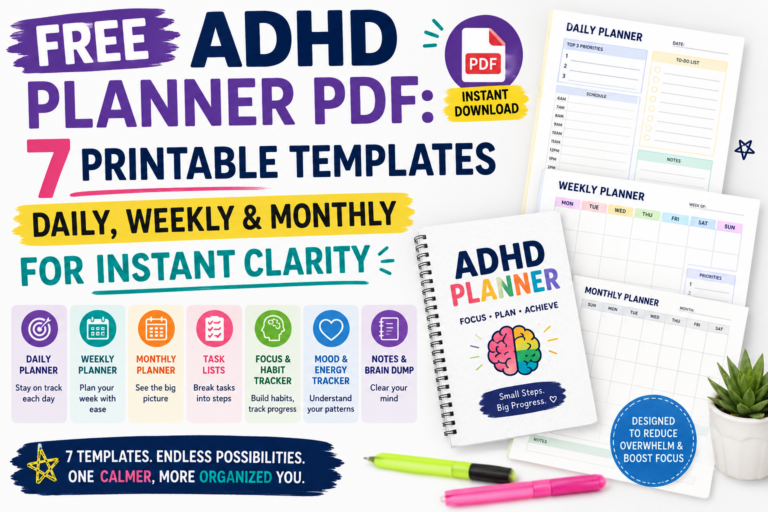
Free ADHD Planner PDF: 7 Printable Daily, Weekly & Monthly Templates for Instant Clarity 📋 Inside Your Free ADHD Planner PDF What’s…
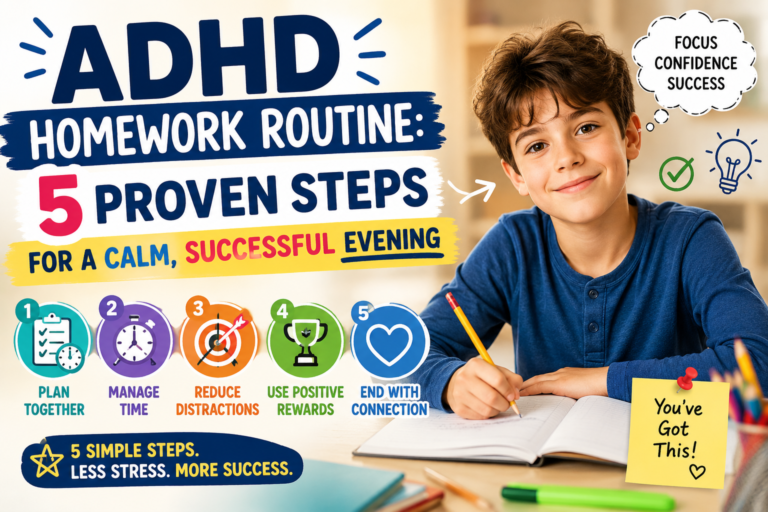
ADHD Homework Routine: 5 Proven Steps for a Calm, Successful Evening 📋 Your ADHD Homework Roadmap Why Typical Homework Routines Fail ADHD…
ADHD Focus Planner: The Ultimate Guide to Reclaiming Your Attention If you have ADHD, your desk or digital workspace is likely a…
ADHD Organization Tools: A Practical Guide for Adults If you have ADHD, your home is likely filled with the ghosts of failed…
Whether you're navigating work, school, parenting, or daily life, there's a starting point that fits your situation rather than a generic template.
For managing a household, admin, and work at once — where nothing is individually hard but everything is due.
Built around academic reality: deadlines that cluster, long readings, and revision that never feels started.
Practical structures for family life — visual schedules, transitions, and reducing repeated reminders.
Strategies for open offices, meeting-heavy weeks, and inboxes that refill faster than they empty.
Find the right guides quickly by topic — from daily focus strategies to printable planning sheets.
Techniques for reducing distraction and finishing what you start — including environment changes that often matter more than willpower.
Browse Guides →Sustainable daily and weekly routines built around existing anchors, so they survive disrupted weeks instead of resetting to zero.
Browse Guides →Planners, checklists, and visual systems designed for scattered days — with fewer fields to fill and more room to think.
Browse Guides →ADHD-friendly study strategies, session planners, and note-taking frameworks aimed at recall rather than tidy notebooks.
Browse Guides →Managing deadlines, emails, meetings and workplace focus — plus how to describe what you need without oversharing.
Browse Guides →Free downloadable planners, habit trackers, and checklists sized for A4 and US Letter, ready to print and use today.
Browse Printables →Most mainstream planning systems assume that once a task is written down, starting it is the easy part. For people who struggle with attention regulation, that assumption is backwards — the writing down is trivial and the starting is the entire problem. This is why a beautifully organised planner can sit untouched while the same three tasks roll forward for a fortnight.
The tools on this site are built around a different assumption: the point of failure is usually initiation, not intention. That changes what a good tool looks like. It means fewer fields, shorter time horizons, visible countdowns instead of abstract deadlines, and a first step small enough that refusing it feels sillier than doing it.
| If your problem is… | Start with | Why it helps | Time needed |
|---|---|---|---|
| I can't get started | Task Breakdown Tool | Shrinks the first action until beginning costs almost nothing | 3 minutes |
| Hours vanish | Focus Timer | Gives time a visible shape and a defined stopping point | 1 minute |
| I forget the steps | Daily Planner | Moves the sequence out of working memory and onto the page | 2 minutes |
| Mornings are chaos | Routine Generator | Fixes the order once so it isn't re-decided every day | 5 minutes |
| Nothing sticks past week one | Habit Tracker | Makes partial progress visible so one gap doesn't end the attempt | 2 minutes |
| Revision never starts | Study Planner | Converts a vague subject into finite, scheduled blocks | 5 minutes |
Scroll the table sideways on smaller screens.
They are organisational aids. They do not assess, screen for, or diagnose any condition, and they are not a treatment. If daily functioning is significantly affected — at work, at school, or at home — that is a conversation for a qualified clinician, who can consider the full picture including sleep, stress, and other conditions that affect concentration in similar ways. Tools like these can sit alongside professional care, but they don't substitute for it.
ADHDGuider was built with one goal: to make everyday organisation support practical, simple, and action-based. Rather than adding to the pile of clinical explanation already available, every tool, guide, and planner here is designed to help you take one small, manageable step today.
Our guides are written and edited by the ADHDGuider editorial team, and are informed by publicly available guidance from recognised health bodies and peer-reviewed research on executive function, habit formation and attention. We deliberately use cautious language — "may help", "can support" — because organisational strategies vary in how well they suit different people, and we would rather be accurate than persuasive.
Every resource is built around doing, not just reading. Tools are interactive, printables are ready to use, and guides end with a concrete next step rather than a summary.
Content draws on reputable educational and health resources and is checked against current terminology. We make no medical claims and never present a tool as a treatment.
Guides carry a visible last-reviewed date and are refreshed when guidance or best practice changes. Corrections are made openly rather than quietly removed.
Read more about who we are and how we work on our About page, our editorial policy, and our privacy policy. Spotted an error? Tell us — we'd rather know.
Simple, practical reads written to help you take real action — not just feel informed.
A step-by-step walkthrough for creating a daily rhythm that survives bad days — starting with three fixed anchors rather than a full schedule.
Read Guide →Planning strategies that reduce overwhelm and improve follow-through, including why a shorter list usually finishes faster than a complete one.
Read Guide →Revision techniques built around short blocks, active recall, and breaks that genuinely restore attention rather than quietly consuming an hour.
Read Guide →A guide to task decomposition — how far to break something down, and the signal that tells you the first step is finally small enough.
Read Guide →Straightforward techniques with no complex system to maintain — including time estimation habits that improve accuracy within a fortnight.
Read Guide →What executive function actually covers, which skills tend to be affected most, and concrete supports that may help each one individually.
Read Guide →A one-page printable planner with time blocks, a top-three priority section, and a small wins box. Sized for A4 and US Letter, designed to stay readable when filled in by hand.
No spam, unsubscribe any time. We never sell or share your email. See our privacy policy.
Quick answers to common questions about ADHDGuider and how to get started.