ADHD Organization Tools: A Practical Guide for Adults
If you have ADHD, your home is likely filled with the ghosts of failed organizational attempts. You have bought beautiful leather-bound planners, complex color-coded filing cabinets, expensive labeling machines, and elaborate app subscriptions. You spend hours setting up the “perfect” system, absolutely convinced that *this time* it will work, that *this time* your life will finally be orderly.
Three days later, the planner is buried under a pile of mail, the filing cabinet is ignored, and you are back to living out of laundry baskets and frantic sticky notes.
This cycle of hope and failure is not a character flaw. It happens because almost all commercially available organizational systems are built by and for neurotypical brains. They assume you have reliable working memory, steady executive function, and the internal motivation to maintain a complex filing system. For the ADHD brain, a complex system is a broken system.
To build an environment that actually supports you, you must stop trying to adapt your brain to neurotypical tools, and start choosing **adhd organization tools** that are specifically designed for your neurodivergent biology.
This comprehensive guide will explain the neuroscience behind why traditional organization fails the ADHD brain, provide an actionable framework for selecting the right systems, and detail the best physical and digital **adhd organization tools** available. By understanding these principles, you can stop fighting your biology, dramatically improve your **productivity**, and finally create a sustainable system of **organization**.
The Science: Why Traditional Organization Fails ADHD Brains
Before you buy another plastic bin, you must understand why the last ten plastic bins failed. The ADHD brain processes the physical environment differently than a neurotypical brain due to specific deficits in executive functioning.
1. The “Out of Sight, Out of Mind” Phenomenon (Object Permanence)
In ADHD, “object permanence”—the cognitive understanding that things continue to exist even when they cannot be seen—is often severely compromised. If you put your bills in a beautiful, opaque filing cabinet, your brain essentially deletes them from existence. If you put vegetables in the opaque crisper drawer of your refrigerator, they rot, because you literally forgot you owned them.
Traditional organization relies heavily on “hiding” clutter to make a space look clean (drawers, cabinets, closed boxes). For an ADHD brain, hiding items guarantees they will be forgotten until a crisis occurs. Effective **adhd organization tools** must be highly visual.
2. Working Memory Deficits
**Working memory** is the brain’s short-term workbench. When a neurotypical person walks through their house, their working memory holds the intention: “I am carrying this cup to the dishwasher.” An ADHD brain drops that intention the moment a more stimulating thought occurs, leaving the cup on a random bookshelf. Traditional systems assume you will remember the multi-step process of putting things away. ADHD systems must minimize the steps required to put something away to accommodate a fragile working memory.
3. The Novelty/Dopamine Chase
Setting up a new organizational system is incredibly stimulating. It provides a massive hit of dopamine—the neurotransmitter the ADHD brain chronically lacks. This is why you love buying office supplies. However, *maintaining* an organizational system provides zero dopamine. It is repetitive, boring, administrative work. If an organizational tool requires high maintenance to function, the ADHD brain will inevitably abandon it once the initial novelty wears off.
Symptoms of a Broken Organizational System
How do you know if your current tools are fighting your neurobiology? Look for these specific hallmarks of ADHD organizational failure.
| Symptom | Description | The Neurological Driver |
|---|---|---|
| The “Doom Box” | Boxes, bags, or drawers filled with completely unrelated, random items hidden away just before guests arrive. | Panic-cleaning combined with an inability to categorize items quickly (executive dysfunction). |
| The Graveyard of Planners | Owning five different planners, all filled out for the first week of January and completely blank afterward. | The dopamine hit of novelty wearing off, combined with a system that has too much friction to maintain. |
| The “Piles” System | Important papers stacked in piles on the kitchen counter, dining table, and desk. | A coping mechanism for poor object permanence; keeping things visible so they aren’t forgotten. |
| The Daily Hunt | Spending 15 minutes every single morning frantically searching for keys, wallet, or phone. | Failure to establish a “Point of Performance” landing zone, relying on flawed working memory instead. |
| Digital Hoarding | Having 14,000 unread emails and a desktop completely covered in randomly named screenshots. | Decision fatigue. Categorizing digital files requires high executive function, so the brain avoids it. |
Real-World Scenarios
Scenario A: The Neurotypical Trap (James’s Story)
James wants to organize his home office. He buys a beautiful, dark wood filing cabinet and hundreds of manila folders. He creates a complex, color-coded alphabetical system. “Red is for medical, Blue is for auto, Green is for taxes.” He spends an entire Saturday setting it up.
By Wednesday, he receives a medical bill in the mail. To file it, he must: 1. Walk to the office. 2. Open the cabinet. 3. Find the Red section. 4. Find the ‘H’ folder for Hospital. 5. Place it inside. 6. Close the drawer.
This is six steps. James’s ADHD brain calculates the executive cost of those six steps, determines it is too high, and he drops the bill on his desk instead. Six months later, his filing cabinet is empty, and his desk is buried under a mountain of paper.
Scenario B: The ADHD-Friendly System (Maria’s Story)
Maria understands her ADHD. Instead of a filing cabinet, she uses **adhd organization tools** built for low friction. She buys a series of clear, open-top acrylic wall pockets and mounts them right next to her front door where she opens her mail.
They are labeled simply: “TO PAY”, “TO READ”, “TO FILE”. When Maria gets a bill, the process is: 1. Drop it in the clear “TO PAY” pocket.
That’s it. One step. Because the pocket is clear, the bill remains in her visual field, satisfying her need for object permanence. Because the pocket is at the door (the point of performance), she doesn’t have to carry it to another room. Her system works flawlessly because it requires almost zero executive function to maintain.
The Actionable Framework: How to Choose ADHD Organization Tools
Do not buy any organizational product until it passes the following neurodivergent design principles.
Principle 1: The Point of Performance
In ADHD treatment, the “Point of Performance” is the exact physical location where a task is executed. Your tools must live exactly where the action happens.
* **Example:** If you always take off your shoes in the middle of the living room, do not put the shoe rack in the hall closet. Your brain will never carry the shoes to the closet. Put an open basket in the middle of the living room. Bring the tool to the behavior, do not try to force the behavior to the tool.
Principle 2: Frictionless Capture (The One-Step Rule)
If an organizational tool requires opening a lid, unzipping a pouch, or clicking through three menus in an app, an ADHD brain will abandon it. Putting something away must take only one step.
* **Example:** Use trash cans without lids. Use laundry hampers without covers. If you have to lift a lid to throw away a wrapper, the wrapper will end up on the table next to the trash can.
Principle 3: Visual and Transparent
To combat the “out of sight, out of mind” deficit, your storage must be visual. If you cannot see it, you do not own it.
* **Example:** Remove the doors from your kitchen cabinets or use clear acrylic storage bins in the pantry. Use open shelving instead of closed dressers for clothes.
Principle 4: Broad Categories over Micro-Sorting
Neurotypical organization loves micro-sorting (e.g., sorting screws by millimeter size). ADHD organization requires macro-sorting (e.g., a bin labeled “Hardware”). The more specific the category, the more decision fatigue you experience when trying to put an item away.
* **Example:** Do not fold and sort underwear by color. Have one large bin labeled “Underwear” and throw it all in. The goal is contained chaos, not perfection.
Top Recommended ADHD Organization Tools
Here is a curated list of physical and digital tools that consistently bypass executive dysfunction.
The Best Physical Tools
- Clear Acrylic Bins: This is the absolute holy grail of ADHD organization. Use them in the refrigerator (so expensive vegetables do not rot out of sight in the opaque crisper drawer), the pantry, the bathroom, and the office. They provide the necessary physical containment of items while perfectly preserving visual object permanence. If you can see it, you know you own it.
- The “Launch Pad” Tray: A distinct, brightly colored, shallow tray placed on a table directly next to your front door. This is exclusively for your keys, wallet, ID badge, and sunglasses. You must establish a rigid rule: you are not allowed to set these items anywhere else in the entire house. Setting up this single Point of Performance tool eliminates the frantic 15-minute daily morning hunt that ruins your mood before you even leave for work.
- Giant Wall Whiteboards: Do not buy a small paper notepad that will inevitably get lost under a pile of mail. Buy the largest whiteboard you can physically fit on a prominent wall in your kitchen or office. Use it for your brain dumps, running grocery lists, and critical reminders. Because the whiteboard is massive and permanently fixed to the wall, your brain cannot visually ignore it.
- Open Baskets (Strategic Doom Baskets): You must accept the reality that you will always generate random clutter throughout the day. Instead of letting that clutter slowly cover your dining tables and countertops, place an aesthetically pleasing, lidless basket in every single room. When you are doing your daily cleaning routine, simply toss the random clutter into the basket. It contains the visual noise and satisfies the one-step rule for tidying up.
- Over-the-Door Clear Shoe Organizers: Do not restrict these solely to shoes. Hang them inside your bathroom door to hold individual toiletries, or inside your office door for charging cables, tape, and office supplies. Because every pocket is clear, everything has a designated home, and every single item is instantly visible without having to dig through a dark drawer.
- The High-Contrast Labeling Strategy: While labels are technically helpful, complex labeling systems are a massive barrier to entry. Do not buy an electronic label maker that requires batteries and menu navigation. Instead, use a massive, thick black permanent marker and write directly on the clear plastic bin, or use wide, brightly colored masking tape. The goal is instant, low-friction identification, not Pinterest-perfect typography. If you have to spend 10 minutes printing a beautiful label, your executive function will fail, and you will just leave the item on the counter instead.
The Best Digital Tools
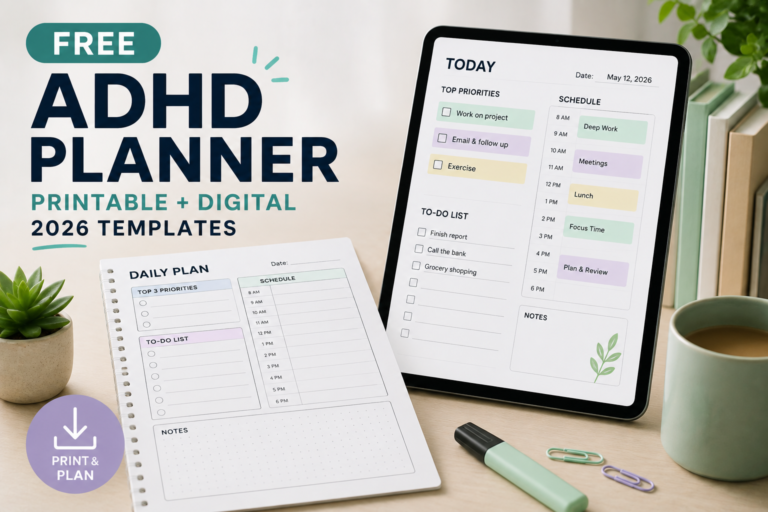
- The ADHD Daily Planner: For day-to-day survival, you need a hyper-focused tool that doesn’t overwhelm you with features. Use the ADHD Daily Planner to securely hold your top three priorities for the day without getting lost in a massive backlog.
- The ADHD Weekly Planner: For parking future tasks that you don’t need to look at today, use the ADHD Weekly Planner. This prevents your daily view from becoming cluttered and overwhelming.
- Voice-to-Text Capture Apps: If you have to type out a reminder, you will likely forget the thought before you unlock your phone. Use apps (like Braintoss or native voice assistants) where you can push one button and speak your reminder. The app then emails it to your inbox or adds it to your task list automatically.
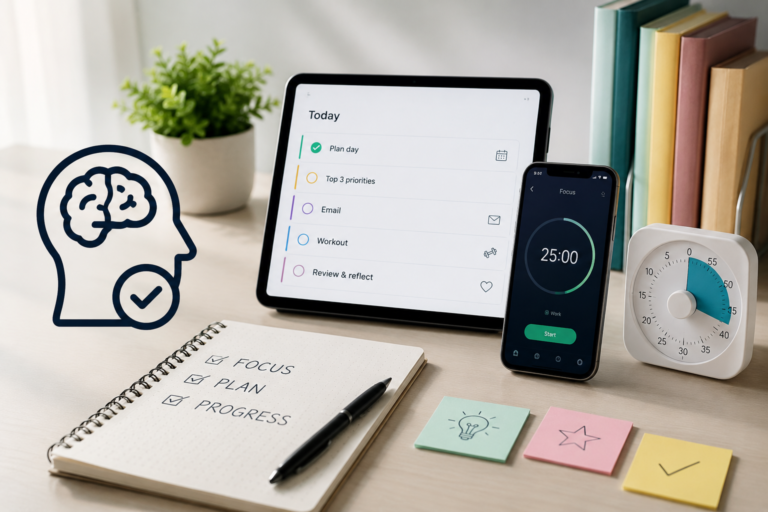
- Time Blocking Tools: Organization isn’t just about physical items; it’s about organizing your time. Use the ADHD Time Management Planner to visualize your day. If your time isn’t blocked out visually, it effectively doesn’t exist.
Printable ADHD Organization Tool Audit Checklist
Template 1: The Tool Audit
Before you buy a new organizational product, run it through this neurodivergent checklist. If it fails too many checks, do not buy it.
[ ] Can I put an item away using only ONE hand?
[ ] Does this tool require opening a lid, drawer, or zipper?
[ ] Can I bypass menus and screens to enter data instantly (digital)?Visibility Check:
[ ] Are the contents visible from across the room?
[ ] Is the material clear (acrylic/glass/wire mesh) rather than opaque?
[ ] If opaque, is it labeled with a massive, high-contrast label?
Location Check (Point of Performance):
[ ] Will this tool live exactly where I use the items?
[ ] Does using this tool require me to walk to a different room?
Maintenance Check:
[ ] Does this system require micro-sorting (sorting by exact color/size)?
[ ] Will this system take more than 5 minutes a week to “reset” or maintain?
Common Pitfalls and Expert Recommendations
Even with the best tools, the ADHD brain will encounter resistance. Here is how experts recommend maintaining your systems and avoiding the traps that lead to abandonment.
1. The “Shiny Object” Trap
You will constantly be tempted by the newest app or the most beautiful, intricate planner on social media. It is vital to remember: the dopamine spike comes from *buying* the tool, not from *using* the tool. For the ADHD brain, novelty is incredibly intoxicating. When you see a new system, your brain falsely promises that this purchase will fix your executive dysfunction. Before switching systems, force yourself to wait a minimum of 72 hours. If your current system works (even if it is ugly, battered, or taped together), do not abandon it for novelty.
2. Confusing Aesthetics with Organization
The neurotypical world heavily markets the idea that “organized” means your home looks like a pristine minimalist magazine cover. For an ADHD brain, “organized” simply means “I know exactly where it is, and I can access it easily without friction.” A clear plastic tub full of tangled cables on your desk is highly organized if you know exactly what is in it and can grab a charger instantly. Conversely, a pristine, hidden drawer full of meticulously wrapped and labeled cables is deeply disorganized if you forget they exist and end up buying new ones on Amazon. Prioritize function over aesthetics every single time. Your home is a machine for living, not a museum for looking.
3. The Setup vs. Maintenance Ratio
If a digital app takes three hours to configure with custom tags, hex colors, cross-linked databases, and nested folders, you will never use it long-term. The best **adhd organization tools** require zero setup. The moment you pull a bin out of the box (or download a basic notes app), it should be ready to capture information. If a system requires you to watch a 45-minute YouTube tutorial to understand how to enter a single task, it is the wrong system for an ADHD brain.
4. The Power of Organization Routines
A tool cannot use itself. A clear bin cannot put the vegetables away for you. The missing link in most ADHD management strategies is the failure to build **routines** around the tools. You cannot rely on willpower or spontaneous motivation to clean your desk or check your planner. You must establish rigid, automated **routines** that bypass executive decision-making. For example, your “Sunday Reset Routine” might involve taking 15 minutes to empty your pockets, clear your launch pad, and wipe down your giant whiteboard. When you anchor these **routines** to existing habits (like listening to your favorite podcast on Sunday evening), the maintenance of your tools becomes automatic.
5. The All-or-Nothing Fallacy
When your system inevitably breaks down—and it will, because life is chaotic—do not throw the entire tool away. ADHD brains are prone to black-and-white thinking. If you forget to use your planner for three days, your brain tells you, “The system failed, I am a failure, I should throw the planner away.” This is a cognitive distortion. A system that works 60% of the time is infinitely better than having zero system. Simply pick the tool back up on day four. Forgive the lapse, reset, and continue.
Frequently Asked Questions
Should I use paper or digital tools?
There is no universal answer, but a hybrid approach usually works best. Digital tools (like phone calendars with alarms) are superior for *prospective memory* (reminding you to do something in the future). However, physical tools (like giant whiteboards and paper planners) are superior for *working memory* because they provide constant, un-ignorable visual presence without the distraction of smartphone notifications. Experiment with both, but lean toward physical visual cues for daily tasks.
My partner hates my visual clutter. What do I do?
This is a common source of conflict in mixed-neurotype households. The compromise is “contained visual clutter.” You cannot use opaque cabinets, and your partner cannot tolerate items strewn everywhere. The solution is using aesthetic but open containers—beautiful woven baskets, sleek wire trays, or high-quality clear acrylic bins. The items remain visible to you, but “contained” for your partner.
How do I remember to actually use the tools?
You cannot rely on willpower to use a tool. You must attach the tool to an existing habit. If you want to remember to check your planner, you must leave the planner physically on top of your coffee maker. To build long-term consistency, track your usage with the ADHD Habit Tracker until the action becomes an automatic reflex.
Conclusion: Stop Fighting Your Brain
The narrative that you are lazy, messy, or incapable of organization is false. You have simply spent your entire life trying to run neurotypical software on a neurodivergent hard drive. It will never work.
True **planning** and **organization** for an ADHD brain is an act of extreme self-compassion. It requires letting go of the fantasy of a perfectly minimalist, hidden home, and embracing a life of visual cues, open containers, and frictionless systems.
By prioritizing the Point of Performance, utilizing clear bins to support your object permanence, and ruthlessly eliminating multi-step maintenance, you can build an environment that finally supports your executive function rather than draining it.
Your tools should serve you, not the other way around. Stop buying tools that require perfection. Start choosing **adhd organization tools** that embrace your reality. When you align your environment with your neurology, the chaos subsides, your **focus** improves, and you reclaim the energy needed to actually live your life.

[…] This room-by-room guide gives you specific, actionable ADHD organization tools for adults that reduce clutter without requiring perfection. If you’ve ever felt ashamed of your space, start here. For a broader planning foundation, explore our organization planning hub. […]
[…] broader context on where these tools fit into a full daily structure, see our guide to organization planning for ADHD, and for lower-cost DIY approaches, our ADHD organization ideas […]