ADHD Focus Planner: The Ultimate Guide to Reclaiming Your Attention
If you have ADHD, your desk or digital workspace is likely a graveyard of abandoned planners. You have purchased beautiful, expensive leather-bound notebooks. You have downloaded highly complex project management applications. Every single time, the pattern is identical: you spend three hours hyperfocusing on setting up the perfect, color-coded system. You feel a massive surge of optimism, convinced that *this* is the tool that will finally fix your life.
By day four, the planner is buried under a pile of mail, the app notifications are being ignored, and you are back to writing frantic, disorganized to-do lists on the backs of old receipts.
This repeated failure is profoundly demoralizing, often leading to deep feelings of shame and inadequacy. However, the failure does not lie with you; it lies with the tools. Almost all commercial planners are designed by and for neurotypical brains. They assume you possess an innate ability to prioritize, an internal sense of time, and the executive function required to consistently engage with a complex system without instant rewards.
For an ADHD brain, a neurotypical planner is not a tool; it is a source of overwhelming anxiety. To actually manage your tasks, you need an **adhd focus planner**—a system specifically engineered to bypass your unique neurobiological deficits, externalize your working memory, and stimulate your dopamine-starved attention network.
This comprehensive guide will deconstruct the science behind why traditional planning fails the ADHD brain, provide a highly actionable framework for creating your own **adhd focus planner**, and equip you with the strategies needed to maintain your **productivity** and **organization** long-term without burning out.
The Science: Why Traditional Planners Fail ADHD Brains
To understand why an **adhd focus planner** is necessary, we must first look at the neurological mechanics of Attention Deficit Hyperactivity Disorder and how standard planners aggressively clash with them.
1. Working Memory Collapse and The “Long List” Paralysis
**Working memory** is the brain’s short-term storage space—the mental workbench where you hold information while manipulating it. In an ADHD brain, working memory capacity is significantly reduced.
Neurotypical planners often encourage “brain dumping” everything onto a single, massive daily list. When an ADHD brain looks at a list of 25 tasks, the working memory crashes instantly. It cannot differentiate between “Call the IRS” and “Water the plants.” Every task feels equally urgent and equally massive. This leads to immediate cognitive gridlock, task paralysis, and an overwhelming desire to avoid the planner entirely.
2. Severe Time Blindness
ADHD is characterized by profound time blindness—an inability to intuitively gauge how long tasks will take or how much time has passed. To the ADHD brain, there are only two times: “Now” and “Not Now.”
Standard planners use tiny, identical lines for hours of the day, assuming the user can accurately estimate task duration. When an ADHD adult attempts to use these, they often schedule eight hours of highly demanding work into a three-hour block. When they inevitably fail to finish, they feel immense guilt. An effective **adhd focus planner** must make time tangible, visual, and highly realistic.
3. The Dopamine Deficiency and System Friction
The ADHD brain is chronically under-stimulated due to a dysregulated dopamine system. It constantly seeks novelty and instant gratification. Standard planners offer zero dopamine. They are administrative, repetitive, and boring.
Furthermore, standard planners often involve high “friction.” If your digital planner requires you to click through three menus and assign five color-coded tags just to enter the task “Buy milk,” your brain will calculate that the executive cost is too high and abandon the task. An ADHD planner must be utterly frictionless to capture information and must build in artificial dopamine rewards to encourage execution.
Symptoms of a Broken Planning System
How do you know if your current organizational method is fighting your neurobiology? Look for these classic hallmarks of ADHD planning failure.
| Symptom | Description | The Neurological Driver |
|---|---|---|
| The Wall of Awful | Opening your planner, feeling a physical wave of nausea or anxiety, and immediately closing it. | Executive overload. The planner contains too many unstructured demands, triggering the brain’s threat response. |
| False Productivity (Procrasticleaning) | Avoiding your top priority task by intensely focusing on a low-priority task, like alphabetizing your bookshelf. | Dopamine seeking. The low-priority task is easier to start and provides faster rewards than the complex, ambiguous high-priority task. |
| The Planner Graveyard | A drawer full of expensive planners that were used passionately for exactly one week before being forgotten. | The cycle of novelty. The dopamine hit came from setting up the system, not from executing it. When the novelty wore off, the system died. |
| “Out of Sight, Out of Mind” Failures | Missing a major deadline because you closed your digital planner app and forgot the task existed. | Lack of object permanence. If an ADHD brain cannot physically see the task, the task ceases to exist in working memory. |
| The Sticky Note Explosion | Your monitor and desk are covered in dozens of overlapping sticky notes with random, contextless reminders. | A desperate attempt to externalize working memory without a central, trusted system to process the information. |
Real-World Scenarios
Scenario A: The Neurotypical Nightmare (David’s Story)
David is a graphic designer. He buys a standard daily planner. On Monday morning, he writes a list of 18 things he wants to accomplish, ranging from “Redesign corporate logo” to “Buy cat food.”
He sits at his desk at 9:00 AM and looks at the list. Because his executive function cannot prioritize, all 18 tasks scream at him simultaneously. He feels paralyzed. To escape the uncomfortable feeling of paralysis, his brain seeks dopamine. He opens Twitter “just for a minute.” Because of his time blindness, he scrolls until 11:30 AM.
Panicked, he finally looks at the list again. He chooses the easiest task—buying cat food online—because “Redesign corporate logo” feels too big to start. By 5:00 PM, he has crossed off three minor chores, the logo remains untouched, and he feels completely exhausted by his own avoidance. His planner is a record of his failure.
Scenario B: The ADHD Focus Mastery (Maya’s Story)
Maya also struggles with ADHD, but she uses a dedicated **adhd focus planner** system. She does not keep a daily list of 18 items.
At 8:30 AM, Maya opens her planner. It is heavily structured but visually simple. She looks at her “Master Backlog” (where she dumped all her tasks the night before) and extracts exactly THREE tasks for the day. That is her absolute limit. She writes those three tasks in her daily view.
Task 1 is “Write Q3 Report Introduction.” Because she struggles with task initiation, her planner includes a “Next Physical Action” box. She writes: “Open Microsoft Word and type the title.”
She sets a visual countdown timer for 25 minutes. She looks at her planner, sees only three items, feels a sense of manageable control, and easily executes the Next Physical Action. By noon, she has completed her top priority. Her planner is a tool that facilitates focus, not a tool that induces guilt.
The Actionable Framework: Building Your ADHD Focus Planner
You do not need to buy a specific brand of notebook to create an effective system. You simply need to apply the following neurodivergent design principles to whatever tool you choose (whether it is a digital app, a whiteboard, or a cheap spiral notebook).
Core Principle 1: Radical Simplification and The Rule of 3
The primary function of an **adhd focus planner** is *restriction*, not *collection*. A neurotypical planner is a bucket where you throw everything you need to do. An ADHD planner is a filter that protects your brain from everything you don’t need to do right now.
- The Master Backlog vs. The Daily View: You must strictly separate your “everything I need to do eventually” list from your “what I am doing today” list. Use the ADHD Weekly Planner as your massive dumping ground. Your Daily View must be a sacred space containing ONLY what you are doing today.
- The Rule of 3: Your Daily View is allowed a maximum of three primary tasks. No exceptions. If you finish them all by 2:00 PM, you can pull more from the backlog. But staring at a list of three is neurologically manageable; staring at a list of ten triggers paralysis.
Core Principle 2: Frictionless Capture
Because ADHD working memory is highly volatile, you will frequently have a brilliant idea or remember an important task while in the middle of doing something else. If you try to hold that thought in your head, you will lose your **focus** on the current task. If your planner takes too long to open, you will lose the thought entirely.
- The “Inbox” Method: Your planner must have an instantly accessible “Inbox” or “Brain Dump” section. If you use a paper planner, this is a blank page permanently kept open on your desk. If you use a digital tool, it should be a widget on your phone’s home screen.
- Zero Formatting: When capturing a thought, do not categorize it, color-code it, or schedule it. Just capture the raw data instantly. You will process and format it later during your evening routine.
Core Principle 3: Breaking the Initiation Barrier
ADHD brains suffer from an inability to transition from resting to working. Large tasks (“Do Taxes”) look like impenetrable walls.
- The “Next Physical Action” Rule: Your planner must force you to break down your Rule of 3 tasks into molecular, physical actions. You do not write “Do Taxes.” You write: “1. Open laptop. 2. Log into bank account. 3. Download January statement.”
- The 5-Minute Buy-In: Write down your next physical action, set a timer for exactly 5 minutes, and promise your brain it can quit when the timer rings. By lowering the barrier to entry, you trick your executive function into starting. Usually, once the dopamine of starting kicks in, you will keep going past the 5 minutes.
- The Planner as a Body Double: Body doubling is a powerful ADHD management technique where the physical presence of another person helps you initiate tasks. If you cannot find a physical body double, your planner can serve as an external anchor. By writing the task down in large, bold letters and placing the open planner directly next to your keyboard, the tool acts as a silent, physical accountability partner. It constantly pulls your visual attention back to the specific task you committed to, preventing you from wandering off into digital distractions.
Core Principle 4: Visualizing Time
To combat time blindness, your planner must make time a physical, visible resource.
- Time Blocking, Not To-Do Listing: A list tells you *what* to do. Time blocking tells you *when* to do it. Use the ADHD Time Management Planner to draw physical blocks of time around your tasks. If a task does not fit inside a block, it cannot be done today.
- Buffer Zones: ADHD brains always underestimate how long things take (the Planning Fallacy). A neurodivergent planner mandates that you take your initial time estimate for a task and multiply it by 1.5. If you think an email will take 20 minutes, block out 30. Build 15-minute “transition buffers” between every major task block.
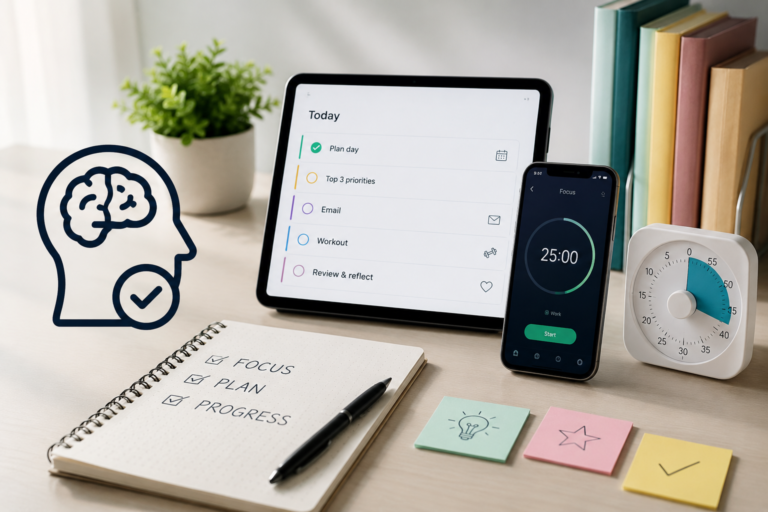
- The Countdown Factor: In conjunction with your visual time blocks, you must use a physical, visual countdown timer (such as a Time Timer) that sits directly next to your planner. Seeing a bright red disk slowly disappear provides a tangible, visceral representation of time passing. This creates a healthy, low-level sense of urgency that spikes dopamine just enough to help you stay engaged with the task you wrote in your block, preventing hours from slipping away unnoticed.
Printable ADHD Focus Planner Architecture
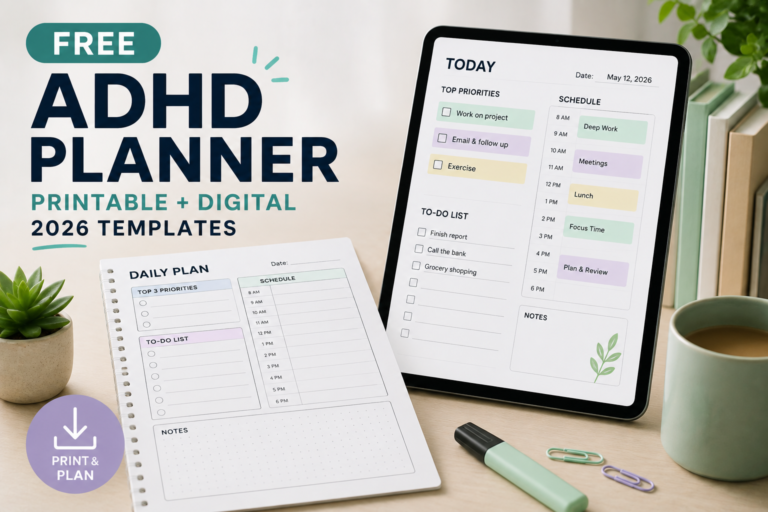
Template 1: The Daily Focus Sheet
If you are building your own paper planner, each daily page should look exactly like this structure to bypass executive dysfunction.
(A blank space at the top corner to instantly scribble distracting thoughts so you don’t lose them or fixate on them.)
Section 2: The Rule of 3 (The Core)
(Only three slots allowed. Force prioritization.)
1. ________________________________________
> Next Physical Action: ______________________
2. ________________________________________
> Next Physical Action: ______________________
3. ________________________________________
> Next Physical Action: ______________________
Section 3: The Dopamine Menu (The Reward)
(What will I do to recharge my executive function today?)
– High Energy Reward: _______________________
– Low Energy Reward: ________________________
Section 4: The Visual Timeline (Time Blocking)
(A vertical timeline from 8 AM to 8 PM to physically draw boxes around tasks, ensuring you don’t overschedule.)
Common Pitfalls and Expert Recommendations
Even the most perfectly designed **adhd focus planner** will face resistance from an ADHD brain over time. Here is how experts recommend you manage the inevitable breakdowns in your system.
1. The Shame Spiral of Abandonment
It is an absolute certainty that at some point, you will stop using your planner for a few days, a week, or even a month. Neurotypical advice says “just try harder.” ADHD experts say “expect the failure and plan for the restart.”
When you abandon the planner, do not feel shame. Your brain simply adapted to the tool, the novelty wore off, and the dopamine ran out. This is a biological reality, not a moral failure. The solution is not to throw the planner away. Simply open it to a fresh page, ignore the blank days behind you, and start again today.
2. Mixing Reference Material with Action Items
A massive mistake ADHD adults make is keeping passwords, meeting notes, project ideas, and daily tasks in the exact same view. This creates extreme visual clutter, which rapidly depletes executive function. Your **adhd focus planner** must only contain *actionable items*. If a piece of information does not require an immediate physical action, it belongs in a separate reference notebook or digital file. Keep your visual field ruthlessly clean.
3. The Perfectionism Trap
ADHD brains are highly prone to all-or-nothing thinking. If you spill coffee on your pristine paper planner, or if you fail to complete your top three tasks perfectly, your brain will tell you the system is ruined and you should quit. You must actively fight this cognitive distortion. A messy planner with crossed-out words, scribbles, and half-finished tasks is the sign of a *working* planner. Perfection is the enemy of **productivity**.
4. Failing to Build a Planner Routine
A planner cannot plan for you. The tool is useless if you do not open it. You cannot rely on your working memory to remember to check the planner. You must anchor the act of checking the planner to an existing, non-negotiable daily habit. For example, use the ADHD Routine Generator to establish a rule: “I will not drink my first cup of coffee until my planner is open on my desk.” By linking the tool to a high-dopamine reward (coffee), you bypass executive resistance and ensure the tool is actually utilized.
Frequently Asked Questions
Should an ADHD Focus Planner be Digital or Paper?
There is no universal answer, but paper is statistically superior for *working memory* and *focus*. Digital planners exist on devices (phones, laptops) that are hyper-stimulating and full of distractions. You open your phone to check your planner, see a notification, and lose 45 minutes to social media. Paper provides an external, persistent visual cue that cannot be closed with a swipe. It satisfies object permanence without the risk of algorithmic distraction. However, digital tools are superior for *prospective memory* (setting alarms for future appointments). The most successful ADHD adults use a hybrid system: a paper **adhd focus planner** for daily execution, and a digital calendar for long-term scheduling.
How do I handle Hyperfocus with my planner?
Hyperfocus is an ADHD superpower, but it is dangerous if uncontrolled. If you sit down to do Task 1, enter a hyperfocus state, and realize four hours have passed, you may have crushed that task but ruined the rest of your day. Your planner must include external “pattern interrupts.” Set loud, physical timers across the room. When the timer goes off, you must physically stand up, look at your planner, and make a conscious decision: “Do I continue this hyperfocus, or do I shift to my next block?” Do not let the hyperfocus dictate the schedule without executive oversight.
What if I get bored of my planner after a month?
This is the ADHD novelty cycle. When the planner becomes boring, you will stop getting dopamine from using it, and the friction to open it will increase. To combat this, you must artificially inject novelty into the same system. Do not buy a new planner. Instead, buy new colored pens. Change the physical location where you do your daily planning. Add a new sticker system. You must “hack” your brain’s desire for the new while maintaining the underlying architecture of your routines.
Conclusion: The Planner is a Tool, Not a Master
The neurotypical world views planners as a measure of discipline. If you use a planner, you are “good” and “responsible.” If you fail to use it, you are “lazy.” This moralization of an organizational tool is deeply toxic to the ADHD brain.
An **adhd focus planner** is not a moral scorecard. It is a prosthetic for your executive function. Just as a pair of glasses corrects a deficit in vision, your planner corrects a biological deficit in your working memory and temporal processing.
When you stop trying to force your neurodivergent brain to use a neurotypical system, the shame dissipates. By embracing radical simplification through the Rule of 3, externalizing your working memory through frictionless capture, and making time visual through blocking, you stop fighting your own biology.
Your planner should be the quietest, most peaceful place in your chaotic day. It should be a refuge that says, “You don’t have to remember everything. You only have to do these three things.” When you build a system based on compassion and neurobiological reality, you finally unlock the true, powerful **productivity** and **focus** that your ADHD brain is deeply capable of.