ADHD Time Blindness: Why Hours Feel Like Minutes
You look at the clock: it is 2:00 PM. You open a document to edit a brief report, or click on a video to learn a new skill. You feel like you have been working for ten minutes. You look at the clock again: it is 4:45 PM. Nearly three hours have vanished into thin air, leaving you panicked, behind schedule, and deeply confused. Alternatively, you are preparing to leave the house for an appointment at 9:00 AM. It is 8:30 AM, and you think, “I have plenty of time.” You wash a dish, choose a pair of shoes, check an email—and suddenly it is 8:58 AM, and you are still in your hallway. You are late. Again.
For individuals with Attention Deficit Hyperactivity Disorder (ADHD), this is not a sign of poor character, disrespect for others, or laziness. It is the daily reality of ADHD time blindness. Coined by leading ADHD researcher Dr. Russell Barkley, time blindness refers to a fundamental, neurological difficulty in perceiving, tracking, and estimating the passage of time. To an ADHD brain, time is not a continuous, steady stream. It is a highly elastic phenomenon where minutes can feel like hours, and hours can disappear in what feels like seconds.
This article provides a comprehensive, expert-level guide to understanding the neuroscience behind ADHD time blindness. We will analyze how it causes chronic adhd lateness, why the ADHD brain is constantly adhd losing track of time, and how you can implement systems for adhd visual time management to regain control of your life.
The Science of ADHD Time Blindness: The Brain’s Broken Clock
To understand time blindness, we must look at how the human brain perceives time. Unlike sight or hearing, there is no single sensory organ dedicated to measuring time. Instead, the brain relies on a distributed neural network—primarily the prefrontal cortex, the basal ganglia, and the cerebellum—to calculate intervals, anticipate future events, and keep us synchronized with the clock.
Key Concept: Neurotypical individuals have an intuitive, physical feel for the passage of time. They can sense when 15 minutes have passed without looking at a clock. For someone with ADHD, this internal “ticking” is quiet or non-existent, leaving them reliant on active, conscious calculation.
1. Dopamine and the Brain’s Pacemaker
The basal ganglia and prefrontal cortex act as the brain’s internal pacemaker, using pulses of dopamine to count intervals of time. Because the ADHD brain has a baseline deficit in dopamine transmission, this internal pacemaker is erratic. When dopamine levels are extremely low (during boring or routine tasks), the pacemaker slows down, making time feel incredibly slow—minutes drag like hours. When dopamine levels are high (during hyperfocus or engaging activities), the pacemaker speeds up, making hours fly by in what feels like moments. This biochemical instability prevents the brain from developing a stable, internal sense of duration.
2. The Two ADHD Time Zones: “Now” and “Not Now”
Dr. Russell Barkley’s research highlights that the ADHD brain is temporally near-sighted. While a neurotypical individual can look ahead to the future and feel its emotional weight (e.g., feeling the urgency of a deadline three weeks away), the ADHD brain operates primarily in two time zones: Now and Not Now.
- Now: Anything currently in your field of vision, immediate awareness, or actively engaging your interest.
- Not Now: Everything else. A deadline next week, an appointment in two hours, or a task that needs to be done tomorrow are all cataloged as “Not Now,” meaning they carry zero emotional weight or urgency until they crash into the “Now.”
3. Executive Dysfunction and Working Memory Deficits
Time management requires strong working memory—the mental scratchpad that allows you to hold information in mind while performing a task. Individuals with ADHD have a smaller working memory capacity. When you are getting ready to leave the house, your working memory must hold multiple variables: How long does it take to walk to the car? Where are my keys? Did I feed the dog? If your working memory drops one of these variables, you lose your sense of sequence, resulting in unexpected delays and chronic lateness.
Symptoms and Everyday Manifestations
Time blindness is not just about being late for meetings. It impacts almost every aspect of daily functioning, decision-making, and emotional well-being. Recognizing these symptoms helps remove the layers of shame that often surround them.
| Behavioral Symptom | How It Manifests | The Underlying Cognitive Deficit |
|---|---|---|
| Chronic Lateness | Arriving 10–15 minutes late to work, social gatherings, or appointments despite trying to be early. | Underestimating transition times and failing to calculate the “getting ready” sequence. |
| Hyperfocus Time Slip | Losing hours while playing a game, coding, researching, or crafting, completely unaware of physical needs like eating. | The absolute dominance of the “Now” zone, which silences external time signals. |
| The Planning Fallacy | Believing a complex project will take “one hour” when it actually requires a full day of work. | Inability to retrieve past time data to build accurate future predictions. |
| “Waiting Mode” Paralysis | Being unable to do anything productive if you have an appointment later in the day (e.g., at 2:00 PM). | The fear of losing track of time causes the brain to freeze all activity to avoid missing the event. |
| Urgency-Driven Action | Only being able to start a task when the deadline is minutes away and panic sets in. | Relying on cortisol and adrenaline (created by panic) to substitute for missing dopamine. |
The Emotional and Relational Cost of Time Blindness
For adults with ADHD, time blindness is rarely just a scheduling problem; it is an emotional burden. When you are constantly late or missing deadlines, the people around you—employers, partners, friends—often interpret this behavior as a sign of disrespect. They assume: “If they cared about me or their job, they would be on time.”
This leads to a repetitive cycle of interpersonal conflict, broken trust, and professional setback. Internally, the individual with ADHD experiences a steady accumulation of shame, anxiety, and low self-esteem. They know they want to be on time, and they try their hardest, but their internal equipment fails them. Over time, this can lead to severe anxiety around scheduling, leading to avoidance of commitments altogether.
Real-Life Examples of ADHD Time Blindness
To see how time blindness plays out, let’s explore three realistic scenarios that highlight the difference between neurotypical time perception and the ADHD experience.
Scenario A: The Deceptive Morning Routine
Mark has an office meeting at 9:00 AM. His drive takes exactly 20 minutes. At 8:30 AM, Mark looks at the clock and reasons, “I have 30 minutes. The drive is 20 minutes, so I have 10 extra minutes.” Because his brain calculates time linearly without accounting for transitions, he does not factor in: finding his car keys (4 minutes), putting on his coat (1 minute), walking to the garage (2 minutes), scraping frost off the windshield (3 minutes), and parking the car (3 minutes). He leaves the house at 8:40 AM, thinking he is on time, but arrives at his meeting at 9:13 AM. To his boss, Mark is irresponsible. To Mark, 13 minutes simply dissolved.
Scenario B: The Hyperfocus Vortex
Clara sits down at her desk at 7:00 PM to design a digital invitation for a family party. She tells her husband, “I’ll be down in 15 minutes to help make dinner.” Once she enters the design application, her brain enters hyperfocus. She tweaks fonts, adjusts colors, and researches layouts. Her brain is completely occupied by the “Now.” She does not hear the household noises, does not register her hunger, and does not check the time. When she finally blinks and looks up, it is 10:30 PM. Her husband has eaten alone, and she has missed their evening together. Clara is shocked; she genuinely believed only 20 minutes had passed.
Scenario C: The “Waiting Mode” Block
Aisha has a dentist appointment at 3:00 PM. She wakes up at 8:00 AM. She has several work tasks she could complete, some laundry to fold, and groceries to buy. However, because she is terrified of adhd losing track of time and missing the appointment, her brain enters “waiting mode.” She sits on her sofa, scrolling on her phone, checking the clock every ten minutes, unable to engage in any meaningful activity for seven hours. She is exhausted by the time she leaves for the dentist, having achieved none of her goals for the day.
The Recovery Framework: ADHD Visual Time Management
To overcome time blindness, you must stop trying to feel time internally. Instead, you need to externalize time, making it visible, audible, and tangible. We call this the **Visual Time Management Framework**.
The Golden Rule: If you cannot see time, you cannot manage it. Your goal is to move time off your internal clock and place it into your physical environment.
Step 1: Visualize Durations (Make Time Visible)
Standard clocks with numbers require cognitive effort to translate into a sense of passage. Visual time displays show the physical volume of time remaining, which is far easier for the ADHD brain to process.
- Use Analog Clocks: Place analog clocks with sweep-second hands in every room you use. Seeing the hands move provides a physical representation of passing time that digital clocks do not.
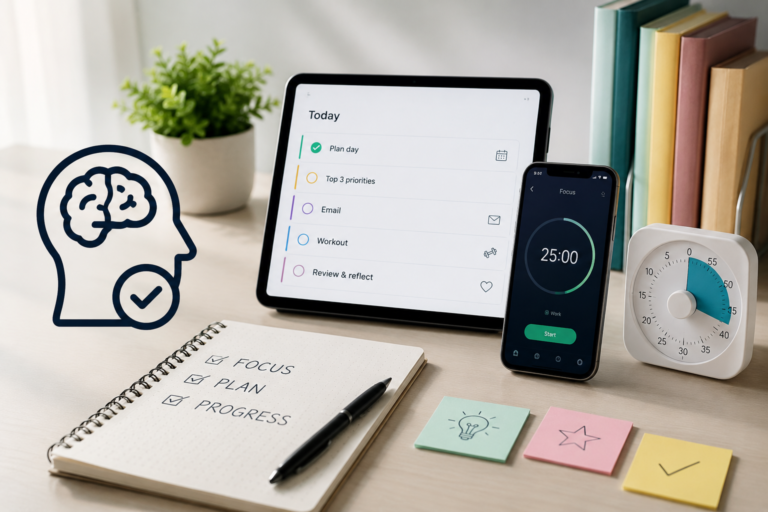
- The Visual Countdown Timer: Use a timer where a colored disk disappears as time counts down. This turns time into a physical resource you can watch shrink. If you struggle to focus during study sessions, combine this with the visual intervals of the ADHD Focus Timer to keep your sessions contained.
- Color-Coded Calendars: Use high-contrast color blocks on your digital or paper planner to represent different types of activities. This helps your brain visually comprehend the structure of your week.
Step 2: Calculate Transition Cost (The Buffer System)
The ADHD brain struggles with “transition time”—the friction points between ending one activity and starting another. To combat chronic adhd lateness, you must calculate and visual these costs.
- Double Your Estimates: If your brain tells you a task will take 15 minutes, write down 30 minutes. This offsets the natural planning bias of the ADHD brain.
- The “Getting Ready” Sequence: Never schedule tasks back-to-back. Treat travel, packing, and wind-down time as separate events on your calendar. If you have an event at 2:00 PM and it takes 30 minutes to travel and get ready, your event actually starts at 1:30 PM.
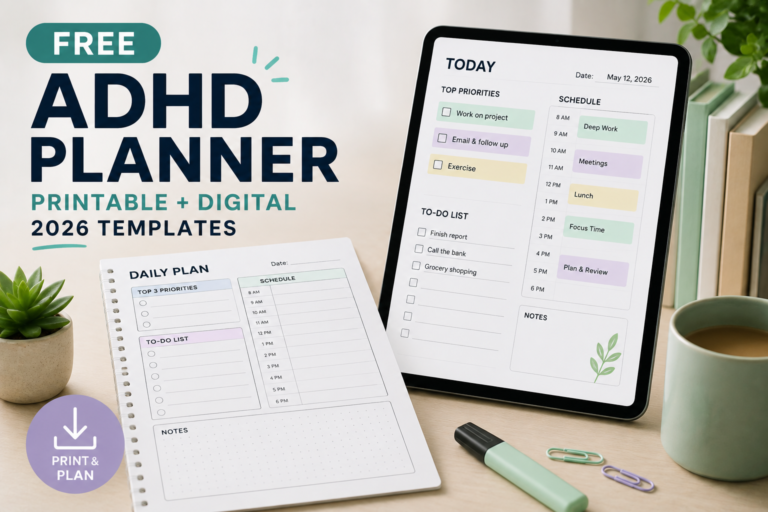
- Externalize Your Routine: Map out your morning routines using the structured layouts of the ADHD Daily Planner, ensuring that transition times are explicitly budgeted.
Step 3: Create Multi-Sensory Anchors (Alarms & Cues)
A single alarm is easy to ignore or turn off. To break through hyperfocus, you need multi-sensory, sequential cues that interrupt your brain and force a transition.
- The 3-Stage Alarm System:
- Alarm 1 (The Warning): Rings 15 minutes before transition. Means: “Start wrapping up your current task.”
- Alarm 2 (The Transition): Rings 5 minutes before transition. Means: “Stop working, gather your belongings.”
- Alarm 3 (The Action): Rings at the transition time. Means: “Physically walk out the door or change tasks.”
- Smart Lighting: Program smart light bulbs to change color in your workspace. For example, have your office lights turn soft orange at 5:00 PM and dim red at 5:30 PM. This visual shift bypasses auditory fatigue and alerts your brain that the workday is ending.
- Haptic Feedback: Use smartwatches that vibrate on your wrist at regular intervals (e.g., every 30 minutes) to gently nudge you back into awareness of the present moment.
Step 4: Pacing Your Focus Sessions
Maintaining long periods of attention is difficult without milestones. Break your work into structured intervals, using external guides to keep you on track.
- Use Structured Intervals: If you are a student or a remote worker, use the ADHD Study Planner to organize your day into clear, manageable focus blocks punctuated by mandatory breaks. This prevents the cognitive exhaustion that triggers late-day time slips.
- Track Time Spent: Keep a notepad on your desk to write down your starting time and target ending time before you begin a task. This creates a quick external reference point for your working memory.
The Actionable ADHD Lateness Prevention Checklist
When you are preparing to leave the house, your executive functions are running low. Keep this simplified, step-by-step checklist on your phone or near your exit door to ensure you stay on schedule.
5 Critical Mistakes to Avoid
When trying to navigate time blindness, using neurotypical scheduling rules often increases failure and shame. Avoid these five major errors:
- Assuming You Will “Remember” the Time: Trusting your internal clock is a recipe for time slip. Assume you have no internal clock and build external visual systems for every event.
- Ignoring the Transition Cost: Thinking a meeting that starts at 10:00 AM requires no travel or setup time. Always map the space between tasks.
- Using Silent Alarms and Notifications: Soft chimes or banners on a screen are easily missed during hyperfocus. Use vibration, bright colors, and persistent sounds.
- Over-scheduling the Day: Packing your calendar with back-to-back tasks leaves zero buffer for executive fatigue. Leave at least 15–30 minutes of blank space between major blocks.
- Allowing Last-Minute Tasks: Engaging in “quick cleanups” or “fast replies” when you are supposed to be leaving. These tasks trigger hyperfocus, leading to lateness.
Printable Time Management Resources
To help you retrain your brain to estimate time accurately, use the following worksheets. You can reproduce these templates on paper or download printable versions from our library.
Resource 1: The Time Estimation Calibration Log
Use this worksheet to log daily tasks and compare your estimated duration with actual duration. Over time, this trains your prefrontal cortex to construct realistic planning templates.
| Task Description | Your Estimate (Minutes) | Actual Time (Minutes) | Difference (+/- Minutes) |
|---|---|---|---|
| Showering & getting dressed | 15 min | 32 min | +17 min (Double next time) |
| Responding to manager’s email | 10 min | 25 min | +15 min (Hyperfocus on editing) |
| Driving to local store | 10 min | 12 min | +2 min (Accurate) |
Resource 2: The Visual Timeline Sketcher
Before starting a busy day, sketch a visual line representing your day, blocking out travel, buffers, and resting windows. This converts lists of digital text into a physical timeline you can see.
Timeline Sketch Template:
[9:00 AM] —– [10:00 AM] —– [11:00 AM] —– [12:00 PM] —– [1:00 PM] —– [2:00 PM]
Activity: [Focus Work Block] → [Buffer / Rest] → [Admin / Calls] → [Lunch] → [Travel Block] → [Appointment]
Expert Recommendations and Clinical Pathways
For severe time blindness that disrupts your career or relationships, combining behavioral strategy with professional treatment is highly recommended. The clinical paths vary by region:
- ADHD Coaching & Occupational Therapy: ADHD coaches and occupational therapists specialize in sensory integration and executive functioning. They can help you design customized visual systems, alarms, and routine sequences that work for your household.
- CBT for Executive Dysfunction: Cognitive Behavioral Therapy helps manage the anxiety, shame, and dread associated with chronic lateness and deadline failures, shifting your cognitive dialogue from panic to systematic problem-solving.
- Medication Support: Stimulant and non-stimulant medications improve baseline dopamine transmission in the prefrontal cortex, which directly stabilizes the brain’s internal interval timing network, helping you feel the passage of time more naturally.
- Regional Directories:
- United States: Check out the resources at CHADD or the ADHD Coaches Organization (ACO) to find certified local guides.
- United Kingdom: Visit The ADHD Foundation or enquire about the Access to Work grant to cover the cost of professional software or coaching.
- Canada: Connect with CADDAC to access adult ADHD groups, resources, and clinical listings.
- Australia: Explore directories on ADHD Australia or consult the AADPA guide to locate developmental psychiatrists.
Frequently Asked Questions
What exactly is ADHD time blindness?
ADHD time blindness is the neurological inability to accurately track, estimate, or perceive the passage of time. It is caused by baseline dopamine deficits and atypical executive networking in the prefrontal cortex, which prevents the brain’s internal clock from operating consistently.
Is time blindness a real symptom of executive dysfunction?
Yes, time perception is a core executive function. Research in neurobiology demonstrates that tracking durations, predicting task length, and sequencing events rely on the prefrontal networks, which are altered in individuals with ADHD.
Why do people with ADHD struggle with chronic lateness?
Individuals with ADHD struggle with lateness because their brains estimate time conceptually rather than practically. They often fail to calculate the small transition times (like packing a bag or parking) and get stuck in cognitive “waiting mode” or hyperfocus loops.
How do you manage ADHD time blindness?
You manage time blindness by externalizing time. This involves replacing internal perception with external indicators, such as visual analog timers, multi-sensory alarm systems, smart lighting, and building buffer blocks into your schedule.
Can medication improve ADHD time perception?
Yes, clinical studies indicate that ADHD medications, particularly stimulants, help regulate the dopamine levels required by the brain’s interval-timing network. This stabilizes the internal pacing mechanism, making time feel more structured and linear.
Conclusion: Navigating Time on Your Own Terms
ADHD time blindness is a biological challenge, but it does not have to govern your relationships, your career, or your self-worth. By understanding that your brain’s internal pacemaker is unstable, you can release the shame of past failures and focus on building external scaffolds that make time visible, audible, and tangible.
Stop trying to fit your neurodivergent mind into a neurotypical mold. Start using visual timers, calculate your transition costs, and set structured multi-stage alerts to keep yourself grounded in the present. You cannot force your brain to feel time, but you can build a physical environment that supports you every minute of the day.
Ready to build an ADHD-friendly schedule? Take control of your daily routine with the visual formats in our ADHD Daily Planner. If you want to build visual pacing directly into your study habits or projects, try the custom intervals in our ADHD Study Planner or stay focused with the visual tracking in the ADHD Focus Timer.