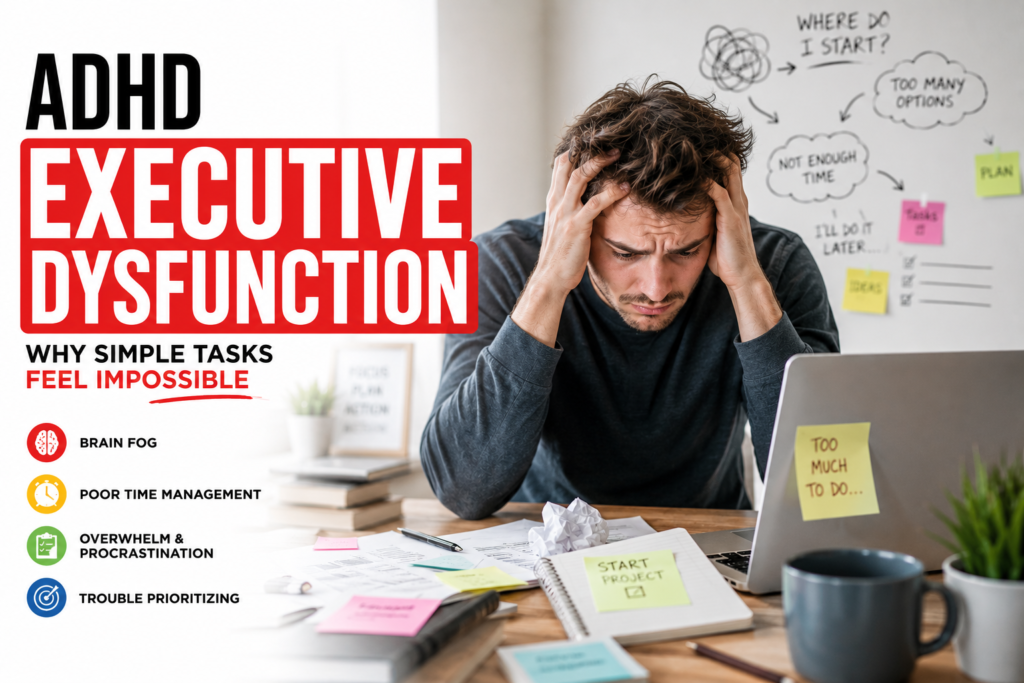
ADHD Executive Dysfunction Explained with Real Examples
Imagine your brain is a large, busy office building. Hundreds of workers (thoughts, memories, sensory inputs, tasks) are moving around, trying to get things done. In a neurotypical brain, there is a highly efficient office manager—an executive assistant who organizes the schedule, decides which tasks are high-priority, filters out background noise, remembers where the files are stored, and keeps everyone calm and focused. In the brain of someone with Attention Deficit Hyperactivity Disorder (ADHD), that office manager is missing, asleep, or completely overwhelmed. The office is running, but there is no one directing the traffic. This is the daily reality of ADHD executive dysfunction.
For a long time, ADHD was misunderstood as simply an inability to sit still or pay attention. Today, neuropsychologists recognize that ADHD is fundamentally a developmental impairment of the brain’s executive functions—the cognitive management system that allows us to plan, focus, remember instructions, regulate emotions, and juggle multiple tasks successfully. When this system breaks down, it leads to chronic organizational difficulties, procrastination, and emotional exhaustion.
This guide provides an expert analysis of executive dysfunction in the context of ADHD. We will explore the neuroscience behind how the brain manages tasks, look at detailed executive dysfunction examples, analyze how it manifests as adhd organization problems, and provide an actionable executive function checklist to help you externalize your brain’s management system and regain control.
The Science of Executive Dysfunction: The Conductor-less Orchestra
To understand executive dysfunction, we must look at the prefrontal cortex (PFC), the region of the brain located directly behind your forehead. The PFC acts as the “executive conductor” of the brain’s neural orchestra. It is responsible for coordinating the complex networks that allow us to engage in goal-directed behavior.
Key Concept: Executive function is not a measure of intelligence. Many highly intelligent individuals experience severe executive dysfunction because the brain’s planning and initiation networks are decoupled from their intellectual capabilities.
In individuals with ADHD, researchers observe specific neurobiological alterations that disrupt this executive command system:
The Seven Core Executive Functions
According to leading clinical models, there are seven core executive functions that manage our behavior:
- Self-Awareness (Self-Monitoring): The ability to look inward and evaluate your own thoughts and actions.
- Inhibition (Self-Restraint): The filter that stops you from acting on every impulse or distraction.
- Non-Verbal Working Memory: The mental scratchpad that allows you to hold visual images in mind (essential for sensing time and predicting outcomes).
- Verbal Working Memory (Internal Speech): The inner voice you use to talk yourself through tasks, instruct yourself, and maintain rules.
- Emotional Self-Regulation: The ability to modulate and manage your emotional responses to events.
- Self-Motivation: The internal generator that produces the drive to complete tasks that do not offer immediate rewards.
- Planning and Problem-Solving: The ability to break down goals, analyze options, and construct step-by-step pathways.
In the ADHD brain, the neural networks connecting the prefrontal cortex to the basal ganglia and cerebellum exhibit altered functional connectivity and delayed maturation. Furthermore, baseline dopamine deficits mean the brain struggles to activate these networks for tasks that are not novel, highly stimulating, or immediately urgent. The conductor is unable to communicate with the musicians, resulting in cognitive discord.
Symptoms: How Executive Dysfunction Alters Behavior
Executive dysfunction is not a single symptom; it is a spectrum of cognitive blockages that impact how you plan, start, and finish your day. Understanding these symptoms helps explain why everyday tasks can feel so difficult.
| Executive Dysfunction Symptom | The Cognitive Breakdown | Real-World Manifestation |
|---|---|---|
| Working Memory Failure | Inability to hold multi-step instructions in mind while executing them. | Walking into a room and completely forgetting why you went there; forgetting phone numbers immediately after hearing them. |
| Activation Friction | Difficulty initiating tasks that are complex, under-stimulating, or lack clear starting points. | Sitting in front of a blank computer screen for hours, unable to write the first sentence of a report. |
| Cognitive Flexibility Deficit | Difficulty switching focus from one task to another; getting “stuck” in loops of activity. | Experiencing intense frustration or anger when interrupted during a project; struggling to stop playing a game. |
| Prioritization Collapse | Inability to distinguish high-importance goals from minor distractions. | Cleaning the desk drawer for three hours when a major client report is due in thirty minutes. |
| Impulse Control Breakdown | Failure of the brain’s natural filtering network to stop immediate reaction. | Interrupting others mid-sentence; making impulse purchases; replying to messages before thinking through the consequences. |
Real-Life Examples of Executive Dysfunction
To illustrate how these symptoms affect adults, let’s explore three realistic profiles. These executive dysfunction examples demonstrate how these breakdowns impact professional, domestic, and academic routines.
Profile A: The Disorganized Office Workspace
James is an engineer. He is highly creative and skilled at solving complex calculations, but his workspace is a physical representation of adhd organization problems. His desk is covered in random sticky notes, half-empty coffee mugs, and unsorted files. In his computer inbox, he has 4,000 unread emails. When his manager asks for a specific blueprint, James panics. Because his visual working memory is weak, if a document is not physically visible, it ceases to exist. He spends two hours searching through folders, misses his deadline, and feels a wave of shame. He knows the engineering calculations, but he cannot manage the administrative systems required to share them.
Profile B: Domestic Chaos and Unfinished Chores
Elena decides to clean her house on Saturday morning. She starts in the living room, picking up a cup to take to the kitchen. In the kitchen, she notices the dishwasher needs emptying. As she empties it, she sees a plant that needs water. She goes outside to get the watering can, notices the lawn needs weeding, and starts pulling weeds. Two hours later, Elena is hot, exhausted, and dehydrated. Her living room is still messy, the dishwasher is half-empty, the watering can is abandoned, and she has pulled three weeds. Because her planning and self-monitoring systems are impaired, she cannot stick to a single sequence, resulting in domestic chaos and self-frustration.
Profile C: The Academic Planning Collapse
Ryan is a graduate student. He has a semester-long thesis project due in three months. Because the deadline is far away, it falls into his brain’s “Not Now” temporal zone. He cannot feel the urgency, so his self-motivation network remains inactive. He spends weeks reading articles but does not write a single page. As the deadline approaches, his planning network fails to break the thesis into weekly milestones. Two days before the deadline, panic triggers a spike of adrenaline, and Ryan pulls a 48-hour all-nighter to write the entire paper. The paper is rushed, his health is compromised, and his sleep cycle is broken. Ryan is not lazy; his brain simply could not generate motivation without the threat of immediate failure.
The Complete Recovery Framework: Externalizing Your Conductor
To overcome executive dysfunction, you must stop trying to manage your brain internally. You need to build a system of external scaffolds that act as your prefrontal cortex. We call this the **Cognitive Offloading System**, organized into four sequential steps.
Phase 1: Externalize Working Memory (Make Information Visible)
Do not hold information in your head. Your brain is for thinking, not for storage. If you try to remember lists, steps, or rules mentally, you drain the executive resources needed to execute the task.
- The Visual Inbox: Keep a notepad, sticky notes, or a whiteboard on your desk. The moment a new task or idea pops into your head, write it down immediately to clear it from your working memory.
- Visual Storage: Use transparent plastic bins, open shelving, and clear labels for your household and office items. If you cannot see where an item belongs, your brain will struggle to organize it. This is the foundation of solving chronic adhd organization problems.
- Checklist Scaffolds: Build written checklists for routine procedures (e.g., leaving the house, shutting down your office). You can use our comprehensive, structured Executive Function Checklist to guide your day.
Phase 2: Isolate Initiations (The “One-Task” Rule)
Choice overload triggers executive freeze. When faced with multiple options, you must isolate a single task and block out the rest of the world.
- The Desktop Sweep: Close all tabs on your browser except the one needed for the immediate task. Clear your desk of all items except the materials required for that single step. If other files are visible, your brain will try to process them, leading to distraction.
- The 60-Second Start: When you feel frozen, do not think about the entire project. Focus only on the first 60 seconds of action. If you need to write an article, your only goal is to open the software and write one sentence.
- Bypass Planning Fatigue: If you struggle to break down complex tasks, utilize the digital ADHD Task Breakdown Tool to automatically segment your goals into simple, manageable checklists.
Phase 3: Scaffold Rhythms (Visual Routines)
ADHD brains struggle to maintain consistency without external structures. Use structured, visual schedules to guide your daily transition points.
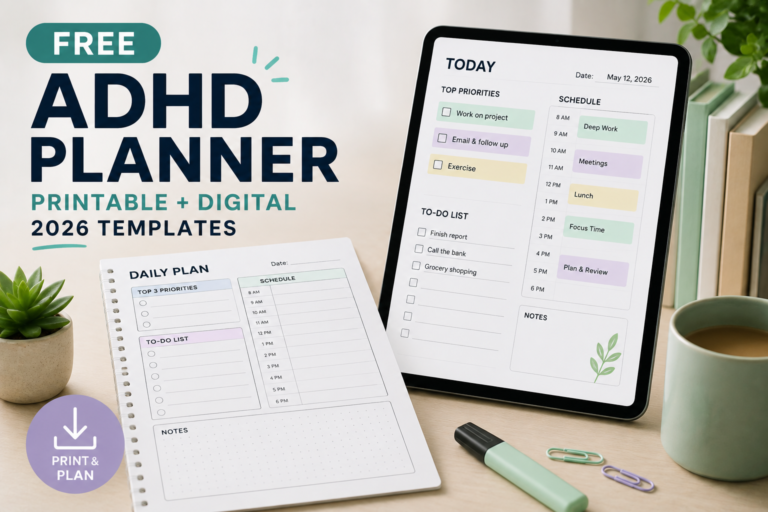
- Time Blocking: Instead of a text-based to-do list, block out visual chunks of time on a calendar. This helps your brain grasp the physical limits of the day. Map your daily schedule using the visual layouts of the ADHD Daily Planner.
- Transition Anchors: Pair routine tasks with environmental cues. For example, place your daily planner directly on top of your keyboard at night. In the morning, you cannot type without physically interacting with your schedule.
- Audio Pacing: Use alarm systems, white/brown noise, or routine playlists to mark transition points and prevent time slip.
Phase 4: Restore Cognitive Energy (Paced Rest)
Executive function is a depletable resource. If you push your brain continuously without structured rest, your cognitive system will shut down, leading to severe burnout and task paralysis.
- The 45-15 Focus Method: Work in intervals of 45 minutes of focused effort followed by 15 minutes of screen-free rest. During the rest block, stand up, hydrate, stretch, or change rooms to allow your prefrontal cortex to recover.
- Sensory Deprivation Breaks: Spend five minutes in a dark, quiet room with your eyes closed to clear sensory overload. This lowers baseline stress and restores executive reserves.
The Actionable Executive Function Checklist
When your brain is overloaded, print or reference this step-by-step checklist to clear cognitive friction and navigate your tasks successfully.
For a physical card to keep on your desk, download the official printable executive function checklist from our resources section below.
5 Critical Mistakes to Avoid
When trying to navigate executive dysfunction, using traditional productivity advice can actually increase cognitive friction. Avoid these common pitfalls:
- Trying to Willpower Through Mental Blockages: Telling yourself to “focus harder” is ineffective if the prefrontal networks lack dopamine. Calm your nervous system and use external scaffolds instead.
- Storing Tasks in Your Head: Relying on mental notes drains your working memory and increases baseline anxiety. Write everything down immediately.
- Working in a Cluttered Environment: Visual clutter acts as a constant stream of distraction for an ADHD brain. Clear your desk before you start a task.
- Setting Vague, Multi-Step Milestones: Creating tasks like “Study for chemistry” or “Clean the kitchen” triggers executive paralysis. Keep milestones physical and micro-sized.
- Ignoring Cognitive Fatigue: Working through extreme brain fog without breaks leads to error accumulation and burnout. Schedule structured intervals of rest.
Printable Planning Resources
To help you offload your mental tasks and organize your space, utilize these structured layouts. You can copy these onto a notebook or download the printable versions from our library.
Resource 1: The Cognitive Load Offloader
Use this table to dump your tasks, prioritize them into three clean categories, and identify the single physical starting action for each.
| Brain Dump Task | Priority Category (High/Med/Low) | Immediate Micro-Start (60 Seconds) | Status |
|---|---|---|---|
| Prepare sales presentation slides | High Priority | Open PowerPoint & select a blank template | [ ] |
| Call the doctor’s office | Medium Priority | Type doctor’s number into phone screen | [ ] |
| Buy printer paper online | Low Priority | Open browser tab and search online retailer | [ ] |
Resource 2: The Visual Cubby Labeler
Use this layout to map your home or office storage bins, ensuring every item has a visible, labeled home to prevent organizational clutter.
Storage Container Blueprint:
Container 1: [Labled: Desk Supplies] → Contains: Pens, Tape, Scissors [ ]
Container 2: [Labled: Active Projects] → Contains: Paper files, current printouts [ ]
Container 3: [Labled: Archive Files] → Contains: Tax records, closed contracts [ ]
Expert Recommendations and Clinical Pathways
While behavioral strategies provide immediate support, severe executive dysfunction that impacts your livelihood, relationships, or academic status requires clinical intervention. Here are the regional paths available:
- Executive Function Coaching: A specialized ADHD coach works alongside you to build organization systems, time management habits, and emotional regulation strategies tailored to your neurodiversity. Look for coaches certified by the *ACO (ADHD Coaches Organization)* or *ICF*.
- Occupational Therapy (OT): For children and adults alike, occupational therapists specialize in modifying your physical environments (home, office, school) to accommodate sensory processing differences and executive planning needs.
- Clinical Cognitive Behavioral Therapy (CBT): Specifically, CBT for ADHD focuses on building coping strategies for the anxiety, depression, and low self-esteem that accumulate after years of executive dysfunction failures.
- Regional Resources:
- United States: Access support directories and educational resources at CHADD or *ADDA*.
- United Kingdom: Consult NHS ADHD services or contact The ADHD Foundation for guidance on assessments and workplace adjustments (Access to Work grants).
- Canada: Connect with CADDAC to access parent guides, adult programs, and support webinars.
- Australia: Explore local practitioners through ADHD Australia or the *AADPA* professional directory.
Frequently Asked Questions
What is ADHD executive dysfunction ?
Executive dysfunction is the impairment of the brain’s cognitive management system, located in the prefrontal cortex. It affects the ability to prioritize, focus attention, recall instructions, start tasks, manage emotions, and plan future behaviors, which are core symptoms of ADHD.
What are some real-life examples of executive dysfunction?
Common examples include starting several tasks at once and leaving them half-finished, losing keys or phones constantly, struggling to start a project despite an approaching deadline, experiencing decision paralysis when choosing clothes, and forgetting instructions immediately after hearing them.
How do you manage executive dysfunction with ADHD?
Manage executive dysfunction by externalizing cognitive load. This means writing down list details, using visual schedules and color blocks, breaking down projects into micro-steps, label storage bins clearly, and utilizing tools like body doubling and visual timers.
Can you improve executive function without medication?
Yes. While medication increases baseline dopamine to support prefrontal networks, behavioral strategies, occupational therapy, ADHD coaching, and environmental modifications are highly effective at building the external structures needed to manage daily tasks.
What is the difference between executive dysfunction and laziness?
Laziness is a voluntary decision to avoid effort because you do not care about the task’s outcome. Executive dysfunction is an involuntary breakdown in the brain’s planning and initiation networks, where you care deeply about the task, want to start, and experience severe stress or anxiety due to being unable to act.
Conclusion: Navigating Tasks with Clarity
ADHD executive dysfunction is a real, neurobiological challenge, but it does not define your capabilities or your future. By understanding that your prefrontal command center operates differently, you can let go of the shame of past disorganization and focus on building external scaffolds that support your daily life.
Stop trying to hold your schedule in your head. Clear your working memory, prioritize using written sheets, and break your tasks down into tiny, low-friction steps. Build your systems around your neurodiversity, be kind to yourself on low-energy days, and rely on physical systems to guide your executive functions.
Ready to support your executive functions? Take control of your organization using our structured Executive Function Checklist. If you want to break down large projects into simple milestones, utilize our digital ADHD Task Breakdown Tool or plan your day visually using the layouts in our ADHD Daily Planner.

[…] the operating system running the student. If you want the underlying neuroscience, our breakdown of ADHD executive dysfunction explained covers why the gap between knowing and doing is neurological, not […]