ADHD Study System for College Students
The transition from high school to college or university is a major milestone. In high school, your days were structured for you by parents, teachers, and a fixed school schedule. You had daily bells, immediate checks on homework, and a clear sequence of events. In college, that structure vanishes. You are suddenly handed a syllabus for five different classes, given hours of unstructured free time, and expected to manage your own readings, essays, midterms, and daily schedule. For many students with Attention Deficit Hyperactivity Disorder (ADHD), this sudden loss of external structure leads to academic overwhelm, chronic procrastination, and severe anxiety. You find yourself asking: “Why can everyone else balance their classes while I am constantly drowning?”
The truth is, your brain is neurodivergent, and neurotypical study methods—like sitting in a quiet library for six hours with a textbook—are fundamentally incompatible with your cognitive wiring. For a student with ADHD, success is not about trying harder, studying longer, or relying on raw intelligence. It is about building a system of external scaffolds that manage your attention, break down complex materials, and pace your learning. To excel academically, you need a personalized **ADHD study system**.
This guide provides a comprehensive, expert-level roadmap tailored for college students with ADHD. We will analyze the neuroscience of learning with a neurodivergent brain, explore detailed study techniques for adhd, discuss how to structure a realistic adhd study schedule, and explain how a digital adhd college planner can help you stay organized throughout the academic year.
The Science of ADHD Study Struggles: The Cognitive Bottleneck
To stop blaming yourself for academic struggles, you must understand the neurobiological factors that impact how your brain processes, stores, and retrieves information. Learning is a multi-step cognitive sequence, and ADHD introduces friction points at three major stages: working memory encoding, dopamine-driven motivation, and prefrontal cortex processing.
1. Working Memory and the Reading Bottleneck
Working memory is the brain’s temporary storage holding space, allowing you to retain information while actively processing it. Adults with ADHD have a significantly smaller working memory capacity. When you read a dense academic chapter, your working memory must hold the concepts of page one while you read page two. For an ADHD brain, this mental workspace overflows quickly. Your mind wanders, and you find yourself reading the same paragraph ten times without absorbing a single word. This is not a reading comprehension issue; it is a working memory bottleneck.
2. Dopamine and Motivation During Non-Preferred Learning
Dopamine is the primary driver of motivation, focus, and cognitive stamina. The ADHD brain has a baseline deficit in dopamine transmission, meaning it struggles to allocate attention to tasks that are perceived as boring or routine. If a college course is not naturally interesting to you, your brain registers the textbooks and lectures as low-dopamine environments. It will actively resist focus, seeking any novel stimulus (social media, cleaning, daydreaming) to raise its dopamine baseline. The brain relies on the urgency and panic of a last-minute cram session to produce the adrenaline necessary to study, which is an exhausting and unsustainable strategy.
3. Executive Dysfunction and the Syllabus Blind Spot
The prefrontal cortex manages the executive functions required to plan, sequence, and execute complex academic projects. In ADHD, this network struggles to prioritize tasks. When you look at five separate course syllabi containing dozens of assignments, quizzes, and readings, every single task presents itself with the same cognitive weight. The brain cannot decide where to start, resulting in choice paralysis. The future is a conceptual blind spot; deadlines that are weeks away are filed under “Not Now,” meaning they carry zero urgency until they become immediate emergencies.
Symptoms of ADHD Study Dysfunction in College
When you attempt to use traditional study habits, you default to a set of survival patterns that result in academic anxiety, missed milestones, and GPA fluctuations.
| Academic Behavior | How It Manifests | The Cognitive Cause |
|---|---|---|
| The Cram-Panic Loop | Studying for midterms or finals the night before, pulling all-nighters, relying on adrenaline. | Inability to generate self-motivation without the threat of immediate failure. |
| Passive Reading Loops | Highlighting paragraphs of text, rereading notes passively without retaining the concepts. | Under-stimulation of the working memory network during passive intake. |
| The Syllabus Slip-Up | Forgetting quiz dates, missing assignment deadlines, showing up to class unprepared. | Executive dysfunction in tracking long-term milestones and sequencing sub-steps. |
| The Library Freeze | Spending six hours in the library but achieving only 30 minutes of actual, focused work. | Unstructured time blocks trigger attention drift and choice paralysis. |
| Hyper-Focus Exhaustion | Studying a single interest topic for ten hours straight, neglecting sleep and other coursework. | The dominance of the interest-driven attention system over the priority-driven system. |
Real-Life Examples of ADHD Academic Struggles
To illustrate how these challenges impact college students, let’s explore three realistic profiles that highlight the difference between trying harder and utilizing a neurodivergent study system.
Scenario A: The Syllabus Overwhelm
Marcus is a sophomore majoring in history. At the start of the semester, he receives five syllabi outlining his readings and essay dates. Because he does not have a centralized adhd college planner, he leaves the documents in separate email threads and folders. To Marcus, the essay due in four weeks is “Not Now.” He spends his evenings hanging out with friends, feeling like he has plenty of free time. Suddenly, he realizes he has two midterms and a major paper all due in the same 48-hour window. He is hit with severe panic, pulls two consecutive all-nighters, and submits subpar work, damaging his GPA and mental health.
Scenario B: The Textbook Stare
Emily has to read 40 pages of organic chemistry for her lecture tomorrow. She goes to a quiet corner of the university library, opens her book, and begins to read. Within ten minutes, her mind wanders to her weekend plans. She catches herself, goes back to the top of the page, and starts again. This cycle repeats for three hours. She has highlighted half the chapter, but she cannot explain a single concept she read. Her brain was completely under-stimulated by the passive reading task. She spent hours in the library but gained zero knowledge, leaving her feeling exhausted and defeated.
Scenario C: The Unstructured Paper
Kevin is a computer science student who has to write a research paper on machine learning algorithms. The professor has given a broad deadline of six weeks with no intermediate milestones. Kevin keeps saying he will “start this weekend,” but every time he sits down, he is frozen. He doesn’t know how to write his thesis, where to find academic journals, or how to outline his paragraphs. Because the project is too vague and complex, his prefrontal cortex shuts down, and he spends his time coding minor personal projects instead, putting off the paper until the final 12 hours.
The Complete Study Recovery Framework: A Step-by-Step System
To build an ADHD-friendly study system, you must stop trying to memorize information passively. Instead, you need to transition your study sessions from a state of passive reading to active, structured retrieval. This framework consists of four sequential phases: **Centralize, Deconstruct, Engage, and Space**.
Phase 1: Centralize (Externalizing the Syllabus)
Never leave your assignments scattered across multiple course portals, syllabus sheets, or emails. You need to create a single, highly visual master calendar that shows the shape of your semester.
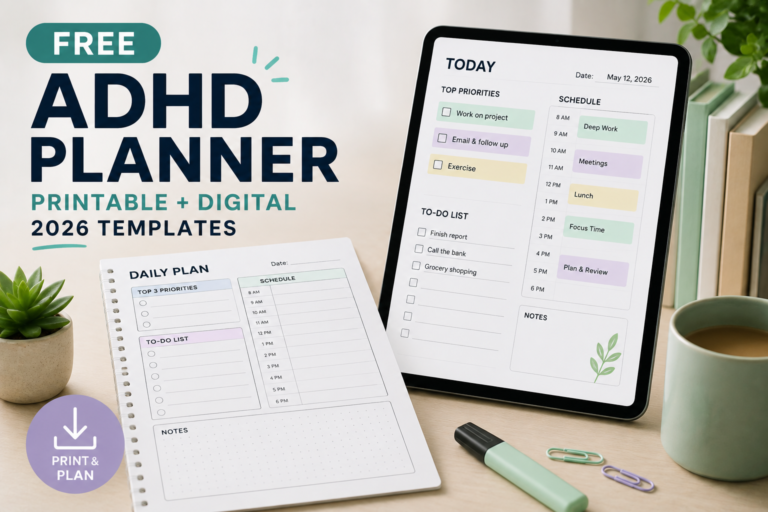
- The Master Deadline Sheet: At the start of the semester, spend one hour consolidating every deadline, test, and quiz from all your courses into a single digital or physical calendar. Color-code each class with a high-contrast hue so you can visually gauge your weekly workload. This is the foundation of building a functional adhd study schedule.
- Keep the Planner Visible: Do not use a planner that you close and hide in a drawer. Use a desk-sized blotter calendar, a large wall whiteboard, or a digital dashboard that stays permanently open on your secondary screen or mobile home screen.
- Visual Pacing: Draw horizontal progress lines leading up to major exams. Seeing a 14-day visual block shrink day-by-day helps your brain perceive the future, breaking the temporal blindness.
Phase 2: Deconstruct (The Milestone Method)
A broad goal like “Study for biology exam” is a major trigger for task paralysis. You must break large academic benchmarks down into tiny, physical tasks that require zero planning to initiate.
- Bypass Planning Fatigue: If a project feels too complex, utilize the digital ADHD Task Breakdown Tool to instantly break your essays, labs, and exam preparations into step-by-step checklists.
- The 10-Minute Action: Define your study tasks by physical output, not time. Instead of writing “Study history for 2 hours,” write: “Find five articles on Google Scholar,” “Write three outline points for paragraph one,” or “Review 15 flashcards.” A physical, finite goal is far easier for an ADHD brain to initiate.
Phase 3: Engage (Active Recall Techniques)
To move information from your working memory into long-term memory, your brain must actively interact with the material. Passive reading and highlighting do not work. Use these study techniques for adhd to create a high-stimulation learning environment:
- The Feynman Technique: Try to explain a complex concept in simple terms, out loud, to an imaginary student or a study partner. The moment you struggle to explain a step, you have identified a gap in your understanding. Speaking out loud engages your auditory processing centers, boosting focus.
- Flashcard Spaced Retrieval: Use digital flashcard systems (like Anki or Quizlet) that utilize spaced repetition algorithms. Instead of reviewing all cards, the system highlights only the cards you are about to forget. Testing yourself with flashcards is an active, high-stimulation retrieval event that releases small hits of dopamine.
- Interactive Note-Taking: Draw mind maps, diagrams, or visual timelines instead of writing paragraphs of text. Visual mapping uses different brain networks than verbal processing, reducing working memory load.
- Gamification: Turn your study sessions into a game. Award yourself points for every section completed, compete with classmates on study scores, or use progress bars to visually track your learning milestones.
Phase 4: Space (Time-Locked Intervals)
Avoid marathon study sessions. An ADHD brain cannot maintain high-quality focus for hours on end. You must break your study sessions into structured, time-locked intervals.
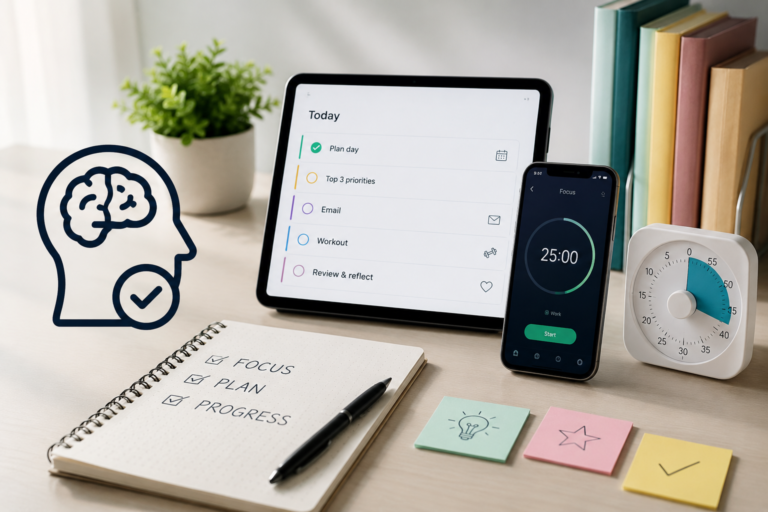
- The Pomodoro Method: Work for 25 minutes, then take a mandatory 5-minute break. During the focus block, close all distractions. During the break, stand up, stretch, and step away from screens. You can manage these intervals automatically using the customized countdown blocks in the ADHD Study Planner.
- Body Doubling: Study in the presence of others. Work with a classmate, join a silent study group in the university library, or use virtual body-doubling platforms. The external presence acts as a social anchor, keeping you grounded in the task.
- Environment Design: Never study in bed or in front of a television. Designate a specific desk in a campus building as your “focus zone.” Your brain responds to environmental cues, and keeping a clear boundary between study spaces and rest spaces trains the mind to shift into focus mode more easily.
The Actionable ADHD Study Session Checklist
When you are sitting down to study, your working memory is vulnerable to distraction. Follow this step-by-step checklist to set up a high-dopamine, low-distraction study session.
For more study planners and checklists, access our printable templates in the next section.
5 Critical Mistakes to Avoid
When designing your academic study systems, avoid these five common neurotypical productivity errors:
- Planning “Study Marathons”: Scheduling a 6-hour library session is counterproductive. Without structured breaks, your attention will drift, and you will waste hours in a frozen state. Focus on short, high-intensity intervals instead.
- Relying on Passive Rereading and Highlighting: Highlighting lines of text is a passive, low-dopamine task that does not engage your memory networks. Shift to active recall strategies like flashcards or explaining concepts out loud.
- Studying in High-Distraction Environments: Working in your bed, a noisy coffee shop, or a room with a TV running forces your brain to constantly filter out background noise, rapidly draining your executive function reserves.
- Neglecting Sleep and Physical Needs: Pulling all-nighters to cram causes cognitive impairment and memory retrieval failure. A sleep-deprived ADHD brain is severely compromised. Prioritize sleep to support long-term consolidation.
- Holding Syllabus Tasks in Mind: Trying to track dates and assignments mentally creates cognitive fatigue. Externalize all schedules on a master visual calendar.
Printable Academic Resources
To help you track your assignments and organize your study blocks, utilize these structured layouts. You can copy these onto a blank paper or download printable versions from our library.
Resource 1: The Study Session Deconstructor
Use this table to break down a study block into four distinct intervals, pairing each with a clear active recall technique and a specific reward.
| Focus Block (25 Min) | Material / Topic | Active Recall Method | Reward / Break Activity (5 Min) |
|---|---|---|---|
| Block 1 (0–25m) | Biology Chapter 3 terms | Flashcard self-test | Drink flavored tea, stand up |
| Block 2 (30–55m) | Calculus derivative rules | Solve 3 sample problems | Quick stretch, step outside |
| Block 3 (60–85m) | History essay outline | Sketch a visual mind map | Listen to favorite song |
Resource 2: The Syllabus Converter
Use this worksheet to convert a single, overwhelming syllabus course block into weekly milestones with explicit buffer times.
Course Name: __________________________________________________
1. Major Deadline Date: ________________________
2. Weekly Milestones (Self-Imposed):
– Week 1 (Research): ________________________________________
– Week 2 (Outline): _________________________________________
– Week 3 (Rough Draft): _____________________________________
– Week 4 (Final Edit & Buffer Week): _________________________
Expert Recommendations and Clinical Pathways
College students with ADHD are legally entitled to academic support and accommodations in many countries. Utilizing these pathways is a key component of academic success:
- University Disability Resource Centers (DRC): Every major college or university has a department (sometimes called the Office of Accessibility or Disability Services) dedicated to coordinating accommodations. You will need to provide documentation of your ADHD diagnosis. Once registered, you can access accommodations such as:
- Extended time on quizzes and exams (typically 1.5x or 2x time).
- Distraction-reduced testing environments.
- Note-taking services or smartpens that record lectures.
- Alternative formats for textbooks (audio or digital text-to-speech).
- Academic ADHD Coaching: Unlike traditional tutoring, an academic coach focuses on executive function support, helping you build schedules, organize folders, break down projects, and manage test anxiety.
- Medical and Therapeutic Management: Ensure your treatment plan is optimized. Proper medication timing and cognitive behavioral therapy can directly support your working memory during lectures and study blocks.
- Regional Accessibility Directories:
- United States: Check out the resources at CHADD or contact the Office for Civil Rights (OCR) for information on Section 504 accommodation laws in higher education.
- United Kingdom: Consult NHS disability support guides or look into the Disabled Students’ Allowances (DSA) grant to fund laptop software, recording tools, and study mentoring.
- Canada: Connect with CADDAC to access post-secondary academic guidelines and transition strategies.
- Australia: Contact the National Disability Coordination Officer (NDCO) program or explore student disability service guides on the ADHD Australia website.
Frequently Asked Questions
How do I create an ADHD-friendly study schedule?
To create an ADHD-friendly study schedule, consolidate all your deadlines onto a single visual calendar. Break your study blocks into short 25-minute intervals (the Pomodoro method) rather than scheduling marathon sessions. Treat travel, research prep, and rest breaks as distinct, scheduled blocks, and build in a full buffer week for major essays.
Can a visual study planner help with ADHD organization?
Yes, visual planners are highly effective because they externalize the passage of time. Seeing color-coded time blocks and horizontal timeline lines helps the ADHD brain grasp the proximity of deadlines, moving them out of the conceptual “Not Now” temporal blind spot.
What are the best active recall techniques for ADHD?
The best active recall techniques are high-stimulation and retrieval-focused. These include the Feynman Technique (explaining concepts out loud to someone else), digital flashcards with spaced repetition algorithms, drawing visual mind maps, and gamifying your progress with points and visual milestones.
How do I register for ADHD accommodations in college?
To register, contact your university’s Disability Services or Accessibility Office. You will need to submit documentation of your diagnosis from a psychiatrist, medical doctor, or clinical psychologist. The office will then issue an accommodation letter outlining your approved supports (like extended testing time) to share with your professors.
Is cramming bad for ADHD students?
Yes. While the panic of cramming produces the adrenaline required to focus, the information gained is stored only in short-term working memory. It is rapidly forgotten after the test and does not transfer to long-term memory, which damages performance in subsequent, sequential courses (like mathematics or languages).
Conclusion: Excelling on Your Own Terms
Succeeding in college with ADHD is not about trying to transform yourself into a neurotypical student. It is about understanding your unique cognitive limits, externalizing your workspace, and using active, high-stimulation techniques to learn. By consolidates your deadlines, deconstructing tasks into micro-steps, and scheduling time-locked study intervals, you can thrive academically.
Be patient with yourself as you test these systems. There will be days when your focus slips or your routine breaks down. Treat these moments as data, not as failures. Adjust your environmental design, recalibrate your timers, and rely on external systems to support your college career.