ADHD Cleaning Schedule That Actually Works
You stand in the center of your living room. The floor is covered in clothes that are neither fully clean nor fully dirty. The mail is piled high on the entryway table. In the kitchen, the sink is overflowing with dishes, some of which have been there for three days. You know you need to clean. You want a tidy, peaceful home, and you are tired of the constant background stress of living in clutter. Yet, as you look around, a wave of exhaustion and anxiety washes over you. You don’t know whether to wash a cup, fold a shirt, or sweep the floor. The sheer volume of decisions freezes you in place. You walk away, sit on the couch, and feel a deep sense of shame. You ask yourself: “Why is keeping a house clean so easy for everyone else and so impossible for me?”
Here is the first thing you need to hear: your struggle with housework is not a moral failure. You are not lazy, dirty, or irresponsible. Keeping a house clean requires a massive amount of executive functioning—planning, sequencing, prioritizing, focus, and emotional regulation. In individuals with Attention Deficit Hyperactivity Disorder (ADHD), these prefrontal cortex networks operate differently. Traditional cleaning tips, like “just clean as you go” or “do one room a day,” fail because they assume a neurotypical level of executive control.
To keep a home clean without triggering executive freeze, you need a system that works with your neurobiology. This guide provides a comprehensive, science-based recovery system designed specifically for the neurodivergent brain. We will analyze the neuroscience of housework struggles, explore detailed cleaning routine adhd strategies, and provide an actionable adhd house cleaning checklist alongside a flexible, energy-aligned cleaning planner adhd system.
The Science of ADHD Cleaning Struggles: The Executive Chores Bottleneck
To break the shame cycle, we must look at why cleaning is a major hurdle for the ADHD brain. Housework is not a simple physical task; it is a complex cognitive maze that triggers executive dysfunction, dopamine depletion, and sensory overload.
1. Executive Dysfunction and Choice Overload
Cleaning a room requires constant, rapid decision-making: Where does this book go? Should I file this paper or throw it away? Do I clean the counters before or after the floor? In an ADHD brain, the prefrontal cortex struggles to prioritize. Every single object in a messy room presents itself with the same level of urgency. This creates choice overload, leading to executive paralysis. Your brain cannot find a starting point, so it shuts down the action pathways to protect you from the overwhelm.
2. Dopamine Regulation and the Interest System
Dopamine is the chemical currency of motivation and focus. The ADHD brain has a baseline deficit in dopamine, meaning it struggles to initiate and sustain tasks that are repetitive, boring, or lack immediate rewards. Cleaning is the ultimate low-dopamine activity. Folding laundry, washing dishes, and dusting offer zero novelty or stimulation. Without a dopaminergic driver, your brain perceives these tasks as physically painful to engage with. The ADHD brain will actively seek out high-dopamine distractions, leading to avoidance and sidequests.
3. Sensory Overload and Tactile Dread
Many ADHD individuals have sensory processing differences. Cleaning is a sensory minefield: the smell of chemical cleaners, the wet feeling of dishwater, the texture of greasy plates, the sound of a vacuum cleaner, and the visual noise of clutter. When your home is messy, the visual clutter acts as a constant stream of low-grade sensory input, keeping your nervous system in a state of mild fight-or-flight. Trying to clean while experiencing sensory dread is incredibly draining.
4. Object Permanence and “Out of Sight, Out of Mind”
ADHD individuals often struggle with non-verbal working memory, which affects object permanence. If an item is placed inside a closed drawer or closet, it effectively ceases to exist in the brain’s working memory. This is why ADHD homes often have piles of items on tables and counters; keeping them visible is the brain’s way of remembering they exist. Traditional cleaning systems that emphasize putting everything away in closed cabinets can actually trigger anxiety, as the brain fears losing access to its belongings.
Symptoms: How Chores Freeze Wrecks the Home
When you are stuck in executive dysfunction at home, cleaning defaults to survival patterns that increase the mess and feed the shame loop.
| Cleaning Pattern | The Cognitive Breakdown | Real-World Manifestation |
|---|---|---|
| The Tornado Effect | Struggling to maintain a single sequence; starting multiple chores at once. | Emptying half the trash in the bathroom, carrying it to the kitchen, starting to wash a dish, going to get a sponge, and starting to sweep the hallway. |
| Hyperfocus Sidequests | Getting distracted by interesting items uncovered during cleaning. | Going to clean the bookshelf, finding an old photo album, and spending three hours sitting on the floor looking at photos. |
| Doom Boxes & Piles | Inability to categorize items without clear visual homes. | Sweeping random items into boxes (Doom Boxes: *Document, Organize, Or, Make-bins-later*) to hide clutter from guests, then leaving the boxes untouched for months. |
| Sensory Avoidance | Dread of tactile or olfactory inputs from dirty spaces. | Letting plates pile in the sink for days because the sensory experience of washing wet, greasy dishes is physically repelling. |
| Guest Panic Cleaning | Relying on panic-driven adrenaline to clean the entire house in a 2-hour sprint before guests arrive. | Working in a state of high stress, arriving at the visit physically exhausted and emotionally drained. |
Real-Life Examples of ADHD Cleaning Friction
Let’s look at how this manifests in three typical household scenarios. Recognizing these profiles helps validate your experience and points toward targeted solutions.
Scenario A: The Kitchen Pileup
Sarah wants to clean her kitchen. She enters the room and sees: a counter covered in mail, a sink full of dirty plates, a trash can that is overflowing, and groceries that need putting away. Her prefrontal cortex fails to prioritize. She stands in the doorway, feeling a wave of cognitive overwhelm. She doesn’t know whether to open a cabinet, wash a fork, or take out the trash. She stands frozen for five minutes, feeling her heart rate rise, and then leaves the room to watch television. The kitchen remains dirty, and Sarah spends the evening feeling guilty and irresponsible.
Scenario B: The Infinite Laundry Cycle
Dave has a pile of clean laundry sitting in a basket. The thought of folding 30 shirts, sorting socks, and hanging jackets triggers immediate decision fatigue. To Dave’s brain, folding is under-stimulating. He leaves the basket in the corner. For five days, he pulls clean clothes directly from the basket. Eventually, the clean clothes get mixed with dirty clothes on the floor. Dave has to rewash the entire load, costing him time, water, and mental energy. He feels frustrated that he cannot complete a simple task like folding.
Scenario C: The Doom Box Closet
Elena’s friends are coming over in one hour. Her living room is cluttered with books, mail, shoes, and chargers. Because she cannot process each item’s home in time, she grabs a large plastic storage bin, sweeps all the clutter into it, and places the bin in her bedroom closet. The living room looks clean, and the visit is successful. However, the bin—now a “Doom Box”—remains in the closet for six months. Whenever Elena needs her charger or a specific book, she cannot find it, causing daily frustration. The clutter was hidden, not organized.
The Complete Cleaning Recovery Framework: Pacing Your Home Rescue
To build a cleaning routine that works, you must move away from neurotypical schedules. You need a system that minimizes decisions, protects your sensory system, and aligns with your daily energy levels. This framework consists of four sequential phases: **Sensory Setup, The 5-Group Sort, Visible Scaffolding, and Energy Routing**.
Phase 1: Sensory Setup (Building the Dopamine Shield)
Before you touch a single item of clutter, you must protect your sensory system and raise your dopamine levels. Do not attempt to clean in silence or discomfort.
- Banish the Dread: Wear thick rubber gloves to block the wet, greasy textures of dishes or trash. Wear noise-canceling headphones to block the loud, irritating sound of the vacuum cleaner or running water.
- Dopamine Pairing: Pair cleaning with high-stimulation audio. Listen to an engaging audiobook, an energetic music playlist, or an interesting podcast *only* while you are cleaning. This tells your brain: “Cleaning time is also entertainment time,” bypassing initiation resistance.
- Set a Finite Timer: Commit to cleaning for exactly 15 minutes. Set a visible countdown timer. Tell yourself that when the timer rings, you have full permission to stop. The secret is that starting is the hardest part; once the transition friction is broken, momentum often carries you forward.
Phase 2: The 5-Group Sort (Deconstructing the Mess)
When faced with a messy room, do not try to clean it all at once. Use the **5-Group Method** to categorize the clutter. This method reduces decision fatigue by focusing only on one group of items at a time. Go through the room in this exact order:
- Trash: Walk through the room with a trash bag. Pick up only items that belong in the garbage. Do not look at anything else. Throw them away.
- Dishes: Walk through the room and gather all cups, plates, and cutlery. Carry them to the kitchen sink. Do not wash them yet; just gather them.
- Laundry: Gather all dirty clothes, towels, and blankets. Throw them into a laundry basket.
- Items with Homes: Pick up items that have a clear, designated spot in the room (e.g., books that go on the shelf, shoes that go in the rack). Put them away.
- Items without Homes: Gather items that do not have a clear spot. Place them into a single temporary bin (a “Waiting Box”). Do not try to organize them now; deal with them later when you have high energy.
This sequence allows you to clear 80% of the clutter without having to make a single complex organizational decision.
Phase 3: Visible Scaffolding (ADHD-Friendly Organization)
To maintain order, your organization systems must match your visual memory. Use these scaffolds to prevent clutter from returning:
- Open Storage: Replace closed cabinets and drawers with open bins, floating shelves, and hanging hooks. If your coats, bags, and keys are visible, you are far more likely to hang them up.
- Clear Labels: Use a label maker or marker to label the outside of every storage bin (e.g., “Meds,” “Chargers,” “Mail”). This reduces the cognitive effort required to put items away.
- Bypass Planning Fatigue: If you struggle to break down your household tasks, utilize the digital ADHD Task Breakdown Tool to instantly break down your cleaning goals into step-by-step checklists.
Phase 4: Energy Routing (The Flexible Schedule)
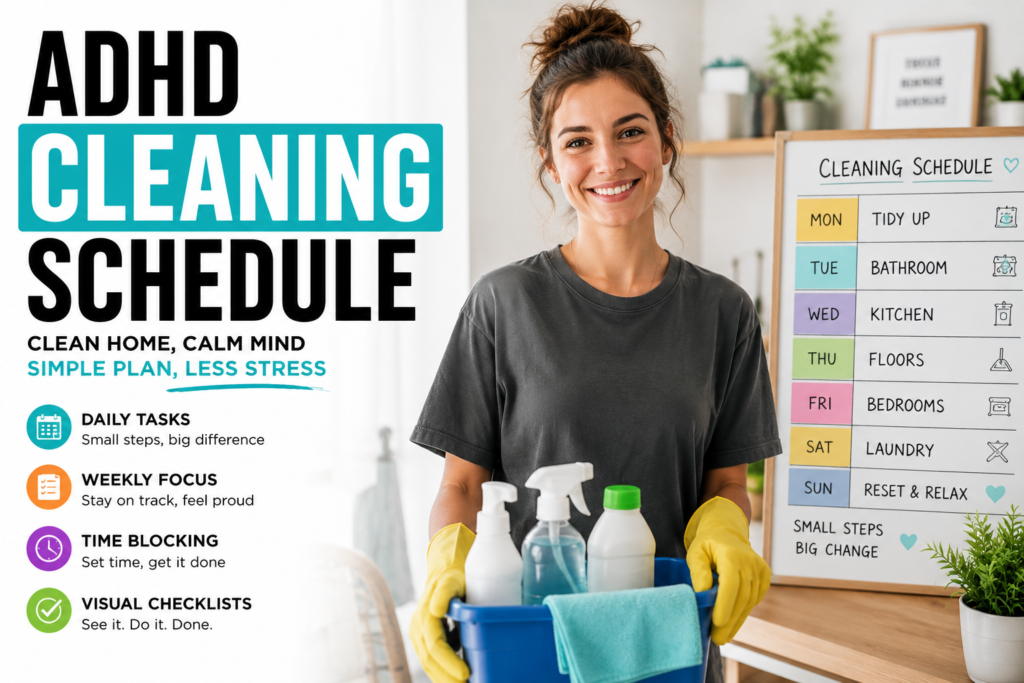
Never lock yourself into a rigid weekly schedule (e.g., “Bathrooms on Tuesday”). If your energy is low on Tuesday, you will fail, triggering guilt. Instead, use an **Energy-Aligned Schedule** that adapts to your daily capacity:
- High-Energy Days: Perform deep cleaning tasks like scrubbing toilets, vacuuming the entire house, or organizing a pantry.
- Low-Energy Days: Stick only to the “Survival Minimums” (taking out the trash, running the dishwasher, clearing a walkway).
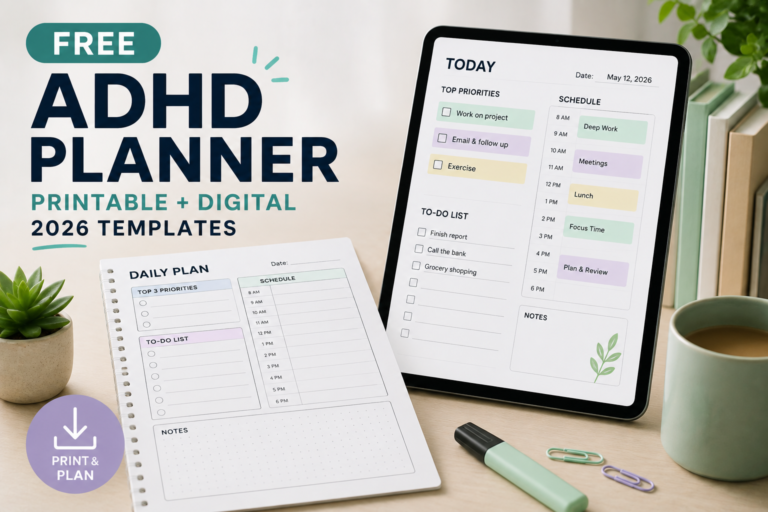
- Track Your Plan: Map your cleaning goals visually alongside your energy cycles using the ADHD Daily Planner, and set visual routines using the ADHD Routine Generator.
The Actionable ADHD House Cleaning Checklist
When your house is messy and your brain is frozen, follow this step-by-step adhd house cleaning checklist to rescue your living space. Do not skip steps or change the order.
For more detailed checklists, refer to our printable worksheets in the next section.
5 Critical Mistakes to Avoid
When trying to establish a cleaning routine, avoid these five common pitfalls that increase executive overwhelm:
- Aiming for “Perfection”: Trying to make your home look like a catalog picture triggers perfectionism. Focus on creating a functional, healthy space, not a perfect one. Good enough is clean enough.
- Cleaning Without a Written Plan: Attempting to clean a messy room without a step-by-step sequence leads to transition drift and sidequests. Stick to your written checklist.
- Ignoring Your Sensory Boundaries: Trying to wash dishes without gloves or sweep in silence when you are already groggy increases executive friction. Protect your senses to save energy.
- Keeping Too Many Closed Storage Cabinets: Storing items out of sight leads to forgetfulness and pileups on surfaces. Keep active items visible on hooks or open bins.
- Spiraling Into Self-Shame: Punishing yourself for laundry piles or dirty dishes drains the dopamine you need to start. Practice self-compassion to lower threat levels.
Printable Cleaning Resources
To help you structure your home organization, use the following worksheets. You can copy these formats onto paper or download printable versions from our library.
Resource 1: The Energy-Aligned Cleaning Planner
Use this structure to organize your cleaning tasks by energy levels rather than fixed days, allowing you to adapt to your daily cognitive capacity.
| Capacity Level | Pillar: Kitchen | Pillar: Bathrooms | Pillar: Floors | Pillar: Laundry |
|---|---|---|---|---|
| Low Energy (Survival) | Run dishwasher, empty trash | Wipe bathroom sink basin | Clear walking path | Move basket out of sight |
| Medium Energy (Routine) | Wipe down countertops | Scrub bathroom toilet bowl | Sweep high-traffic areas | Wash and dry one load |
| High Energy (Deep Clean) | Clean inside oven/fridge | Scrub shower and tub walls | Mop floors, vacuum carpets | Fold clothes and put away |
Resource 2: The Doom Box Index Card
Use this card to catalog the contents of a temporary storage box, ensuring you don’t lose items when hiding them from view.
Box Identifier: Box A (Closet) [ ]
1. Date Created: ________________________
2. Contents:
– Item 1: _________________________________________________
– Item 2: _________________________________________________
– Item 3: _________________________________________________
3. Target Deconstruction Date: ________________________
Expert Recommendations and Clinical Pathways
If chronic disorganization, hoarding behaviors, or severe chore anxiety impact your safety, relationships, or lease agreement, seek professional support:
- Professional Organizers for ADHD: Seek professional organizers who specialize in adult neurodiversity. They can help you design custom, visual storage systems that suit your brain, rather than trying to force you into standard aesthetic systems. Look for members of the *National Association of Productivity & Organizing Professionals (NAPO)* who specialize in ADHD.
- Occupational Therapy (OT): Occupational therapists can evaluate your home environments, identify sensory triggers, and help you structure low-friction sequences for cooking, cleaning, and self-care.
- ADHD Coaching and Therapy: Coaches can help you navigate the emotional blockages (shame, anxiety) associated with home management, helping you transition from panic-cleaning to a sustainable schedule.
- Regional Support Directories:
- United States: Check out the support listings and local groups on CHADD or ADDA.
- United Kingdom: Find guidance on local therapists and NHS support networks via The ADHD Foundation.
- Canada: Connect with CADDAC to access webinar courses and adult ADHD coaching listings.
- Australia: Search professional directories on ADHD Australia or AADPA to locate local clinical specialists.
Frequently Asked Questions
How do I start cleaning when overwhelmed by ADHD?
To start when overwhelmed, use physical shifts. Put on rubber gloves and noise-canceling headphones with music. Set a 15-minute timer, grab a trash bag, and focus *only* on picking up garbage. Bypassing other decisions clears initial visual noise and builds momentum.
What is a realistic ADHD cleaning schedule?
A realistic ADHD cleaning schedule is energy-aligned, not calendar-aligned. Instead of cleaning specific rooms on specific days, categorize your tasks into Low, Medium, and High Energy tasks, and execute them based on your daily cognitive capacity.
What is a doom box in ADHD organizing?
A doom box (*Document, Organize, Or, Make-bins-later*) is a storage bin where random clutter is swept to clear surfaces quickly. While useful for short-term clearing, they can become cognitive black holes if left unlabeled. Labeling the outside and listing contents prevents losing items.
Why does ADHD make cleaning so hard?
Cleaning is difficult because it requires heavy prefrontal cortex effort—sorting, sequencing, prioritizing, and decision-making. Furthermore, the baseline dopamine deficit in ADHD makes repetitive, low-stimulus tasks physically under-stimulating and hard to initiate.
How do you create an ADHD house cleaning checklist?
Create an ADHD house cleaning checklist by organizing tasks by category of items rather than rooms. A list should guide you through: Trash, Dishes, Laundry, items with homes, and items without homes (for a temporary bin). This reduces choice fatigue.
Conclusion: Creating a Peaceful Home with Kindness
Managing a home with ADHD is not about trying harder or forcing yourself through neurotypical chore lists. It is about understanding your unique cognitive limits, protecting your sensory channels, and building visual organization systems that support your brain.
Be kind to yourself on low-energy days. A sink full of dishes is not a reflection of your worth. Protect your senses, deconstruct your rooms using simple sorting methods, and build flexible schedules that align with your capacity. Work with your neurodiversity to create a home that feels like a sanctuary, not a chore.