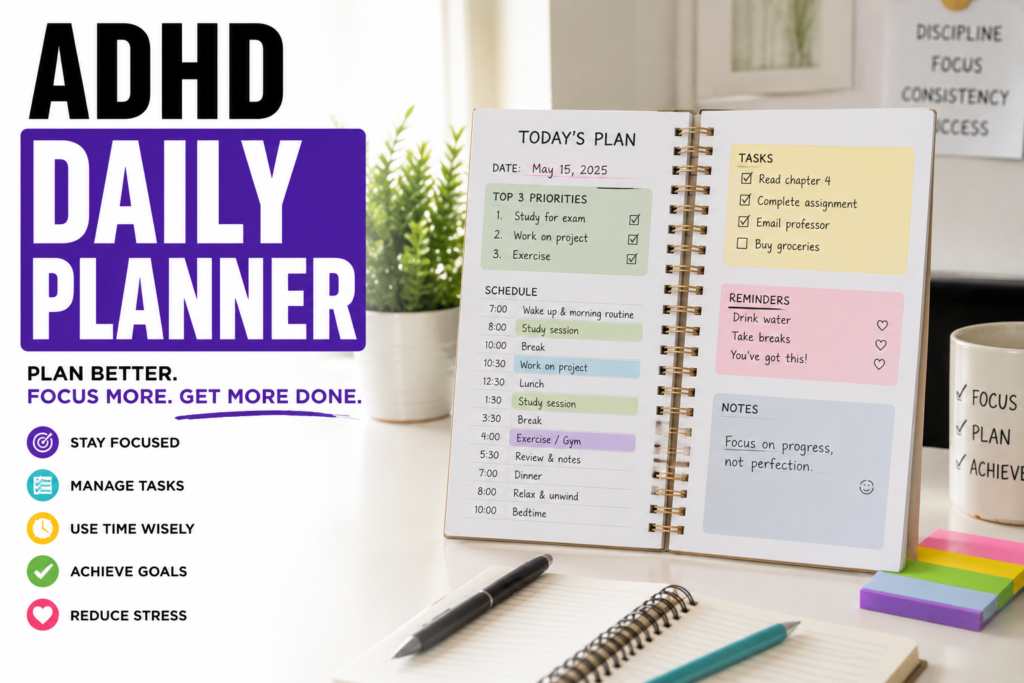
ADHD Daily Planning System That Prevents Overwhelm
You know the cycle. You feel disorganized and overwhelmed, so you search for a solution. You buy a beautiful new planner—perhaps a premium leather-bound book, a colorful academic planner, or a complex digital dashboard. You spend three hours filling out page one, color-coding your tasks, and writing a perfect, highly ambitious schedule. You feel a wave of hope. But by day three, the planner is sitting under a stack of papers on your desk. By week two, you have completely forgotten it exists, and it joins the “unused planner graveyard” in your closet. You are back to relying on random sticky notes, mental lists, and a constant, low-grade sense of panic.
For adults with Attention Deficit Hyperactivity Disorder (ADHD), this cycle of planning and abandonment is incredibly common. Traditional planning systems are built on neurotypical assumptions. They assume that your brain can easily prioritize a list of 20 items, estimate time accurately, follow a rigid hourly schedule, and maintain consistent habits day after day. When a neurodivergent brain tries to use these tools, they trigger executive overload, decision fatigue, and emotional shame, leading to immediate avoidance.
To plan your day successfully without triggering freeze, you need a system that works with your neurobiology. This guide provides a comprehensive, expert-level system for neurodivergent individuals. We will analyze the neuroscience of why traditional planners fail, explore practical strategies for adhd daily planning, and introduce a flexible, low-friction adhd planning system built around a visual adhd daily planner framework.
The Science of ADHD Planning: Why Standard Planners Fail
To break the cycle of planner abandonment, you must understand that your difficulty is biological, not a lack of discipline. Planning is a highly complex cognitive task that requires the coordination of multiple executive functions in the prefrontal cortex—networks that are altered in individuals with ADHD.
Key Concept: Traditional planners are directories of commitments that expect your brain to provide the executive control. An ADHD planner must act as the executive control itself, reducing choices, externalizing working memory, and pacing your energy.
1. Working Memory and Choice Fatigue
Working memory is the brain’s active mental scratchpad. In ADHD, this scratchpad is limited. When you look at a traditional list of 15 tasks, your working memory tries to process all of them simultaneously. Because the brain struggles to prioritize, every task—from “finish quarterly report” to “buy milk”—presents itself with the same cognitive weight. This triggers choice fatigue and immediate overwhelm. The brain cannot resolve the priority, leading to analysis paralysis and avoidance behavior.
2. Dopamine Regulation and Execution Fear
Dopamine is the neurotransmitter responsible for motivation, anticipation, and focus. The ADHD brain has a baseline deficit in dopamine. When a neurotypical individual writes down a task, they experience a small spike in dopamine simply by *anticipating* its completion. The ADHD brain does not. Writing a task list without dopamine creates a sense of dread. The brain registers the list as a catalog of failures and expectations, leading to avoidance. To protect your self-esteem, your brain stops looking at the planner.
3. The Planning Fallacy and Time Blindness
Due to altered functional connectivity in the prefrontal-cerebellar networks, individuals with ADHD experience “time blindness”—the inability to accurately perceive the passage of time or estimate how long tasks take. This triggers the planning fallacy: the tendency to severely underestimate the time required for a task. When planning, an ADHD adult will write down 10 complex tasks for a single afternoon, believing they have plenty of time. When they only complete two, they experience frustration, feel like a failure, and abandon the system.
4. Demand Avoidance and Rigid Calendars
Many ADHD brains exhibit Pathological Demand Avoidance (PDA) patterns. When you schedule a task for a rigid time slot (e.g., “Write report at 10:00 AM”), your brain registers that schedule as an external demand. When 10:00 AM arrives, your brain experiences internal resistance and actively fights the task, seeking autonomy in a distraction. An ADHD-friendly system must offer flexibility and choice, rather than a rigid calendar.
Symptoms of ADHD Planning Overwhelm
When trying to navigate daily tasks without a neurodivergent-friendly system, you default to patterns that trigger stress, procrastination, and disorganized workspaces.
| Planning Pattern | The Cognitive Breakdown | Real-World Manifestation |
|---|---|---|
| The Exhaustive List | Writing down 20–30 tasks on a single page without structure or grouping. | Looking at the massive list, feeling immediate anxiety, and deciding to play a video game instead. |
| The Planner Graveyard | Abandoning planners after a few days because they feel too high-maintenance. | Having five half-used planners in drawers, feeling a sting of guilt whenever you see them. |
| Sticky Note Chaos | Relying on scattered physical visual reminders to substitute for working memory. | Having 15 sticky notes stuck to your monitor, desk, and fridge, losing important tasks in the visual clutter. |
| Calendar Avoidance | Ignoring calendar alerts and notifications because they feel demanding or annoying. | Dismissing phone alerts immediately and returning to scrolling or hyperfocus, completely missing appointments. |
| Hyper-Scheduling Burnout | Trying to account for every 15-minute block of the day, leaving zero room for transitions. | Running late on task one, feeling the entire day’s schedule collapse, and giving up on productivity entirely. |
Real-Life Examples of ADHD Planning Friction
Let’s look at how these physiological challenges manifest in real life. Recognizing these profiles helps validate your experience and points toward targeted solutions.
Scenario A: The Exhaustive List Trap
Mark starts his Monday morning. He sits down with a blank sheet of paper and writes down every task he can think of. His list grows to 25 items, ranging from “Update client files” to “Fix closet door hinge” and “Email accountant.” He looks at the paper. Because his brain cannot prioritize, all 25 tasks scream for attention at the same volume. He experiences acute decision paralysis. He spends the morning pacing his office, checking his email, and reorganizing his desk. By 1:00 PM, he has completed none of the tasks on his list, and his baseline stress is elevated.
Scenario B: The Forgotten Premium Planner
Clara buys a premium, leather-bound adhd productivity planner designed to track daily goals, habits, water intake, gratitude, and hourly schedules. She spends her Sunday night filling it out, feeling motivated. On Monday, she uses it. On Tuesday, she gets busy, runs late, and forgets to write in it. On Wednesday, looking at the blank Tuesday page triggers a sense of guilt and failure. To avoid that uncomfortable feeling, she puts the planner in her desk drawer. Two weeks later, she buys another digital app, starting the cycle over.
Scenario C: The Back-to-Back Collapse
Ryan plans his workday using 30-minute time blocks: 9:00 AM: Write emails; 9:30 AM: Review report; 10:00 AM: Call client; 10:30 AM: Code feature. Because of time blindness, Ryan’s emails take 45 minutes instead of 30. When he looks at his schedule at 9:45 AM, he realized he has missed his start time for the report. His brain registers this delay as a system failure. The structure of the day is broken. Ryan experiences a wave of demotivation, closes his planner, and spends the next hour scrolling online, abandoning his schedule entirely.
The Complete Planning Recovery Framework: An ADHD-Friendly System
To design a daily planning system that works, you must build flexibility, visual containment, and dopamine pacing into your day. This framework consists of four sequential phases: **Clear the Cache, The Rule of 3, Visual Containers, and Energy Anchors**.
The Golden Rule: An ADHD planner should be a tool for containment, not accumulation. Your goal is not to write down *everything* you could possibly do, but to define the *few* things you will actually commit to today.
Phase 1: Clear the Cache (The External Brain Dump)
Never try to prioritize or organize while your thoughts are still in your head. Your working memory must be cleared first.
– **The Dump Zone:** Keep a raw notepad next to your planner. Write down every task, chore, idea, or worry floating in your head. Do not structure it; just write it down until your head feels empty.
– **Isolate the List:** Once the brain dump is complete, close the notepad or cover it with a sheet of paper. Your brain dump list is *not* your daily schedule; it is just a storage bin. You will only pull a few items from it.
Phase 2: The Rule of 3 (Containment is Key)
To prevent choice paralysis, you must limit your daily commitments. Focus exclusively on three main milestones for the day.
– **The Rule of 3:** Pull only **three** high-priority tasks from your brain dump list. Write them down in your active daily planner. These are your non-negotiables for the day. If you complete only these three tasks, your day is a complete success.
– **The “Admin Zone” Separation:** Keep small, low-friction tasks (emails, phone calls, quick chores) in a separate, contained box labeled “Quick Wins” or “Admin Zone.” Limit these to five items. Do not let them mingle with your three main focus blocks.
Phase 3: Visual Containers (Rather than Rigid Times)
Stop scheduling tasks at exact, minute-by-minute times. Use broad visual containers or time regions (Morning, Afternoon, Evening) to allow for transitions and energy fluctuations.
– **Time Boxing by Energy:** Assign your three main tasks to broad energy regions. Schedule your most complex, high-dopamine task for your peak energy container (e.g., Morning), and routine tasks for low-energy containers (e.g., Late Afternoon).
– **Calculate Transition Buffers:** Leave 15–30 minutes of unscheduled space between your containers to account for travel, setup, and cognitive reset.
– **Use Visual Planners:** Utilize visual structures that let you drag and drop tasks, see progress, and structure your containers. You can plan your daily containers visually using the digital ADHD Daily Planner.
Phase 4: Energy Anchors (Dopamine Routing)
Pace your cognitive stamina by building sensory cues and micro-rewards directly into your schedule.
– **Dopamine Pairing:** Schedule a favorite beverage, an upbeat playlist, or a sensory shift (like working in a coffee shop) to accompany your most difficult task.
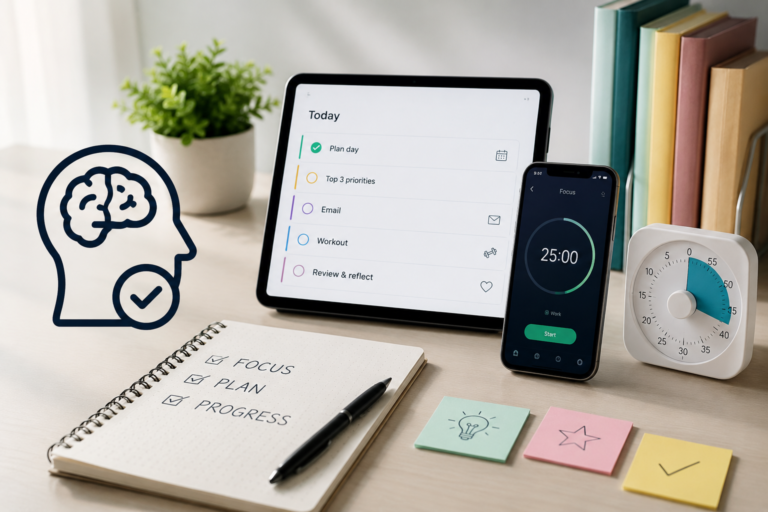
– **Structured Intervals:** Do not attempt long periods of focus. Break your day into structured focus blocks with scheduled breaks. You can manage your focus sessions using the time-locked methods in the ADHD Daily Planner or the visual countdowns in our ADHD Time Management Planner.
The Actionable ADHD Daily Planning Checklist
When you are preparing your day, follow this step-by-step adhd daily planning checklist to set up your schedule without overwhelm. Do not skip steps.
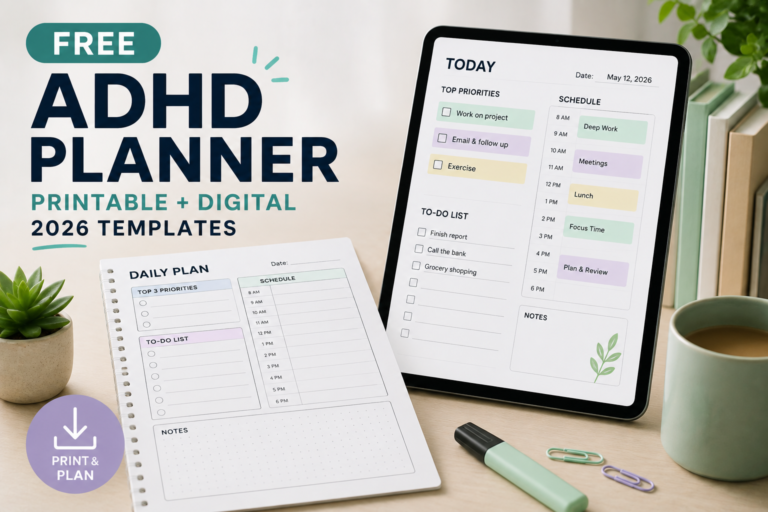
For more detailed visual layouts, access our printable templates in the next section.
5 Critical Mistakes to Avoid
When implementing a daily planning system, avoid these five common pitfalls that increase cognitive friction and lead to planner abandonment:
- Over-scheduling your capacity: Writing down more than three major tasks for a single day. This triggers executive freeze and failure feelings early in the day. Keep commitments small.
- Trying to plan on the fly: Re-evaluating your list mid-work block. This invites distraction and choice paralysis. Set your plan in a dedicated morning window, and stick to execution during the day.
- Using rigid, minute-by-minute time slots: Back-to-back scheduling collapses the moment a task runs late. Use broad, flexible time containers (Morning, Midday, Afternoon) and buffers.
- Neglecting transition time: Assuming you can jump instantly from one focus block to another. Leave at least 15–20 minutes of blank space to stretch, stand up, and reset your brain.
- Punishing yourself for blank pages: Viewing missed days in your planner as a total failure. ADHD planning is non-linear; missing a day is just data. Simply turn to the next page and start fresh.
Printable Planning Resources
To help you organize your daily containers, utilize these structured layouts. You can copy these formats onto a blank page or download the printable templates from our library.
Resource 1: The Daily Three-Box Planner
Use this layout to divide your day into three visual containers, reserving one slot for low-effort admin tasks and planning rewards.
| Time Container | Task Commitment (Focus Only ONE) | Dopamine / Environmental Trigger | Completed? |
|---|---|---|---|
| Morning Container (Peak Energy) | Write draft report slides (45m) | Work in favorite cafe, order double espresso | [ ] |
| Midday Container (Routine Flow) | Organize paper files on desk (30m) | Listen to high-tempo playlist | [ ] |
| Afternoon Container (Admin / Wins) | Send 3 follow-up emails, call doctor | Fidget toy on desk, cup of tea | [ ] |
Resource 2: The Weekly Buffer Scheduler
Use this visual block diagram to ensure that you are scheduling blank buffer zones between your daily containers to protect your prefrontal cortex.
Daily Block Blueprint:
[Block 1: Morning Focus] → (15-Minute Buffer / Walk) → [Block 2: Midday Work] → (30-Minute Buffer / Rest) → [Block 3: Admin Zone]
Expert Recommendations and Clinical Pathways
For chronic planning difficulties that impact your employment status, clinical health, or academic grades, seek professional support to build systems:
- ADHD Coaching: An ADHD coach can help you test different daily planner formats, design customized routine sheets, and help you navigate the guilt and shame of past failures. Look for credentialed guides from ACO or PAAC.
- Occupational Therapy (OT): Occupational therapists specialize in executive function training, helping you design sensory-friendly workspaces and develop low-friction systems for daily self-care and work tasks.
- Cognitive Behavioral Therapy (CBT): Specifically, CBT for adult ADHD focuses on reframing cognitive distortions like perfectionism (“If I don’t use this planner perfectly, I shouldn’t use it at all”) and developing healthy coping strategies for anxiety.
- Regional Directory Listings:
- United States: Check out the lists of local clinics and support groups on CHADD or ADDA.
- United Kingdom: Find guidance on local NHS ADHD services or certified therapists through The ADHD Foundation.
- Canada: Connect with CADDAC to access adult ADHD groups, resources, and coaching lists.
- Australia: Contact the ADHD Australia support team or search local professionals through AADPA.
Frequently Asked Questions
What is the best daily planner for ADHD adults?
The best daily planner for ADHD adults is visual, simple, and flexible. It should emphasize task containment (such as the Rule of 3), provide broad time containers (Morning, Midday, Afternoon) rather than rigid hours, and require minimal maintenance to prevent cognitive burnout.
How do I start daily planning with ADHD?
To start, perform a 5-minute brain dump on a scratch notepad to clear your working memory. Select only three priority tasks as your core focus for the day, assign them to broad time blocks, and close the raw brain dump list to protect your attention from choice overload.
Why do I buy planners and never use them?
You abandon planners because traditional layouts are built for neurotypical brains. They require high executive function to maintain, offer low dopamine rewards, and trigger feelings of guilt or failure when you miss a day, leading your brain to avoid them.
What is a low-energy daily planning system?
A low-energy daily planning system is one that minimizes daily decisions. It relies on the Rule of 3, focuses only on the next physical step of a task, uses broad time blocks with built-in buffers, and doesn’t penalize you for missed days or changes in schedule.
Can medication help with daily planning?
Yes, ADHD medications improve the transmission of dopamine and norepinephrine in the prefrontal cortex. This directly supports the executive functions needed to prioritize tasks, sustain focus during planning sessions, and bridge the gap between intention and action.
Conclusion: Planning Your Day with Kindness
Keeping a daily planner with ADHD is not about trying to transform yourself into a perfectly organized machine. It is about understanding your unique cognitive limits, externalizing your memory, and designing flexible systems that protect your brain from overwhelm.
Be gentle with yourself on low-energy days. Missing a day in your planner is not a sign of failure; it is just a normal variation in your neurodivergent experience. Focus on container schedules, limit your daily commitments, and use visual systems to support your daily routines.
Ready to design an ADHD-friendly day? Take control of your daily schedule with the visual formats in the ADHD Daily Planner. If you want to establish consistent morning or evening flows, build a custom sequence with the ADHD Routine Generator, and manage your focus sessions with the visual timers in the ADHD Time Management Planner.

[…] sensitivity. We’ll address them all directly. For broader planning strategies, explore our ADHD daily planning system that complements after-school […]
[…] you can start using today. If you want to pair it with a complete daily system, check out our ADHD daily planning system for deeper […]
[…] you’re not sure which one fits, our broader ADHD daily planning system guide walks through how to test a layout for a week before committing to it […]