ADHD Sleep Problems – Practical ADHD Guide to Restful Nights
It is 11:30 PM. You know you need to wake up at 7:00 AM for an important meeting. You put away your laptop, brush your teeth, and turn off the lights. You lie down, expecting sleep to arrive.
Instead, your brain turns on a high-definition projector. Suddenly, you are replaying a socially awkward conversation you had in 2018. Then, you are mentally redesigning your living room furniture layout. Then, a song you haven’t heard in five years begins playing on an endless loop in your head. You pick up your phone “just for five minutes” to check a fact, and when you look up, it is 2:15 AM. You are exhausted, yet profoundly, uncomfortably awake. The next morning, you drag yourself out of bed, your brain in a deep fog, your executive function severely depleted, and you promise yourself you will go to bed early tonight. But the cycle repeats.
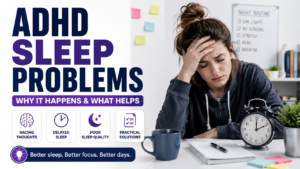
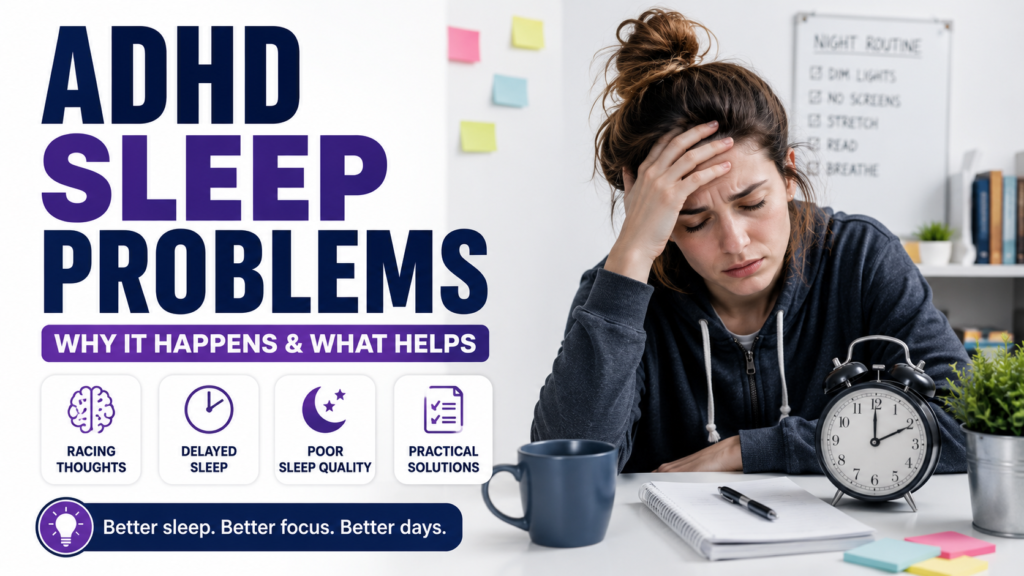
If this sounds familiar, you are experiencing one of the most common, debilitating, and frequently misunderstood aspects of Attention Deficit Hyperactivity Disorder. Up to 80% of adults with ADHD experience chronic sleep dysfunction. Yet, **adhd sleep problems** are rarely treated with the seriousness they deserve, often dismissed by well-meaning friends as simply “bad sleep habits” or “being a night owl.”
In reality, ADHD sleep disruption is a neurological issue rooted in circadian rhythm delays, dopamine dysregulation, and executive function failure. The relationship is bidirectional: ADHD causes severe sleep disruption, and chronic sleep deprivation exponentially worsens ADHD symptoms the following day, destroying **ADHD productivity** and shattering any attempts at **ADHD organization**.
This comprehensive **adhd sleep problems guide** provides an evidence-based clinical framework for understanding and resolving neurodivergent insomnia. We will explore the science behind why your brain refuses to shut down at night, provide a structured system of **adhd sleep problems tips**, and give you actionable tools to break the cycle of exhaustion.
The Science: Why ADHD Brains Cannot Sleep
To fix the problem, we must first understand the machinery. **ADHD sleep problems** are not caused by a lack of willpower; they are the result of three specific neurological mechanisms that operate differently in the neurodivergent brain.
1. Delayed Circadian Rhythm Phase
The circadian rhythm is the body’s internal 24-hour clock that regulates the sleep-wake cycle through the release of melatonin (the sleep hormone) and cortisol (the wake hormone). In neurotypical individuals, melatonin begins to rise around 9:00 PM, preparing the body for sleep by 11:00 PM.
Research shows that in individuals with ADHD, this circadian clock is frequently delayed by 1.5 to 2 hours. This is called Delayed Sleep Phase Syndrome (DSPS). Your brain does not biologically signal “nighttime” until 1:00 AM or 2:00 AM. When you try to force yourself to sleep at 11:00 PM to fit society’s schedule, you are essentially asking your brain to sleep at biological midday. The neurochemical environment required for sleep simply does not exist yet.
2. The Hyperactive Default Mode Network (Racing Thoughts)
The Default Mode Network (DMN) is the brain system responsible for daydreaming, mind-wandering, and internal thought. In a neurotypical brain, the DMN is suppressed when focusing on a task, and it gently quiets down as sleep approaches.
In the ADHD brain, the DMN is chronically overactive and poorly regulated. When you turn off the lights and remove external stimulation, the DMN seizes control. Without an external task to anchor your attention, your working memory becomes flooded with racing thoughts, imaginary arguments, and intrusive ideas. This internal cognitive hyperactivity creates physiological arousal (increased heart rate and mild anxiety), directly blocking the transition into sleep.
3. Revenge Bedtime Procrastination and Dopamine Deficit
Because the ADHD brain struggles with task initiation and time management throughout the day, adults with ADHD often reach the evening feeling that they have accomplished nothing, or that their entire day was dictated by other people’s demands.
The evening hours—when the world is finally quiet and no one expects anything from you—become the only time you feel truly autonomous. To compensate for the lack of dopamine and autonomy during the day, the ADHD brain engages in “Revenge Bedtime Procrastination.” You refuse to go to sleep, instead binge-watching television, scrolling social media, or starting a new hobby at midnight. Your brain is desperately seeking the dopamine reward it was denied during the day, trading tomorrow’s energy for tonight’s stimulation.
4. Executive Function and the Transition to Sleep
Going to sleep is not a passive event; it is an active transition. It requires stopping current activities, initiating hygiene tasks (brushing teeth), and deliberately changing environments. These are all acts of **executive function**.
Because executive function is impaired in ADHD, the transition to sleep feels like climbing a mountain. The “activation energy” required to put down the phone, get out of a comfortable chair, and initiate the bedtime routine is often too high for a depleted evening brain to muster.
Symptoms of ADHD Sleep Dysfunction
**ADHD sleep problems** manifest in highly specific patterns that differ from general insomnia.
| Sleep Issue | Description | ADHD Neurological Driver |
|---|---|---|
| Sleep Onset Insomnia | Taking longer than 45 minutes to fall asleep after getting into bed. | Hyperactive Default Mode Network causing racing thoughts; delayed circadian melatonin release. |
| Bedtime Resistance | Actively avoiding the process of getting ready for bed despite feeling physically exhausted. | Executive dysfunction making the multi-step transition routine feel overwhelming. |
| “Second Wind” Energy | Feeling deeply fatigued at 8:00 PM, but suddenly experiencing a massive surge of mental clarity and energy at 10:30 PM. | The delayed circadian rhythm finally hitting its “peak” wakefulness phase late in the evening. |
| Sleep Inertia (Morning Fog) | Extreme, painful difficulty waking up; feeling neurologically offline for 1-2 hours after alarms sound. | Waking up during biological “deep night” because the circadian rhythm is shifted late. |
| Restless Sleep | Tossing, turning, and physically moving throughout the night; frequently waking up. | Physical hyperactivity translating into sleep; restless leg syndrome (highly comorbid with ADHD). |
Real-World Sleep Scenarios
Scenario A: The Chronic Exhaustion Cycle (Sarah’s Story)
Sarah is a 34-year-old project manager. She is deeply invested in her career, but her lack of **ADHD planning** around her evenings is destroying her days.
Every night, Sarah sits on the couch at 10:00 PM. She knows she should go to bed. Instead, she opens TikTok. She tells herself she will watch for ten minutes to “wind down.” Because her ADHD brain struggles with time blindness and impulse control, two hours evaporate. At midnight, she feels guilty, brushes her teeth quickly, and gets into bed.
Now, her brain is highly stimulated by the blue light and rapid dopamine hits of the app. Her thoughts race. She finally falls asleep at 2:00 AM. When her alarm rings at 7:00 AM, she hits snooze four times. She arrives at work feeling physically sick with exhaustion. Her **working memory** is shot, she cannot focus, and her emotional regulation is non-existent. She survives on caffeine, crashes at 8:00 PM, gets a “second wind” at 10:00 PM, and the cycle repeats.
Scenario B: The “Night Owl” Trap (Marcus’s Story)
Marcus, a freelance graphic designer, assumed he was just a natural night owl. His **ADHD productivity** peaked at 1:00 AM. He would do his best design work between midnight and 4:00 AM when the world was silent and there were no incoming emails to distract him.
However, society operates on a daytime schedule. Client meetings were at 10:00 AM. Marcus was constantly missing morning appointments, sleeping through phone calls, and feeling completely disconnected from his friends and partner who operated on normal schedules. His late-night productivity was an adaptation to his untreated ADHD, but it was causing massive social and professional friction.
Scenario C: The Managed Transition (Leo’s Story)
Leo struggled with severe sleep onset insomnia until he learned about his delayed circadian rhythm. Instead of forcing himself to sleep at 10:00 PM, he aimed for midnight, shifting his morning alarm to 8:00 AM.
More importantly, Leo built a physical barrier against his racing thoughts. He purchased a dedicated e-reader (with no internet browser) and placed it on his nightstand. He instituted a hard rule: no smartphone in the bedroom. When he got into bed, his racing thoughts would start. Instead of fighting them, he would read fiction on the e-reader. The fiction provided just enough structure to occupy his Default Mode Network without providing the hyper-stimulating dopamine hits of social media. After 20 minutes, his brain would quiet down, and he would drift to sleep.
The ADHD Sleep Management Framework: Actionable Strategies
Resolving **adhd sleep problems** requires more than drinking chamomile tea or doing deep breathing. It requires structural, environmental, and behavioral scaffolding designed specifically for the neurodivergent brain.
Phase 1: Environmental Design (Friction and Anchors)
You cannot rely on executive function to make good choices at 11:30 PM. You must design your environment so that sleep becomes the path of least resistance.
- The “Phone Quarantine”: The smartphone is the single greatest destroyer of ADHD sleep. It provides infinite novelty and bright light. You must create physical friction. Buy a cheap digital alarm clock for your bedside. Plug your phone charger in the kitchen or bathroom. If the phone is not in the bedroom, you cannot impulsively reach for it during a moment of restlessness.
- Light Management (Circadian Anchoring): Because your circadian rhythm is already delayed, you must forcefully signal to your brain when day ends and night begins. At 9:00 PM, turn off all overhead lights in your home. Switch entirely to low-level, warm-toned lamps. Install software like f.lux or use “Night Shift” on all devices to eliminate blue light, which actively suppresses melatonin.
- The Sensory Cave: The ADHD brain is highly sensitive to sensory input. Ensure your bedroom is completely dark (blackout curtains are essential), exceptionally cool (around 65°F / 18°C), and sound-managed. Use a white noise machine or a heavy-duty fan to mask the unpredictable environmental noises that jolt the ADHD brain back to wakefulness.
- Weighted Blankets: Deep Pressure Stimulation (DPS) provided by a weighted blanket can significantly reduce physiological arousal and anxiety. Many adults with ADHD report that a 15-pound weighted blanket creates a “grounding” sensation that calms the physical restlessness associated with sleep onset.
Phase 2: The Evening Shutdown Routine (Bridging the Transition)
A routine reduces the executive function required to transition from “awake” to “asleep.”
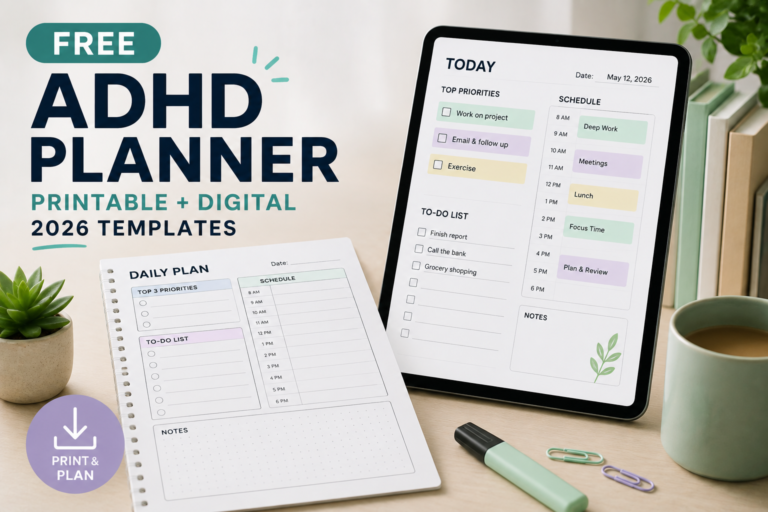
- The “Brain Dump” Protocol: To stop your working memory from violently churning through tomorrow’s tasks while you lie in bed, you must externalize them. At 8:30 PM, use the ADHD Daily Planner to write down every lingering task, anxiety, or idea. Tell your brain: “It is written down. We do not need to hold onto this until tomorrow.”
- The Visual Cue: Transition requires a cue. Set a specific, non-jarring alarm (like a gentle chime) on your phone for 9:30 PM. This is not the “go to sleep” alarm; it is the “start the shutdown sequence” alarm.
- Bridging Activities: You cannot go from high-stimulation (video games, intense work) straight to sleep. You need a “bridge.” This should be an activity that is engaging enough to keep your brain occupied, but low-stimulation enough to allow cortisol to drop. Examples include: reading fiction, doing a jigsaw puzzle, knitting, or listening to an audiobook.
- Use the Routine Generator: Build a custom evening shutdown sequence using the ADHD Routine Generator. Keep the sequence short (3-4 steps max). If the routine is too complex, your executive dysfunction will cause you to avoid it entirely.
Phase 3: Managing Racing Thoughts in Bed
When you are finally in bed, the Default Mode Network will attempt to take over. You need specific **ADHD focus tips** for the dark.
- Cognitive Shuffling (The Serial Diversity Method): This is an evidence-based technique to short-circuit racing thoughts. Pick a random word (e.g., “BIRD”). Visualize an object starting with B (Bus). Then another (Ball). Then another (Bread). When you run out of B words, move to I (Ice, Igloo, Island). This task requires just enough focus to block out anxieties, but is nonsensical enough that it mimics the random imagery of early-stage sleep, tricking your brain into powering down.
- Audio Distraction (The Anchor): Complete silence is often the enemy of the ADHD brain because it leaves a vacuum for racing thoughts to fill. Listen to a familiar, low-stakes podcast or a familiar audiobook on a sleep timer. The content must be interesting enough to capture your attention, but not exciting enough to keep you awake. “Sleep stories” or history podcasts are highly effective.
- The 20-Minute Rule: If you have been tossing and turning for what feels like 20 minutes, get out of bed. Lying in bed frustrated trains your brain to associate the bed with anxiety rather than sleep. Move to a dim room, do a low-stimulation activity (read a book), and only return to bed when your eyelids feel physically heavy.
Building Daytime Habits for Nighttime Sleep
Your ability to sleep at night is heavily determined by what you do during the day.
1. Morning Light Exposure
To combat a delayed circadian rhythm, you must anchor your morning. Within 30 minutes of waking up, get actual sunlight in your eyes (not through a window). Stand outside for 10-15 minutes. This light exposure forcefully stops melatonin production and sets a biological timer that will trigger sleepiness 14-16 hours later.
2. Caffeine Management
Caffeine has a half-life of 5-7 hours. For an ADHD brain already prone to hyperarousal at night, late-afternoon caffeine is disastrous. Set a hard cutoff for all caffeine consumption by 1:00 PM or 2:00 PM at the latest. Use the ADHD Habit Tracker to monitor your caffeine intake times and correlate them with your sleep quality.
3. Strategic Productivity
Revenge Bedtime Procrastination happens when you feel you achieved nothing during the day. Combat this by using the ADHD Weekly Planner to designate just one “Must Do” priority per day. When you complete that one priority, you can give your brain permission to feel successful. A brain that feels successful is much more willing to shut down at night.
Printable Sleep Management Checklist
Template 1: The ADHD Evening Shutdown Routine
Print this checklist and place it on your bathroom mirror or bedside table.
[ ] All overhead lights turned off; warm lamps turned on.
[ ] Phone charger moved to the kitchen or bathroom.
[ ] “Brain Dump” completed: All lingering tasks/anxieties written down in the planner.
Phase 2: The Transition (9:30 PM)
[ ] Hygiene tasks completed (teeth brushed, face washed).
[ ] Screen-free “bridge” activity engaged (reading, puzzle, podcast).
[ ] Bedroom temperature checked (cool, around 65°F/18°C).
Phase 3: The Anchor (10:30 PM)
[ ] In bed with weighted blanket.
[ ] Sleep timer set on familiar audiobook or podcast.
[ ] If racing thoughts start, initiate Cognitive Shuffling.
Expert Recommendations and ADHD Help
If you have implemented environmental controls and routines, but still suffer from severe **adhd sleep problems**, it is time to seek clinical **ADHD help**.
- Melatonin Supplementation: Because ADHD brains have a delayed melatonin release, taking a very low dose of melatonin (0.5mg to 1mg) approximately 90 minutes before your target bedtime can help shift your circadian rhythm earlier. *Do not use massive doses (5mg+), as they can cause morning grogginess and disrupt natural production. Consult a doctor before starting.*
- Medication Timing: Stimulant medications are highly effective for daytime **focus**, but if taken too late in the day, they will destroy sleep onset. Conversely, some patients experience a “rebound effect” where ADHD symptoms (racing thoughts, physical restlessness) surge wildly as the medication wears off in the evening, preventing sleep. Work closely with your psychiatrist. Sometimes, a tiny “booster” dose of short-acting medication in the late afternoon can smooth the crash and actually *improve* sleep by calming the racing thoughts.
- Cognitive Behavioral Therapy for Insomnia (CBT-I): CBT-I is the gold-standard psychological treatment for chronic insomnia. It involves sleep restriction, stimulus control, and cognitive restructuring. An ADHD-informed therapist can adapt CBT-I protocols to work alongside your executive function challenges.
Frequently Asked Questions
Why do I have more energy at night with ADHD?
This is the result of a delayed circadian rhythm (Delayed Sleep Phase Syndrome) combined with the removal of daytime demands. During the day, you are burning executive function attempting to manage external expectations, which is exhausting. At night, those demands disappear, and your delayed biological clock finally signals “wakefulness,” resulting in a massive surge of clarity and energy right when you should be sleeping.
Can I just embrace being a night owl?
If your career, social life, and family obligations allow you to sleep from 3:00 AM to 11:00 AM consistently without negative consequences, yes. The biological timing of sleep matters less than the consistency and duration. However, for most adults, attempting to live on a delayed schedule conflicts with standard employment hours, leading to chronic sleep deprivation, which exponentially worsens ADHD symptoms.
Do ADHD medications cause insomnia?
Stimulant medications (like Adderall, Vyvanse, or Ritalin) can absolutely cause sleep onset insomnia if the dosage is too high, or if they are taken too late in the day. However, untreated ADHD also causes severe insomnia due to racing thoughts. It requires careful titration by a medical professional to find the balance where the medication provides daytime focus without disrupting nighttime rest.
How many hours of sleep does an ADHD brain need?
Adults with ADHD generally need the same amount of sleep as neurotypical adults: 7 to 9 hours per night. However, because ADHD brains process information less efficiently during the day and constantly battle sensory overload, the *quality* of that sleep is paramount for cognitive recovery.
Conclusion: Reclaiming Your Rest
You cannot hack your way out of sleep deprivation, and you cannot outwork an exhausted brain. Managing **adhd sleep problems** is not a secondary concern—it is the foundational pillar upon which all other **ADHD organization** and productivity systems rest. If you do not fix the sleep, you cannot fix the focus.
The core realization is that sleep is not an event that just “happens” to you; it is a transition that requires management. Your neurodivergent brain needs external scaffolding to make that transition successfully.
By separating yourself from your smartphone, establishing a dark and cool sensory environment, externalizing your racing thoughts through a brain dump, and providing your Default Mode Network with a low-stakes audio anchor, you can bypass the executive dysfunction that keeps you awake.
Start tonight. You do not need to execute the entire framework perfectly. Choose one intervention: leave your phone in the kitchen. That single boundary is often the catalyst that breaks the cycle of exhaustion and allows you to finally get the rest your brain so desperately needs.