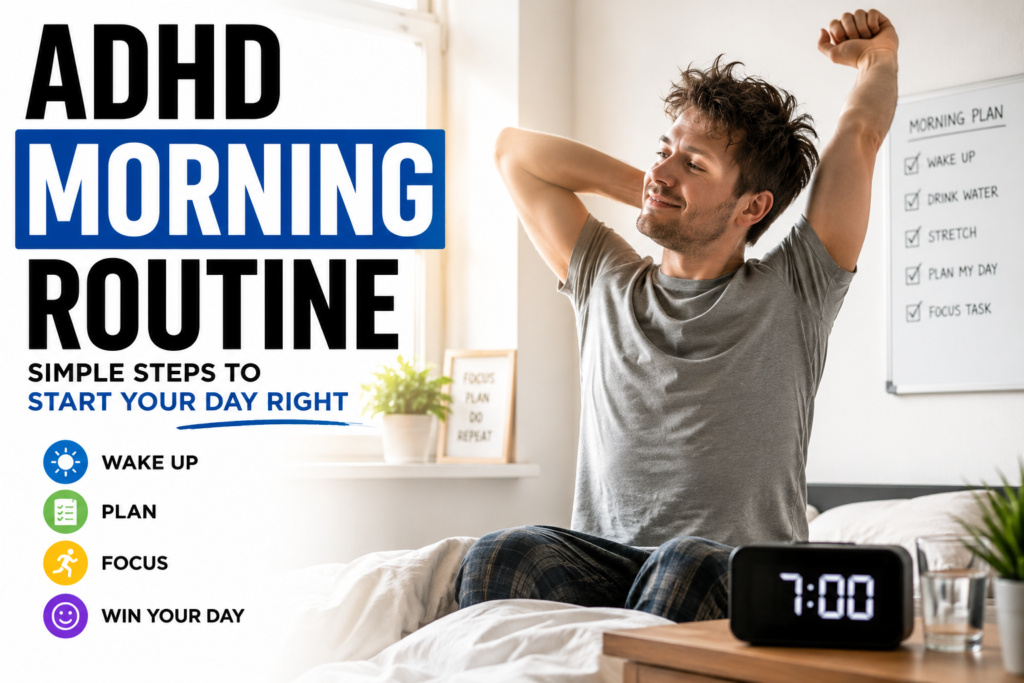
ADHD Morning Routine for Adults Who Hate Mornings
The alarm rings. For most people, this is a signal to stretch, sit up, and begin the day. But for you, it feels like a physical assault. Your eyelids are glued shut, your limbs feel like lead weights, and your brain is shrouded in a thick fog. You hit the snooze button. Then you hit it again. And again. By the time you finally drag yourself out of bed, you are already thirty minutes behind schedule. The morning becomes a frantic, stressful sprint of looking for lost keys, skipping breakfast, and rushing out the door with a stomach full of adrenaline and anxiety. You promise yourself tomorrow will be different, but tomorrow, the same cycle repeats.
If you are an adult with Attention Deficit Hyperactivity Disorder (ADHD), you likely hate mornings. This struggle is not a character flaw. It is not because you are lazy, disorganized, or lack willpower. It is a biological mismatch. Most generic morning advice is built for neurotypical brains—urging you to rise at 5:00 AM, meditate, write in a journal, drink green tea, and complete a complex 10-step checklist. For an ADHD brain, this high-effort, low-stimulation model is a recipe for executive dysfunction and burnout.
To build a successful ADHD morning routine, you need to throw out the neurotypical rulebook. You need a system that respects your unique neurobiology, accommodates low-energy mornings, and uses external scaffolding to guide you through the transition from sleep to wakefulness. This article provides a comprehensive, science-based recovery system to build a morning routine for adhd adults who hate mornings.
The Science of ADHD Morning Struggles: Why Waking Up is Hard
To stop blaming yourself for your morning difficulties, you must understand the neurological and physiological systems that govern sleep and wakefulness in the ADHD brain. Waking up is not just a decision; it is a complex biological transition that is disrupted in individuals with ADHD.
Key Insight: Up to 75% of adults with ADHD experience chronic sleep problems, including delayed sleep onset, sleep fragmentation, and severe morning sleep inertia. Waking up is a physical hurdle, not a motivational one.
1. Delayed Sleep Phase Syndrome (DSPS)
Research indicates a strong genetic link between ADHD and Delayed Sleep Phase Syndrome (DSPS). In neurotypical individuals, the sleep hormone melatonin rises in the late evening, prompting sleep around 10:00 PM or 11:00 PM, and drops in the early morning to trigger waking. In the ADHD brain, this circadian rhythm is shifted forward by two to three hours. Melatonin does not rise until 1:00 AM or 2:00 AM, and it does not drop until late morning. When your alarm rings at 7:00 AM, your body is physiologically in the middle of its deep sleep phase. You are fighting your core biological clock.
2. Dopamine Deficit and the Under-Aroused Brain
The ADHD brain operates with a chronic deficit of dopamine, the neurotransmitter responsible for motivation, anticipation, and alertness. Upon waking, a neurotypical brain experiences a natural spike in cortisol and dopamine that clears sleep fog and prompts activity. In contrast, the ADHD brain wakes up in a state of severe neurochemical under-arousal. Without that immediate dopamine driver, your brain struggles to find the motivation to open its eyes, let alone execute a task. The bed remains the most high-dopamine, safe environment, making it physically difficult to leave.
3. Severe Sleep Inertia
Sleep inertia is the transitional state between sleep and waking, characterized by temporary cognitive impairment, slow reaction times, and grogginess. While sleep inertia lasts 10 to 30 minutes for most people, it can persist for several hours in adults with ADHD. During this window, your prefrontal cortex—the part of the brain responsible for planning, organizing, and executing tasks—is effectively offline. Expecting yourself to make decisions, locate items, or stick to a schedule during severe sleep inertia is like trying to run a computer with no operating system loaded.
Symptoms of a Broken Wake-Up Routine
When you do not have an ADHD-friendly system in place, your mornings default to a set of survival patterns that drain your executive function before your workday even begins.
| Behavioral Symptom | What it Looks Like | Impact on the Day |
|---|---|---|
| Snooze Abuse | Hitting the snooze button for 60–90 minutes, experiencing fragmented, low-quality sleep. | Severe physical fatigue, starting the day with immediate time deficit and guilt. |
| The Morning Freeze | Sitting on the edge of the bed or sofa, staring at the wall or doom-scrolling for 40 minutes. | Losing the entire preparation window, leading to panic and rush. |
| Decision Paralysis | Staring into the closet trying to pick clothes, or looking at the pantry trying to choose breakfast. | Draining limited morning willpower on minor decisions, leaving less energy for work. |
| The Lost-Item Scramble | Frantically searching for keys, wallet, phone, or work badge in the final 5 minutes before leaving. | Spiking cortisol levels, arriving at work or school in a state of sensory overload. |
Real-Life Examples of ADHD Morning Dread
Let’s look at how these physiological challenges manifest in real life. These scenarios illustrate the difference between trying harder and utilizing a neurodivergent-friendly system.
Scenario A: The Frantic Sprint
Tom is an accountant who has to be at his office by 8:30 AM. He sets his alarm for 7:00 AM, intending to exercise and eat a healthy breakfast. When the alarm rings, his brain is in a deep fog. He hits snooze until 8:00 AM. In a panic, he jumps out of bed, throws on the first clothes he finds, skips breakfast, and spends ten minutes searching for his car keys, which he left in his jacket pocket. He drives to work in a state of high stress, arriving at 8:45 AM. He spends the first two hours of his workday recovering from the anxiety of his morning, unable to focus on his spreadsheets.
Scenario B: The Low-Energy Fog
Maya works from home. Her laptop needs to be open at 9:00 AM. She wakes up at 8:00 AM, but she has zero mental energy. She moves from her bed to the sofa, wraps herself in a blanket, and opens her phone. She intends to check the weather, but instead gets sucked into a social media feed for 50 minutes. At 8:55 AM, she drags herself to her computer, still in her pajamas, without having brushed her teeth or had water. She feels sluggish, unfocused, and guilty for wasting her morning, which sets a negative tone for the rest of her day.
Scenario C: The Student Scramble
Chloe is a college student with a 9:00 AM lecture. Because she has no structured adhd wake up routine, she wake up late, cannot decide what to wear, and spends 15 minutes packing her backpack. She misses her bus, arrives at the lecture hall 20 minutes late, and feels the sting of public embarrassment as she walks to a seat. She struggles to follow the professor’s slides because her nervous system is still recovering from the morning rush. She could benefit from a structured guide like the ADHD Students Guide Tool to help sequence her days.
The Complete Recovery Framework: Building an ADHD-Friendly Morning
To design an ADHD morning routine that works, you must move away from the expectation of high effort. Instead, we use a 4-phase framework: **Wake the Body, Outsource Decisions, Paced Transition, and Paved Exit**. This framework is designed to move you from sleep to alertness with the lowest possible cognitive friction, creating a sustainable low energy adhd morning routine.
Phase 1: Wake the Body (Sensory Activation)
Do not rely on mental strength to wake up. Use physical and sensory triggers to gently alert your nervous system and clear sleep inertia.
- The Pre-Wake Medication Trick: If you take stimulant medication, set an alarm 45–60 minutes before your actual wake-up time. Keep your medication and a glass of water on your nightstand. Take your pill, and go back to sleep. When your second alarm rings an hour later, the medication will have kicked in, helping to naturally clear the brain fog and make rising easier.
- Light Exposure: Light stops the production of melatonin. Use a sunrise alarm clock that slowly brightens your room before your alarm goes off. As soon as you open your eyes, open your blinds or turn on a bright therapy light. This signals your biological clock that the deep sleep phase is over.
- Tactile Shift: Move your body. If you cannot stand up, sit up in bed and drink a full glass of cold water. Keep a damp washcloth or facial mist on your nightstand to cool your face, which stimulates the vagus nerve and triggers alertness.
- Put the Alarm Across the Room: If you use a physical alarm clock, place it out of arm’s reach. This forces you to step out of bed to turn it off, breaking the snooze loop.
Phase 2: Outsource Decisions (The Night-Before Prep)
Morning executive function is limited. To protect your brain from decision fatigue, complete all planning and sorting tasks the night before. Your morning self should only have to execute, not make choices.
- The Visual Uniform: Lay out your entire outfit—including socks, underwear, and accessories—in a visible spot. Do not leave room for choices in the morning.
- Launchpad Setup: Establish a designated spot near your front door (a tray or hook) for your keys, wallet, phone, and work bag. Place these items on the launchpad the night before. If it is not on the launchpad, it does not exist.
- Pre-Staged Breakfast: Decide what you will eat and set out the pans, mugs, or ingredients. If you make coffee, set the timer on your machine to brew automatically before you wake up. The smell of coffee acts as a powerful sensory cue.
Phase 3: Paced Transition (The Low-Energy Flow)
Once you are out of bed, give yourself permission to ease into the day. A morning routine does not have to be fast-paced; it just needs to be continuous and low-friction.
- The Minimalist Checklist: Keep your morning tasks small and simple. Focus only on three pillars: hygiene (brush teeth, wash face), hydration (drink water/coffee), and fuel (eat breakfast). You can generate customized, low-friction morning sequences using the digital ADHD Routine Generator.
- Audio Anchors (Playlist Routines): Rather than watching the clock, use a specific playlist to measure time. Create a morning playlist that is exactly 20 minutes long. Train your brain to match tasks to the songs: Song 1 & 2 = getting dressed; Song 3 & 4 = brushing teeth and washing face; Song 5 & 6 = eating breakfast. When the last song plays, you know it is time to leave. This replaces stressful clock-watching with intuitive audio cues.
- Dopamine Pairing: Make the morning rewarding. Listen to an engaging audiobook, your favorite podcast, or upbeat music *only* while you are completing your morning hygiene and dressing routines. This pairs a low-stimulation task with a high-dopamine reward, bypassing initiation resistance.
Phase 4: Paved Exit (Preventing Departure Panic)
The final transition out of the house is where routines often break down. Create a buffer system to protect yourself from lateness.
- Build a 15-Minute Buffer: If you need to leave the house at 8:00 AM, set your target departure time for 7:45 AM. Treat this buffer as a mandatory part of your schedule. If you run late, the buffer absorbs the delay, ensuring you still arrive on time.
- The Last-Minute Sweep: Before you close the front door, perform a physical scan using the acronym **K-P-W-P** (Keys, Phone, Wallet, Pack). Touch each item to verify it is in your possession.
The Actionable ADHD Morning Routine Checklist
Use this simplified, step-by-step checklist to guide your morning transitions. Print this list and place it on your bathroom mirror or kitchen counter.
For more detailed planning sheets and routines, refer to our printable worksheets in the next section.
5 Critical Mistakes to Avoid
When trying to improve your morning routine, avoid these common pitfalls that can trigger executive dysfunction:
- Trying to Wake Up 2 Hours Earlier: Shifting your sleep schedule too quickly backfires. If you want to wake up earlier, adjust your alarm time in tiny 10-minute increments over several weeks.
- Engaging in High-Effort Morning Activities: Expecting yourself to read complex literature, write detailed journal entries, or plan your entire week in the morning drains your limited mental energy. Keep mornings simple and leave high-effort tasks for later in the day.
- Making Decisions on the Fly: Trying to decide what to wear, eat, or pack in the morning leads to decision paralysis. Prepare everything the night before.
- Opening Social Media or Email First Thing: Waking up your brain with the infinite stimulation of social media or the stress of work emails triggers attention wandering. Keep your phone out of reach until your hygiene and breakfast routines are complete.
- Allowing Late-Stage Chores: Deciding to vacuum, fold a blanket, or empty the trash right before you need to leave. These sudden ideas trigger hyperfocus and cause lateness. Write the task down on a notepad and walk away.
Printable Morning Routine Templates
To help you track your morning habits without relying on memory, use these structured worksheets. You can copy these formats onto paper or download printable versions from the ADHDGuider library.
Resource 1: The Energy-Aligned Routine Mapper
Use this structure to organize your morning by energy and friction, ensuring you don’t schedule high-effort tasks when your brain is still groggy.
| Routine Stage | Low-Energy Tasks (Grogginess) | Medium-Energy Tasks (Alertness) | Completed? |
|---|---|---|---|
| Stage 1: Wake Up (0–15m) | Drink water, open blinds, stretch in bed. | None (Do not attempt planning). | [ ] |
| Stage 2: Grooming (15–30m) | Wash face, brush teeth, dress in pre-laid clothes. | Listen to upbeat audio/podcast. | [ ] |
| Stage 3: Fueling (30–45m) | Eat breakfast, drink coffee/tea. | Review daily calendar schedule briefly. | [ ] |
| Stage 4: Exit (45–60m) | Grab items from launchpad, check keys/phone. | Step out door (15-minute buffer active). | [ ] |
Resource 2: The Night-Before Prep Card
Use this index card template to tick off your morning prep tasks before going to bed. Keep this card on your nightstand.
Night-Before Checklist:
1. Clothes laid out (socks and shoes included) [ ]
2. Keys, wallet, phone, and bag on the launchpad [ ]
3. Breakfast decided and pans/plates prepared [ ]
4. Bedside water glass filled [ ]
5. Phone alarm set and placed across the room [ ]
Expert Recommendations and Clinical Pathways
If you struggle with severe morning exhaustion, chronic lateness, or sleep problems that disrupt your livelihood, seek professional support. Waking up issues are often tied to treatable sleep and neurobiological conditions.
- Cognitive Behavioral Therapy for Insomnia (CBT-I): For adults with ADHD whose morning struggles are driven by late-night insomnia, CBT-I is the clinical gold standard for resetting circadian rhythms and building healthy sleep-wake associations.
- Sleep Medicine Consultation: If you experience severe morning grogginess despite sleeping 8 hours, consult a sleep specialist to rule out sleep apnea, restless legs syndrome (RLS), or chronic sleep fragmentation, which are common in adults with ADHD.
- ADHD Coaching: An ADHD coach can help you customize your morning routines, design visual checklists, and hold you accountable as you test different strategies in your household.
- Regional ADHD Networks:
- United States: Search the provider directories on CHADD or the Attention Deficit Disorder Association (ADDA).
- United Kingdom: Find local support via the NHS services directory or consult the ADHD resources at The ADHD Foundation.
- Canada: Connect with CADDAC to access support groups, parent guides, and adult coaching resources.
- Australia: Search directories on ADHD Australia or AADPA to locate psychiatrists or therapists specialized in adult neurodiversity.
Frequently Asked Questions
Why is it so hard for adults with ADHD to wake up in the morning?
Morning waking struggles are caused by delayed circadian rhythms (melatonin shifts), severe sleep inertia (sleep grogginess), and baseline dopamine deficits. These biological factors keep the brain in a state of under-arousal upon waking, making transitioning out of bed physically and mentally exhausting.
What is a good morning routine for ADHD adults?
A good morning routine for ADHD adults is low-friction, decision-free, and sensory-focused. It relies on preparations completed the night before, clear visual checklists, and sensory stimulation (like light, cold water, and music) to wake the brain, rather than willpower or raw effort.
How do I build a low-energy morning routine?
To build a low-energy morning routine, reduce your morning steps to the absolute essentials: hygiene, hydration, and fuel. Pre-select your clothes the night before, automate your coffee, listen to an engaging playlist, and allow yourself to ease into the day without high-effort tasks.
Does ADHD cause severe sleep inertia?
Yes. Due to lower levels of dopamine and altered functional connectivity in the networks that manage arousal, the ADHD brain takes significantly longer to clear sleep hormones and activate the prefrontal cortex, resulting in prolonged brain fog and grogginess.
Can medication help with morning waking?
Yes, many adults with ADHD find success by taking their stimulant medication 45–60 minutes before their wake-up alarm and returning to sleep. The medication is absorbed during this hour, naturally increasing dopamine levels and making waking up much easier.
Conclusion: Starting Your Day with Compassion
Building a morning routine that works with your ADHD brain is not about joining the “5 AM club” or forcing yourself through a rigid sequence of high-effort tasks. It is about understanding your unique sleep physiology, automating your morning decisions, and using sensory triggers to wake your brain gently.
Be kind to yourself on low-energy mornings. Some days will require a slower transition than others, and that is perfectly acceptable. Stop trying to force a neurotypical morning mold. Focus on externalizing your cues, outsourcing decisions to your night-before self, and pacing your movements to create a sustainable start to your day.
Ready to build your morning routine? Build your custom low-friction morning sequence using the ADHD Routine Generator. If you are balancing study blocks or need to organize focus sessions later in the day, check out our structured intervals in the ADHD Study Planner or explore our practical guidelines in the ADHD Students Guide Tool.

[…] morning decision-making, which preserves executive function. Build a transition routine using the ADHD Morning Routine Guide to ease the start of your […]
[…] ADHD Morning Routine for Adults […]
[…] that needs to be defended perfectly to work. This same forgiving structure shows up in a full ADHD morning routine for adults, if Sundays consistently don’t […]