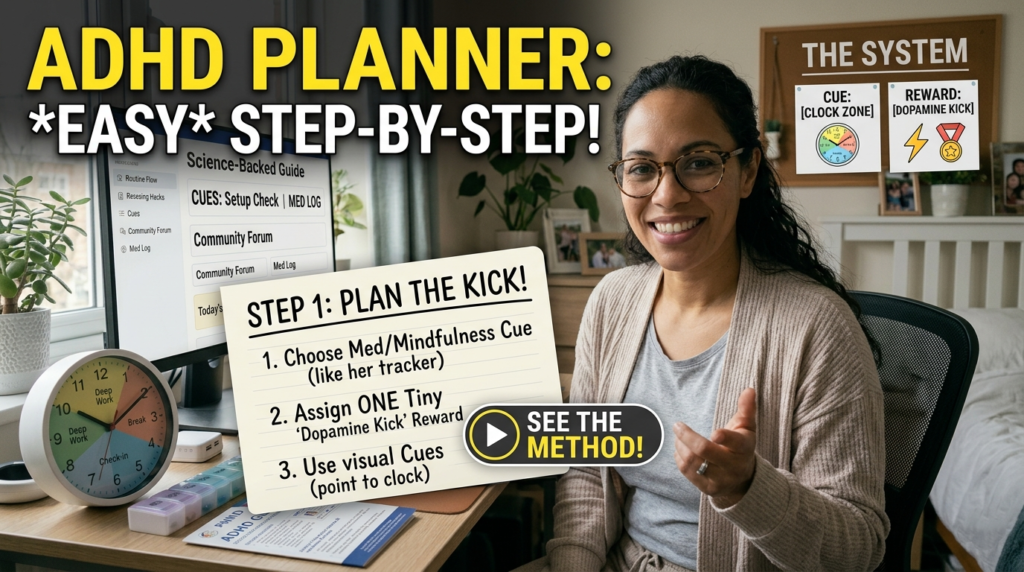
Most adults with ADHD own a small cemetery of half-used notebooks, expensive leather binders, and complex planning apps. We call it the “planner graveyard.”
You buy a new planner on a wave of high-dopamine optimism. For three days, you log every task, color-code your meetings, and feel completely in control. By day four, the novelty wears off, your dopamine baseline drops, you miss a day, and the resulting guilt causes you to hide the planner in a drawer, never to be opened again.
Standard planners are built for neurotypical brains that possess stable, self-regulating executive functions. If you have Attention-Deficit/Hyperactivity Disorder, your prefrontal cortex struggles with task prioritization, working memory, and time perception. When a planner demands that you follow a rigid, multi-step scheduling protocol, it triggers instant cognitive friction and task avoidance.
Learning how to use an adhd daily planner effectively is not about trying harder to fit into a neurotypical mold. It is about choosing a system designed for your cognitive style and using strategies that reduce decision fatigue, gamify task initiation, and accommodate your natural energy cycles.
Why This Matters: ADHD and the Executive Function Gap
To understand why traditional planning systems fail you, it is essential to look at the cognitive deficits associated with ADHD. The prefrontal cortex of an ADHD brain has difficulty executing several core functions:
- Working Memory Deficit: Standard planners assume you can hold your priorities in mind while managing details. An ADHD brain has a small “mental desktop,” meaning thoughts quickly slip away if they are not continuously visible. This is known as the “out of sight, out of mind” phenomenon.
- Task Initiation Paralysis: Standard planners present you with a long, flat list of tasks. When the brain cannot easily categorize or prioritize these items, it perceives them all as equally urgent, leading to severe cognitive overwhelm and freeze states.
- Time Blindness: The ADHD brain experiences time in two states: “Now” and “Not Now.” Because estimating the duration of tasks is highly inaccurate, adults with ADHD regularly overcommit and underplan buffer zones.
An effective daily planning strategy must act as an external prefrontal cortex. It must hold your tasks, prioritize them for you, make time visible, and lower the neurological barrier required to start working.
The Rules of ADHD Planning: How to Stop the Planner Graveyard
Before writing down a single task, you must establish three rules to protect your routine from collapsing:
Rule 1: Go Undated to Eliminate Guilt
Dated planners are guilt machines. When you inevitably miss three days or a week due to illness, hyperfocus, or burnout, the blank pages stare back at you as physical evidence of failure. Use an undated daily layout. If you miss a day, you simply turn to the next clean page and write the current date. No wasted pages, no guilt.
Rule 2: Keep it Physically Visible
A planner closed on your desk is a planner that does not exist. If you use a paper planner, keep it open next to your keyboard at all times. If you use a digital planner, keep it set as your browser’s default homepage or pin the window to your desktop. If you have to click or open something to see your tasks, you won’t do it.
Rule 3: Limit Daily Tasks to the “Rule of 3”
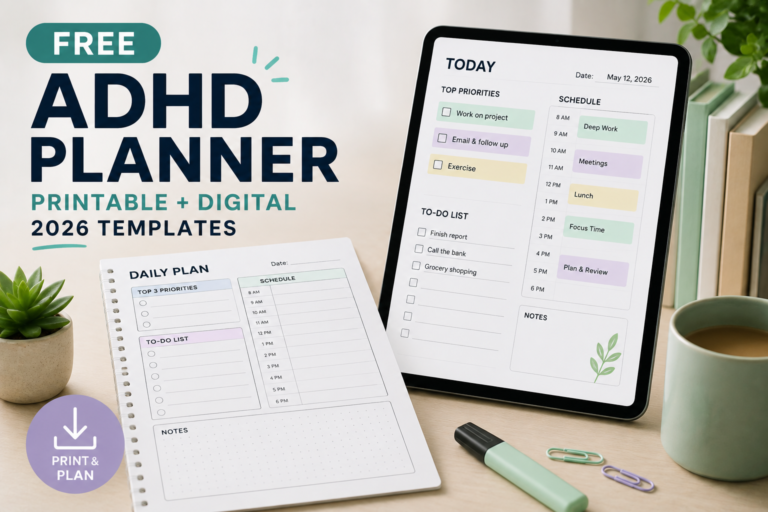
A list of 20 tasks triggers executive paralysis. Your daily planner should feature a maximum of **three high-impact priorities** for the day. Anything else is placed in a separate “brain dump” list to be tackled only if the primary three are completed.
Step-by-Step Action Plan: How to Use Your Planner Daily
Follow this 4-step sequence every morning to structure your day without triggering executive overwhelm.
Perform a Morning Brain Dump
Spend 5 minutes writing down every task, chore, email, and anxiety floating in your head onto a separate sheet of paper or scratchpad. Do not organize them yet. The goal is to clear your working memory desktop so you can think clearly.
Select Your “Rule of 3”
Review your brain dump. Choose exactly three tasks that must be done today to make the day a success. Write these in the main priority block of your daily planner. These are your non-negotiables.
Time-Block with Generous Buffers
Assign your top three tasks to specific time blocks on your schedule. If you think a task will take 30 minutes, block out 60 minutes. This creates a safety net for distractions, bathroom breaks, and transition delays.
Anchor the Plan to Your Workspace
Place your planner open where you can see it without moving. If you lose focus during the day, your eyes will naturally drift back to the planner, acting as a visual reset for your attention.
How to Integrate Your Support Tools
A daily planner holds the structure of your day, but you need supporting tools to assist with task execution and focus maintenance.
1. The ADHD Focus Timer
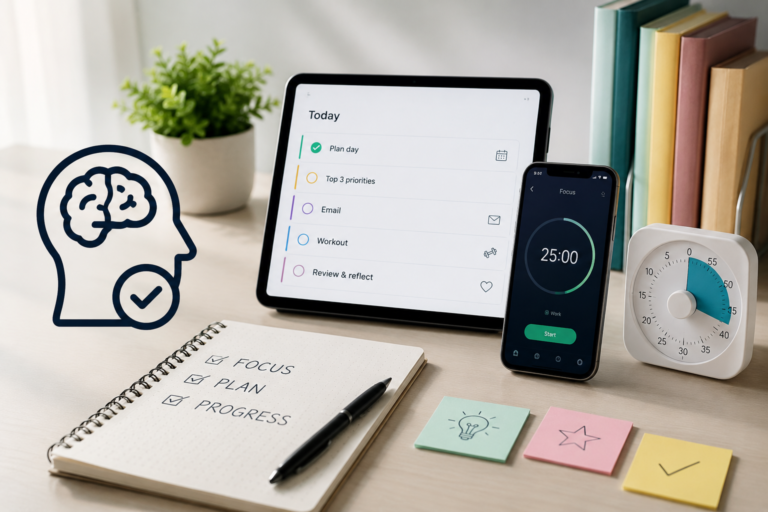
Once your planner dictates *what* to do, your focus timer dictates *how long* to do it. The ADHD brain struggles to initiate tasks because it perceives the work as endless. Setting a timer for a short block (like 20 or 25 minutes) makes the task feel bounded and manageable. Use the ADHD Focus Timer to run structured Pomodoro intervals with built-in sensory breaks.
2. The ADHD Task Breakdown Tool
If one of your “Rule of 3” priorities is something vague like “Write project proposal,” your brain will avoid it because the entry point is unclear. Before writing a large task in your planner, run it through the ADHD Task Breakdown Tool to split it into micro-steps (e.g., “1. Open Google Doc, 2. Write outline headings, 3. Draft paragraph 1”). Write only the first micro-step in your planner.
Try selecting your top priorities below to see how isolating tasks reduces visual noise:
-
Priority 1: Write down your single most critical task
-
Priority 2: Choose one supporting or administrative task
-
Priority 3: Choose one personal care or household item
-
Brain Dump: List all remaining items on a secondary page
Common Planner Mistakes to Avoid
If you have struggled with planners in the past, you were likely making one of these common mistakes:
1. The “Dopamine-Fueled” Over-Planning Session
On high-energy days, you might feel like a superhero. You write down a schedule packed with 12 consecutive hours of work, zero breaks, and intense chores. This is a trap. You are planning for your “best self” rather than your “average self.” Always plan for your lowest-energy days. If your routine works when you are tired, it will work anytime.
2. Overcomplicating the System
Using five different colored pens, three tracking indexes, and multiple apps creates massive cognitive overhead. The moment planning becomes a chore, your brain will abandon it. Keep your daily planning simple. Use one pen, one page, and one list.
3. Neglecting “Transition Cost”
Mornings, travel, getting dressed, and wrapping up tasks require cognitive transition times. If you schedule a meeting from 10:00 to 11:00 and another task starting at exactly 11:00, you will fall behind. Build a 10-minute transition block between tasks to allow your brain to reset. Track these transitions with the ADHD Time Management Planner.
Practical Examples: ADHD Planning in Action
Example A: The Academic Student
Leo is a university student who constantly missed assignment deadlines because he got overwhelmed by the syllabus load.
His Solution: Leo started using the ADHD Study Planner in combination with a paper desk sheet. Every Sunday, he dumps all homework tasks into the study planner. Each morning, he transfers only two study tasks to his physical desk planner and keeps it open next to his textbooks. Because his daily list is tiny, he no longer freezes when sitting down to study.
Example B: The WFH Professional
Maya is a software developer working remotely. She struggled with distractions at home and spent hours jumping between Slack, code reviews, and personal chores.
Her Solution: Maya established a “planning ritual” at 9:00 AM. She dumps all tasks onto a notepad, selects her “Rule of 3,” and schedules them. She uses the Executive Function Checklist to ensure she sets up her environment before starting (closing social media tabs, putting her phone on do-not-disturb, filling her water bottle). This setup routine protects her time-blocks from external distractions.
ADHD-Friendly Daily Planning Tips
- Celebrate Completed Tasks Immediately: When you finish a task, cross it off with a thick, satisfying marker. This physical action triggers a small release of dopamine, rewarding your brain and encouraging you to start the next task. Use the digital ADHD Habit Tracker to visualize your planning consistency.
- Plan for Distractions: Do not assume you will work in perfect focus. Assume you will get distracted. Build “catch-up blocks” (e.g., 3:00 PM to 4:00 PM) where you schedule absolutely nothing. Use this time to catch up on tasks that ran over.
- Align Tasks with Your Energy Levels: If your focus peaks in the morning, schedule your most complex “Rule of 3” task at 9:00 AM. Schedule routine, low-dopamine tasks (like responding to administrative emails or cleaning your desk) for your early afternoon slump.
- Use the “10-Minute Routine” to Close Your Day: At the end of the day, spend 10 minutes checking off completed items, moving unfinished tasks to tomorrow’s list, and clearing your desk. Closing your day prevents task anxiety from bleeding into your evening sleep blocks. Use the ADHD Routine Generator to construct this evening shutdown sequence.
Frequently Asked Questions
Conclusion
Using an adhd daily planner effectively is not about planning your life to perfection. It is about creating a compassionate framework that reduces decision fatigue, supports your memory deficits, and guides your focus when you get distracted.
Remember: a planner is a tool to help you navigate your day, not a standard by which to judge your worth. If you miss a week, forgive yourself, turn to a fresh page, and start small today.
Scientific References & Literature Cited:
- American Psychological Association (APA). (2021). Executive Dysfunction: Cognitive implications and practical interventions in ADHD populations.
- CHADD. (2022). Managing Time Blindness and Executive Function Challenges. Retrieved from chadd.org.
- National Institutes of Health (NIH). (2020). Neurocognitive processes in adults with Attention-Deficit/Hyperactivity Disorder. PubMed Central.
- Barkley, R. A. (2020). Executive Functions: What They Are, How They Work, and Why They Evolved. Guilford Press.
- Nigg, J. T. (2018). What Causes ADHD? Understanding the Science of Focus and Behavior. Guilford Press.

Dr. Aris Vance is a clinical psychologist specializing in behavioral intervention programs and neurodiversity. She conducts workshops on executive function strategies and writes evidence-based guides to help neurodivergent adults navigate daily routines with science-backed solutions.

[…] counter. Finish one tiny sequence completely before moving to the next. Protect your focus with the ADHD Daily Planner to isolate your top three […]