
ADHD Task Paralysis: The Complete Recovery System
You are sitting at your desk, looking at a screen or a stack of papers. You know exactly what you need to do. The deadline is approaching, the consequences of delay are clear, and you genuinely want to start. Yet, you cannot move. It feels as if your brain has put a physical clamp on your muscles, or as if you are trying to push a heavy stone wall. Instead of working, you find yourself staring blankly, checking your phone for the twentieth time, or reorganizing folders—trapped in a state of physical and mental immobility. You are not lazy. You are experiencing ADHD task paralysis.
This state of being adhd frozen and can’t start tasks is one of the most frustrating, shame-inducing, and misunderstood aspects of living with Attention Deficit Hyperactivity Disorder (ADHD). To those on the outside—and often to our own harsh inner critics—it looks like procrastination, poor time management, or a lack of discipline. But neurologically, it is none of these. It is a complex executive function breakdown that requires a targeted, neurodivergent-friendly recovery system to resolve.
This guide provides a comprehensive, science-based recovery system designed specifically for the ADHD brain. We will explore why task paralysis happens, how it affects your nervous system, and a step-by-step framework to melt the freeze response and regain control of your day.
The Science of ADHD Task Paralysis: Why Your Brain Freezes
To break free from ADHD task paralysis, you must first understand that it is a neurological event, not a moral failure. The neurotypical approach to productivity relies on a linear sequence: Recognize Task → Evaluate Importance → Decide to Act → Initiate Action. For an ADHD brain, this pathway is interrupted by three major neurological factors: executive dysfunction, dopamine regulation issues, and amygdala-driven emotional avoidance.
1. Executive Dysfunction and the Prefrontal Cortex
The prefrontal cortex (PFC) is the brain’s command center. It is responsible for executive functions, including organizing, prioritizing, estimating time, and—most importantly—task initiation. In individuals with ADHD, the networks connecting the PFC to other brain regions show altered functional connectivity and delayed development. When faced with a multi-step task, a neurotypical brain automatically filters the steps and highlights the starting point. An ADHD brain struggles to prioritize; every single sub-task presents itself with the same level of urgency and weight. This creates cognitive overload, leading to paralysis.
2. Dopamine Regulation and Anticipatory Reward
Dopamine is the neurotransmitter responsible for motivation, focus, and reward anticipation. The ADHD brain has a baseline deficit in dopamine transporters and receptors. While a neurotypical brain experiences a small spike in dopamine simply by anticipating the completion or progress of a task, an ADHD brain does not. Without this chemical engine, initiating a task that does not offer immediate, highly stimulating feedback feels physically exhausting. The brain perceives the low-dopamine task as a low-priority survival event, refusing to allocate the necessary cognitive resources to begin.
3. Amygdala Hijack: The Emotional Dimension
When you feel overwhelmed by a task, your amygdala—the emotional radar of the brain—perceives that overwhelm as a threat. It registers the anticipated failure, confusion, or boredom of the task as a danger to your well-being. The amygdala triggers a survival threat response: fight, flight, or freeze. In the context of ADHD, this manifests as a cognitive “freeze.” Your body goes into a defensive state, shutting down action pathways to protect you from the discomfort of the task. This is why task paralysis is often accompanied by physical symptoms like muscle tightness, shallow breathing, and rapid heart rate.
Symptoms and Cognitive Patterns of ADHD Freeze
ADHD task paralysis is rarely silent. It is accompanied by specific cognitive, emotional, and physical patterns. Recognizing these symptoms is the first step toward intervention.
| Symptom Category | Common Manifestations | What it Feels Like |
|---|---|---|
| Cognitive | Analysis paralysis, choice overload, brain fog, loops of repetitive thinking. | “I have five things to do, but I cannot figure out which one is the absolute best to start with.” |
| Emotional | Intense shame, guilt, dread, anxiety, feelings of worthlessness, emotional exhaustion. | “Why am I like this? Everyone else can do this easily. I am failing my team/family.” |
| Physical | Physical immobility, staring, doom-scrolling, muscle tension, fatigue despite inactivity. | Feeling literally glued to a chair or bed, unable to stand up and walk to the workstation. |
| Behavioral | Productive procrastination (doing unrelated chores instead of the target task), avoidance. | Cleaning the baseboards or organizing the spice rack while a major tax document sits blank. |
When you are stuck in these patterns, you are dealing with a severe drain on your executive function resources. The longer you sit in the freeze state, the more exhausted your nervous system becomes, making eventual initiation even harder.
Common Triggers: What Freezes the ADHD Brain?
Not all tasks are created equal. An ADHD brain is highly selective, and certain characteristics make a task far more likely to trigger a freeze response. Identifying these triggers allows you to proactively modify the task before you try to start it.
- Vague or Undefined Goals: A task like “Work on project” or “Clean the garage” has no defined starting point. Because the brain cannot visualize the first physical action, it defaults to avoidance.
- High-Stakes Performance Anxiety: Tasks linked to critical outcomes (a final exam, a performance review, a difficult conversation) trigger perfectionism. The fear of doing it poorly leads to doing nothing at all.
- Multi-Step Complexity: Tasks that require gathering materials, making phone calls, and organizing data overwhelm the brain’s working memory. Without a clear path, the system crashes.
- Low-Stimulation Tasks: Repetitive, administrative, or highly structured tasks (expense reports, sorting mail, folding laundry) offer zero dopamine. The brain registers them as painfully under-stimulating.
- Unclear Instructions: If you do not know how to perform a step, the ambiguity creates a cognitive wall that feels impossible to climb.
The Anatomy of the ADHD Overwhelm Cycle
To illustrate how task paralysis operates, consider the typical loop that keeps neurodivergent individuals stuck for hours, days, or even weeks:
- The Trigger Task: A complex, low-stimulation, or high-stakes task is presented.
- Executive Apprehension: The brain recognizes the executive effort required and fails to locate an easy starting point.
- Emotional Threat Detection: The amygdala identifies the anxiety of the task and signals danger.
- The Freeze Response: Physical and cognitive immobility sets in. The individual begins doom-scrolling or staring.
- The Shame Spiral: Internal dialogue shifts to self-criticism (“Why can’t I just do this?”). This increases baseline stress.
- Sensory & Cognitive Exhaustion: The brain spends valuable energy fighting the freeze, leaving even less dopamine for the task.
Breaking this cycle requires intercepting it at the physiological and cognitive levels rather than trying to power through with sheer willpower.
Real-Life Examples of ADHD Task Paralysis
Let’s look at how this manifests in three distinct environments: professional, domestic, and academic. Recognizing these scenarios helps normalize the experience and points toward targeted solutions.
Scenario A: The Workplace — The Unopened Email Chain
Sarah is a marketing coordinator. She has a thread of 15 unread emails regarding a campaign launch. She knows she needs to reply to her manager, but the complexity of the thread, the conflicting requests, and the fear of missing an detail has frozen her. She sits at her computer, opening the email tab, feeling a wave of panic, closing the tab, and opening a social media feed. She spends four hours at her desk doing nothing productive, leaving the office physically exhausted and filled with dread about the next morning.
Scenario B: The Home — The Laundry Mountain
David needs to fold a massive basket of clean laundry sitting in the corner of his bedroom. The task has been there for four days. Every time David looks at the basket, his brain registers: Sort lights and darks → Fold shirts → Match socks → Hang jackets → Put away in drawers. The sheer number of movements and decisions triggers a freeze. He walks past the basket, feeling a spike of guilt, and decides to watch television instead—but he cannot enjoy the show because the laundry is constantly in his peripheral vision.
Scenario C: Academic — The Major Term Paper
Alex is a university student who has a 3,000-word term paper due in three days. He has done some research, but he has not written a single sentence. When he opens a blank document, the cursor flashes, representing infinite choices and potential failures. He doesn’t know what his thesis statement should be, or how to structure his introduction. He spends hours researching more articles, claiming he is “preparing,” but he is actually frozen in analysis paralysis, terrified of writing a bad first draft.
The Complete Recovery Framework: A Step-by-Step System
To recover from task paralysis, you need to transition your nervous system from a state of threat (freeze) to a state of safety and play (action). This framework consists of four sequential phases: Regulate, Deconstruct, Initiate, and Sustain.
Phase 1: Regulate (Calming the Nervous System)
Before you touch the task, you must lower the physiological stress response. You need to prove to your amygdala that the task is not a threat to your physical survival.
- The Temperature Shift: Splash cold water on your face or hold an ice cube in your hand. This stimulates the vagus nerve, triggers the mammalian dive reflex, and slows your heart rate, breaking the physical freeze loop.
- Somatic Reset: Change your physical posture. If you are sitting frozen at your desk, stand up, stretch, or do ten jumping jacks. Physically moving to a different room breaks the environmental lock.
- Nervous System Breathing: Perform box breathing (inhale for 4 seconds, hold for 4, exhale for 4, hold for 4) to shift your body from the sympathetic (fight-or-flight) nervous system to the parasympathetic (rest-and-digest) system.
- Release the Shame: Say to yourself: “My brain is currently overloaded, which is why I am stuck. This is a neurochemical reaction, not a character flaw. I can take a small step when I am ready.”
Phase 2: Deconstruct (The Micro-Stepping Method)
Once your body is relatively calm, the next hurdle is cognitive overload. You must turn the vague, overwhelming task into hyper-specific, physical actions. This is where adhd task initiation strategies come into play.
Instead of writing “Work on taxes,” write down steps so small they feel almost ridiculous. A micro-step is an action that requires no cognitive effort to figure out. For example:
- Open the laptop.
- Open one browser tab.
- Log into the tax portal.
- Locate the W-2 document folder on the desktop.
If you struggle to break down your tasks manually, utilize the digital ADHD Task Breakdown Tool to instantly split any large, overwhelming objective into small, bite-sized checklists.
Phase 3: Initiate (Building Micro-Momentum)
Initiation is the hardest part of the process. The goal here is not to finish the task; it is simply to start moving. We use low-friction momentum techniques to bypass the brain’s resistance.
- The 5-Minute Rule: Commit to working on the task for exactly five minutes. Set a timer. Tell yourself that if you want to stop after five minutes, you have full permission to do so. The secret is that once the transition friction is broken, the brain’s interest system often kicks in, making it easier to continue.
- High-Dopamine Pairing: Pair the boring task with a highly stimulating sensory input. Listen to an energetic playlist, put on brown noise, work in a favorite coffee shop, or drink a flavored beverage while working. This elevates baseline dopamine, reducing initiation friction.
- The “Worst-First” vs. “Easiest-First” Choice: If you have high energy, do the most dreaded micro-step first to get it out of the way. If your energy is low, do the easiest, most rewarding micro-step first to build momentum.
- Write a “Zero Draft”: If you are stuck writing or planning, give yourself permission to write poorly. Tell yourself you are writing garbage that no one else will ever see. Lowering the quality bar bypasses perfectionism.
Phase 4: Sustain (Maintaining the Flow)
Once you have initiated, you need external scaffolds to keep your focus from wandering. ADHD brains struggle to maintain internal structure, so external structures are essential.
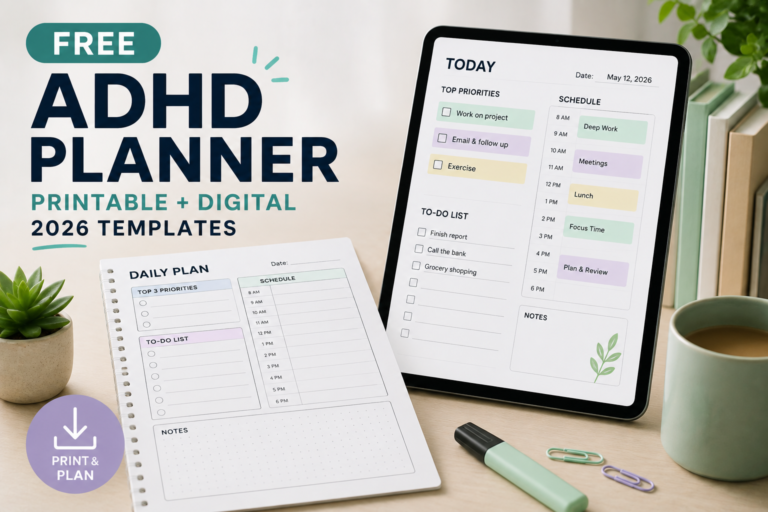
- Use Visual Tracking: Keep your checklist visible on your desk. The physical act of crossing off a micro-task provides a small hit of dopamine that fuels the next step. You can structure your daily schedule visually using the ADHD Daily Planner.
- Body Doubling: Work in the presence of someone else. This could be a friend sitting quietly in the room, a coworker on a Zoom call, or a virtual body-doubling platform. The external presence acts as a social anchor, keeping your brain grounded in the task.
- Time-Locked Focus Blocks: Use a visible countdown timer (like a Pomodoro timer) to define your work windows. A physical timer creates a mild sense of urgency and makes the passage of time visual. If you are studying or working, the ADHD Study Planner is a great method for balancing intense focus intervals with structured breaks.
The Actionable ADHD Overwhelm Checklist
When you are in a state of paralysis, reading a long article is difficult. Keep this simplified, step-by-step adhd overwhelm checklist handy for when you feel frozen. Follow the steps in order:
For a physical version you can write on, download our printable adhd task paralysis checklist template in the resources section below.
5 Critical Mistakes to Avoid
When trying to resolve task paralysis, many well-meaning strategies backfire because they are designed for neurotypical brains. Avoid these five common pitfalls:
- Relying on Willpower and Pressure: Telling yourself to “just sit down and do it” or waiting for a massive burst of pressure only increases anxiety. This makes the amygdala freeze response stronger.
- Trying to Complete the Entire Task at Once: Looking at the end goal (e.g., “Write the report”) rather than the next step triggers choice overload. Focus exclusively on the immediate transition.
- Ignoring Emotional and Sensory Blockers: If you are hungry, thirsty, cold, or sitting in a noisy room, your executive function is already compromised. Address your physical comfort first.
- Beating Yourself Up for Being Stuck: Shame is a paralytic agent. Self-criticism raises your cortisol levels, draining the dopamine you need to initiate. Practice self-compassion to lower threat levels.
- Working Without a Written Plan: Trying to hold the steps of a task in your head while trying to execute them causes cognitive fatigue. Externalize everything on paper or a digital screen before you begin.
Printable ADHD-Friendly Resources
To help you externalize your daily planning, use these structured layouts. You can copy these formats onto a blank piece of paper or download the official printables from the ADHDGuider library.
Resource 1: The Daily Dopamine Pacer
Use this structure to organize your day around energy and rewards, rather than fixed hourly slots that fail when execution drops.
| Focus Area (High Energy) | Admin Task (Low Energy) | Dopamine Reward | Completed? |
|---|---|---|---|
| Write report draft (45m) | Organize email inbox (15m) | Walk to get coffee (15m) | [ ] |
| Prepare presentation slides (45m) | Submit expense receipts (15m) | Listen to favorite podcast episode (20m) | [ ] |
Resource 2: The Micro-Step Deconstructor
Use this template when you feel frozen on a specific task. Write the main task in the center, and break it down into five tiny, sequential steps.
Main Task: __________________________________________________
1. Step 1 (Physical Start – Under 1 Minute): ________________________
2. Step 2 (Next Action): _________________________________________
3. Step 3 (Next Action): _________________________________________
4. Step 4 (Next Action): _________________________________________
5. Step 5 (Milestone): ___________________________________________
Expert Recommendations and Clinical Pathways
While behavioral strategies are powerful, severe and chronic task paralysis often requires professional guidance. Here are the clinical pathways and coaching resources available in different regions:
- ADHD Coaching: Unlike traditional therapy, an ADHD coach specializes in executive function training, helping you build systems for task initiation, time management, and emotional regulation. Look for credentials from organizations like the Professional Association of ADHD Coaches (PAAC) or the International Coaching Federation (ICF).
- Cognitive Behavioral Therapy (CBT): Specifically, CBT adapted for ADHD focuses on identifying and reframing the cognitive distortions (like perfectionism and shame) that fuel emotional task avoidance.
- Medical Management: For many individuals, ADHD medication (stimulant or non-stimulant) is a key component of recovery. By adjusting dopamine and norepinephrine levels in the prefrontal cortex, medication lowers the internal friction required to start a task. Consult a psychiatrist or medical doctor to discuss options.
- Regional Resources:
- United States: Visit CHADD (Children and Adults with Attention-Deficit/Hyperactivity Disorder) for support groups, directory listings, and educational materials.
- United Kingdom: Consult the NHS ADHD services directory or reach out to The ADHD Foundation for guidance on assessment, coaching, and workplace adjustments (Access to Work scheme).
- Canada: Connect with CADDAC (Centre for ADHD Awareness Canada) for advocacy, parent programs, and adult support resources.
- Australia: Contact the ADHD Australia network or search the Australian ADHD Professionals Association (AADPA) directory for local clinical experts.
Frequently Asked Questions
Is ADHD task paralysis a real medical condition?
Yes, ADHD task paralysis is a recognized manifestation of executive dysfunction, which is a core feature of Attention Deficit Hyperactivity Disorder. It is documented in neuropsychological literature as a breakdown in task initiation, goal-directed behavior, and emotional self-regulation, driven by dopamine pathways and atypical prefrontal cortex activity.
How do I break ADHD task paralysis immediately?
To break the freeze response immediately, focus on physical and sensory shifts rather than cognitive planning. Splashing cold water on your face, changing rooms, holding ice, or setting a 5-minute timer to perform a single physical action (like opening a document) are the fastest ways to reset your nervous system and start moving.
What is the difference between ADHD task paralysis and laziness?
Laziness is a conscious decision to avoid effort because you do not care about the outcome. ADHD task paralysis is a state of cognitive and emotional overload where you care deeply about the outcome, want to start, and feel intense stress, anxiety, or guilt because you are physically and mentally unable to initiate action.
How long does ADHD paralysis last?
ADHD paralysis can last anywhere from a few minutes to several days or weeks, depending on the severity of the trigger task, your stress levels, and the lack of external support. Without intervention, it often persists until an external deadline creates enough urgent panic to bypass the dopamine deficit.
Can medication help with ADHD task initiation?
Yes, ADHD medications (especially stimulants) increase the availability of dopamine and norepinephrine in the prefrontal cortex. This directly addresses the chemical deficit that makes task initiation difficult, making it easier to bridge the gap between intending to do a task and physically starting it.
Conclusion: Moving Forward with Compassion
Overcoming ADHD task paralysis is not about trying harder. It is about understanding your unique neurobiology and working with your brain, not against it. By applying somatic regulation to calm your nervous system, breaking tasks down into tiny micro-steps, and using external scaffolds like body doubling and visual planning, you can break the freeze and regain your agency.
Be patient with yourself as you practice these strategies. Recovery is not a linear process, and some days will require more regulation than execution. Treat yourself with compassion, celebrate every micro-start, and rely on external systems to support your executive functions.

[…] frozen and hard to start no matter what you plan, that’s a slightly different problem — see ADHD task paralysis: how to start when you’re frozen for a more targeted […]
[…] ADHD Task Paralysis: How to Start When You’re Frozen […]
[…] Anytime you feel frozen and can’t figure out where to start — this is a fast way through ADHD task paralysis. […]