ADHD Weekly Reset Routine: How to Start Every Week Without Overwhelm
It is Sunday evening. You are sitting on the couch with a vague, uncomfortable knot in your stomach. Tomorrow is Monday, and you know the week ahead is full of deadlines, appointments, and responsibilities—but you cannot quite remember what they are. Your inbox has 47 unread messages. Your desk is buried under a week’s worth of unopened mail, half-finished notes, and three coffee mugs. Your phone’s calendar shows two events, but you are certain there are more floating somewhere in your memory, in a text thread, or scribbled on a sticky note that you cannot find.
You tell yourself you will sort it all out in the morning. But Monday morning arrives with its own chaos—an alarm you snooze three times, a missing shirt, a forgotten lunch—and by 10 a.m. you are already behind. By Wednesday, the week feels like a landslide. By Friday, you are exhausted, ashamed, and promising yourself that next week will be different.
If you have Attention Deficit Hyperactivity Disorder (ADHD), this is not a character flaw. It is the predictable result of launching a new week without resetting your external systems. Your brain does not automatically archive last week, organize this week, or preview next week. Without a deliberate ADHD weekly reset, every Monday begins with the accumulated cognitive debris of every week before it.
This guide provides a complete, expert-level framework for building a neurodivergent-friendly sunday reset adhd routine—a structured process that clears mental clutter, rebuilds your external scaffolding, and gives your brain the clean launchpad it needs to start every week with clarity instead of chaos. You will also find an actionable adhd weekly checklist, printable templates, and a step-by-step system for adhd weekly planning that prevents overwhelm before it begins.
Why ADHD Brains Need a Weekly Reset: The Neuroscience
A weekly reset is not a luxury or a productivity trend. For the ADHD brain, it is a neurological necessity. Understanding why requires examining three core cognitive systems that operate differently in ADHD.
1. Working Memory Overflow
Working memory is the brain’s temporary holding space—the mental whiteboard where you keep track of what you need to do right now. Research consistently shows that ADHD significantly reduces working memory capacity. Where a neurotypical brain might hold five to seven active items, an ADHD brain often manages three to four before information starts falling off the edges.
Without a weekly reset, uncompleted tasks, unprocessed messages, and unresolved decisions from the previous week remain lodged in working memory. They do not disappear; they consume cognitive bandwidth in the background, like browser tabs draining your computer’s RAM. By Monday morning, your working memory is already at capacity before a single new task arrives. This is why you feel overwhelmed the moment you wake up, even before anything has gone wrong.
2. Temporal Context Collapse
ADHD disrupts the brain’s ability to mentally organize events along a timeline. Psychologists call this “temporal myopia”—a nearsightedness about time. Last week, this week, and next week tend to blur together into an undifferentiated mass of obligations. Without external temporal anchors, you lose the ability to distinguish between what is urgent today, what is due Thursday, and what happened last Tuesday.
A weekly reset creates an artificial but critical temporal boundary. It draws a line between “last week” and “this week,” giving your brain the structural marker it cannot generate internally. This boundary is what allows you to stop carrying last week’s unfinished business into this week’s fresh start.
3. Decision Fatigue Accumulation
Every unmade decision consumes executive energy. The ADHD brain, which already operates with reduced executive resources, is especially vulnerable to decision fatigue. Over the course of a week, dozens of small decisions pile up: emails that need responses, errands that need scheduling, bills that need paying, social commitments that need confirming. Each one sits in an “open loop,” silently demanding attention.
A weekly reset is a scheduled decision-processing session. It forces you to close open loops—respond or archive, schedule or defer, commit or decline—so that your executive system starts Monday with a cleared queue rather than a backlog.
Symptoms of a Missing Weekly Reset
When you skip the weekly reset—or have never had one—the cognitive debris accumulates in predictable ways. Recognizing these patterns is the first step toward building a system that prevents them.
| Symptom | What Is Happening Cognitively | How It Feels in Daily Life |
|---|---|---|
| Monday Morning Paralysis | Working memory is overloaded with carryover tasks before new ones arrive. | Sitting at your desk for 45 minutes “trying to figure out where to start.” |
| Phantom Obligations | Unprocessed commitments float in memory, creating anxiety without clarity. | A constant feeling that you are forgetting something important, but you cannot identify what. |
| Environment Entropy | Physical and digital spaces accumulate clutter that acts as visual noise, overloading sensory processing. | A desk covered in papers, an inbox with 200 unread messages, a phone with 14 unread notifications. |
| Week Bleed | Without temporal boundaries, obligations from different weeks merge into one undifferentiated mass. | Unable to remember whether a deadline is this week or next, leading to either panic or neglect. |
| Emotional Carryover | Unprocessed frustrations, disappointments, and shame from the previous week persist unchecked. | Starting Monday already feeling defeated because last week “was a disaster.” |
Real-Life Examples: With and Without a Weekly Reset
Scenario A: A Week Without a Reset
James has ADHD and works as a freelance graphic designer. On Sunday evening, he watches television and tells himself he will “figure out the week” on Monday morning. Monday arrives: he cannot find the client brief he downloaded last Wednesday. He spends 30 minutes searching his downloads folder. He discovers two emails from Friday that he forgot to respond to—both from important clients. He spends the next hour on damage control. By noon, he has not started any actual design work. He feels behind, stressed, and ashamed. The pattern repeats every week.
Scenario B: A Week With a Reset
James starts doing a 45-minute Sunday reset. During the reset, he processes his inbox (responding, archiving, or starring every message), reviews his calendar for the week, identifies his three priority projects, clears his desk of last week’s papers, and charges his devices. On Monday morning, he sits down to a clean desk, an empty inbox, and a clear list of three priorities. He starts working on his first design within 15 minutes. He is not more disciplined than before—he simply has a system that does the organizational work his brain cannot do automatically.
Scenario C: The Partner Perspective
Aisha and her partner have been arguing every Sunday about the upcoming week—who is taking the kids to school, who is covering the evening shift, whether they are attending Saturday’s event. The arguments are not about the logistics themselves; they are about the fact that logistics are never discussed until they become emergencies. Aisha starts doing a 20-minute Sunday reset with a shared family calendar review. She and her partner now spend 10 minutes on Sunday afternoon aligning the week’s logistics. The arguments decrease dramatically—not because they agree on everything, but because decisions are made proactively rather than reactively.
The ADHD Weekly Reset Framework: A Step-by-Step System
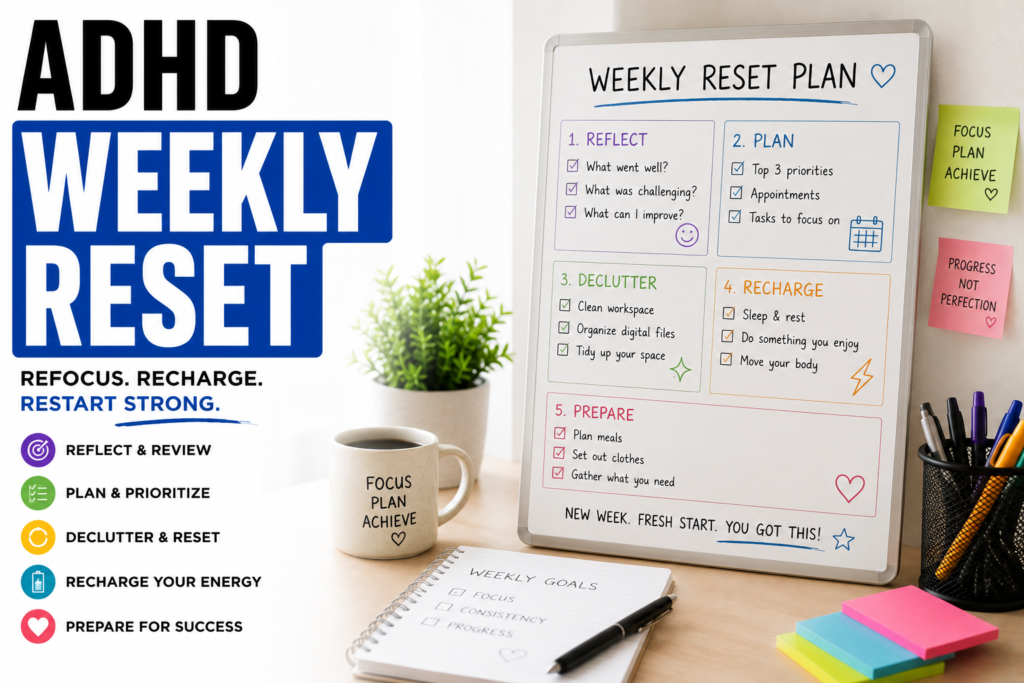
This framework is designed for the ADHD brain. It is structured, time-boxed, and forgiving. The entire reset should take 30 to 60 minutes. Do not aim for perfection—aim for “good enough to start Monday clearly.”
Step 1: Close the Previous Week (10 Minutes)
Before you can plan ahead, you must formally close what came before. This step prevents carryover clutter from contaminating the new week.
- Process Your Inbox: Open your email. For every message, take one of four actions: Reply (if it takes under 2 minutes), Archive (if no action needed), Star/Flag (if it requires action this week), or Delete. The goal is inbox zero—or as close as possible.
- Review Last Week’s Task List: Look at whatever task list you used last week. For each item: mark it complete, migrate it forward to this week, or deliberately delete it. Do not leave tasks in limbo.
- Capture Loose Threads: Scan your phone notes, sticky notes, text messages, and browser tabs for anything that represents an uncommitted task or idea. Write each one onto a single capture list.
Step 2: Reset Your Physical Environment (10 Minutes)
Your external environment directly impacts your internal cognitive state. Visual clutter creates sensory noise that drains attention and increases anxiety.
- Clear Your Desk: Remove everything from your primary workspace. Put items where they belong. If you do not know where something belongs, put it in a “decision box” to sort later—but get it off the desk.
- Reset Your Digital Desktop: Close all browser tabs. File or delete desktop files. Clear your phone’s notification badges.
- Prepare Physical Tools: Charge your laptop and phone. Refill your water bottle. Lay out tomorrow’s clothes. Set your bag by the door. These micro-preparations eliminate Monday-morning friction.
Step 3: Preview the Week Ahead (10 Minutes)
Now—and only now—look forward. The previous two steps cleared the cognitive runway; this step builds the flight plan.
- Calendar Scan: Review every day of the upcoming week. Note meetings, appointments, deadlines, and social commitments. Identify days that are unusually full (high-demand days) and days that have space (buffer days).
- Identify 3 Weekly Priorities: From your capture list and calendar, choose a maximum of three priority outcomes for the week. These are the things that, if completed, would make the week feel successful. Write them on a card and post it where you will see it daily.
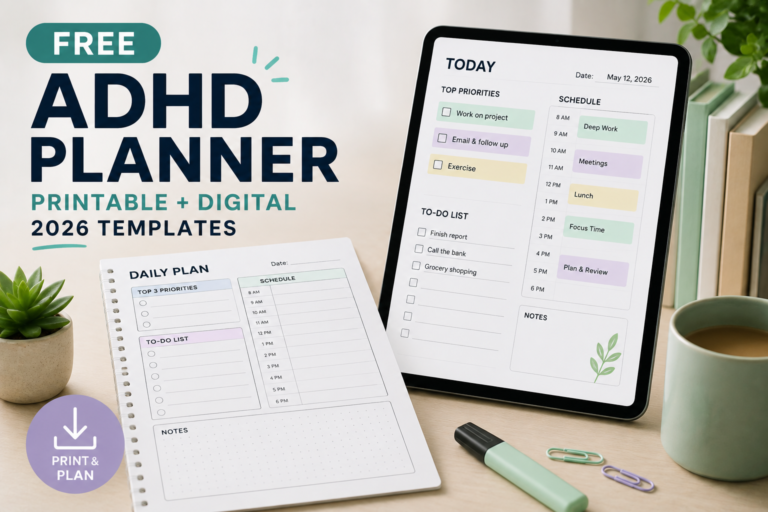
- Time-Block Priority Work: For each priority, schedule a specific time block on a specific day. Do not leave priorities floating as “I’ll get to it.” Assign them a place in time. Use a visual planner built for ADHD brains—the ADHD Daily Planner provides structured daily layouts that prevent time blindness.
Step 4: Emotional Reset (5–10 Minutes)
This step is frequently overlooked but critically important for the ADHD brain, which often carries disproportionate shame and frustration from the previous week.
- The “What Went Well” Review: Write down three things that went well last week—no matter how small. “I responded to that difficult email” counts. “I remembered to eat lunch on Wednesday” counts. This counteracts the ADHD brain’s negativity bias, which disproportionately remembers failures.
- The Compassion Check: Ask yourself: “If my best friend had the exact same week I just had, what would I say to them?” Write that statement down. Read it to yourself. This exercise uses perspective-taking to bypass the harsh self-critic that ADHD often amplifies.
- Set a Weekly Intention: Choose one word or phrase that captures how you want to approach the week. Examples: “Steady,” “One thing at a time,” “Good enough is good enough.” Write it on your priority card alongside your three weekly priorities.
The Actionable ADHD Weekly Reset Checklist
Print this checklist or copy it onto a card. Use it every week as a step-by-step guide. The entire process should take 30 to 60 minutes.
🔄 Sunday Reset Checklist
When and Where to Do Your Reset
The timing and setting of your weekly reset matter more than you might expect. The ADHD brain is highly sensitive to environmental cues, and anchoring your reset to a specific time and place increases the likelihood of it becoming a sustainable routine.
Best Timing
- Sunday Afternoon (2–4 PM): This is the most popular reset window. You are rested from the weekend but close enough to Monday to feel the relevance of planning. Avoid Sunday evening—if you are tired, the reset becomes another dreaded chore.
- Saturday Morning: If Sundays are family days or if anticipating Monday triggers anxiety, do your reset on Saturday morning while your executive function is fresh. The key is choosing a time that works for your life, not mimicking someone else’s routine.
- Friday Afternoon (Work Reset): Some people prefer closing the work week on Friday afternoon with a 15-minute professional reset, followed by a personal reset on Sunday. This splits the cognitive load across two sessions.
Best Environment
- A Consistent Location: Do your reset in the same place each week—a specific chair, a coffee shop, or your desk. Environmental consistency creates a contextual cue that primes your brain for the reset routine.
- Minimal Distractions: Put your phone on Do Not Disturb. Close social media. If you live with others, communicate that you need 30 to 60 minutes of uninterrupted time.
- A Sensory Anchor: Pair your reset with a specific sensory experience—a particular playlist, a cup of tea, a scented candle. Over time, the sensory anchor becomes a cue that tells your brain: “It is reset time.” Generate custom routine sequences to match your energy patterns using the ADHD Routine Generator.
5 Critical Mistakes to Avoid
- Turning the Reset Into a Full Planning Session: The reset is about clearing and closing, not about building elaborate weekly plans with color-coded schedules. If your reset takes more than 60 minutes, you are overcomplicating it. Keep it to 30–45 minutes.
- Choosing More Than 3 Weekly Priorities: Your brain cannot hold more than three priority threads without losing track. If you list seven priorities, you effectively have zero—because working memory cannot juggle them and you will default to whatever feels most urgent in the moment.
- Skipping the Emotional Reset: If you only process logistics and skip the “What Went Well” review, you carry shame and frustration from the previous week into the new one. The emotional reset is not optional—it is what prevents burnout from compounding week over week.
- Waiting Until Monday Morning: If you try to do your reset on Monday morning, you are already competing with the demands of the new week. Emails arrive, meetings start, and your reset gets pushed to “later”—which means never. Do the reset before Monday begins.
- Demanding Perfection: A reset does not need to be complete to be valuable. If you process half your inbox and identify two priorities instead of three, you are still in a dramatically better position than someone who did no reset at all. Done is better than perfect.
Printable Weekly Reset Resources
Resource 1: The Weekly Close-Out Template
Use this template every Sunday to formally close the previous week before planning the next one.
🗂️ Weekly Close-Out Template
Week Ending: _____ / _____ / _____
Tasks Completed This Week:
1. ___________________________________________________
2. ___________________________________________________
3. ___________________________________________________
Tasks to Migrate Forward:
1. ___________________________________________________
2. ___________________________________________________
Tasks to Delete (No Longer Relevant):
1. ___________________________________________________
Loose Threads Captured:
1. ___________________________________________________
2. ___________________________________________________
What Went Well:
1. ___________________________________________________
2. ___________________________________________________
3. ___________________________________________________
Resource 2: The Weekly Launchpad Card
Fill out this card after your close-out. Post it on your fridge, desk, or bathroom mirror for the entire week.
| 📋 Weekly Launchpad — Week of _____ / _____ / _____ | |
|---|---|
| Weekly Intention | _________________________________________ |
| Priority #1 | _________________________________________ → Scheduled: ______ (day/time) |
| Priority #2 | _________________________________________ → Scheduled: ______ (day/time) |
| Priority #3 | _________________________________________ → Scheduled: ______ (day/time) |
| High-Demand Days | _________________________________________ |
| Buffer Days | _________________________________________ |
Scaling the Reset for Different Life Stages
Your reset routine should fit your actual life, not an idealized version of it. Here is how to adapt the framework for different situations:
For Students
Add a 5-minute “assignment scan” to Step 3. Review your syllabi or learning management system (Canvas, Blackboard) and note every deadline for the coming week. Students with ADHD frequently discover assignments the night before they are due. A weekly scan eliminates surprise deadlines.
For Working Professionals
Split your reset into two parts: a 15-minute Friday afternoon “work close-out” (process work email, file documents, update project trackers) and a 20-minute Sunday “personal reset” (calendar, home tasks, self-care). This prevents your Sunday reset from being dominated by work stress.
For Parents with ADHD
Include a 5-minute “family logistics” scan: review the kids’ school calendars, extracurricular schedules, and meal plans. If you share parenting responsibilities, do this scan together with your partner for 10 minutes. The ADHD Daily Planner includes family-friendly layouts that accommodate shared scheduling needs.
For People in Crisis or Burnout
If even a 30-minute reset feels impossible, reduce it to a 5-minute “survival reset”: (1) What is the single most important thing I must do tomorrow? (2) Is my phone charged? (3) Do I have clean clothes? That is it. A 5-minute reset is infinitely better than no reset. You can expand the routine when your capacity returns.
Expert Recommendations and Clinical Pathways
If disorganized weeks are consistently impacting your work performance, relationships, or mental health, professional support can help you build and sustain reset routines:
- ADHD Coaching: Certified ADHD coaches specialize in helping you design weekly systems, troubleshoot where routines break down, and build accountability structures. Look for coaches certified by ACO, PAAC, or ICF with specific ADHD specialization.
- Cognitive Behavioral Therapy (CBT): CBT for ADHD helps address the perfectionism and shame patterns that sabotage organizational systems. It builds the cognitive flexibility needed to recover from imperfect weeks without spiraling.
- Professional Organizers: ADHD-specialized professional organizers can help you design physical environments that support your reset routine—from desk layouts to filing systems to visual cue placement.
- Regional Resources:
- United States: CHADD provides support groups, professional directories, and educational resources for adults with ADHD.
- United Kingdom: The ADHD Foundation offers coaching referrals and organizational workshops through the NHS pathway.
- Canada: CADDAC provides webinars, coaching directories, and adult ADHD support groups across provinces.
- Australia: ADHD Australia connects individuals with specialists, peer support networks, and workplace accommodation resources.
Frequently Asked Questions
What is an ADHD weekly reset?
An ADHD weekly reset is a structured 30-to-60-minute routine, typically done on Sunday, where you close the previous week by processing your inbox, clearing your physical and digital spaces, reviewing your calendar, selecting three weekly priorities, and performing an emotional check-in. It prevents cognitive carryover and gives your brain a clean start for Monday.
How long should a weekly reset take?
Aim for 30 to 60 minutes. If it consistently takes longer than an hour, you are overcomplicating it. For people in crisis or burnout, a 5-minute survival reset (one priority, phone charged, clothes ready) is a valid starting point.
What if I skip my weekly reset?
If you miss your Sunday reset, do a shortened version on Monday morning before starting work. Even a 10-minute version—process five emails, identify one priority, clear your desk—provides significant benefit. The goal is not a perfect streak; it is reducing the number of weeks you start without any reset at all.
Should I do my reset on Sunday or another day?
Sunday afternoon is the most common and effective timing, but it is not mandatory. Choose the time that fits your life—Saturday morning, Friday afternoon, or even Monday before dawn. The important factor is consistency: doing it on the same day each week turns it into an anchored routine rather than a floating intention.
Can I do a weekly reset with my partner or family?
Yes, and many people find it helpful. A 10-minute shared logistics review (who is driving, what is due, what events are happening) prevents the reactive arguments that come from uncoordinated weeks. Each person can then do their individual reset separately.
Conclusion: Give Every Week a Clean Start
The ADHD brain does not naturally archive the past, organize the present, or preview the future. Without external intervention, every Monday morning begins buried under the unprocessed debris of every week before it. The weekly reset is that intervention. It is not about being more organized or more disciplined. It is about building a simple, repeatable system that does the cognitive housekeeping your brain cannot do automatically.
Start small. This Sunday, spend 20 minutes closing your inbox, clearing your desk, and writing down three priorities for the week. That is your reset. Next Sunday, add the emotional check-in. The following Sunday, add the time-blocking. Build the habit gradually, and forgive yourself when you miss a week. The goal is not perfection—it is giving yourself a fighting chance to start each week with clarity.