ADHD Habit Tracker: Building Habits Without Burnout
You have tried everything. You have downloaded the top-rated habit tracker app, bought a spiral-bound habit journal, printed color-coded spreadsheets, and pinned inspirational quotes to your bathroom mirror. For three days—sometimes five, sometimes seven—you fill in the boxes. You meditate, drink water, exercise, read ten pages. The streak grows. You feel a surge of hope: “This time is different. I am finally becoming the person I want to be.”
Then life happens. You sleep through your alarm on day eight. You skip your workout on day nine. On day ten, you look at the two empty boxes in your streak and feel a sharp stab of failure. The empty boxes do not feel like a small setback; they feel like proof that you are fundamentally broken. You close the journal, delete the app, and the habit tracker joins the graveyard of abandoned self-improvement systems. Two weeks later, you start the cycle over with a new app and a new promise. The pattern repeats, season after season, year after year.
If you are an adult with Attention Deficit Hyperactivity Disorder (ADHD), this cycle is not a sign of weak willpower. It is a predictable collision between a neurotypical habit system and a neurodivergent brain. Traditional habit trackers are built on the assumption that consistency breeds automaticity—that if you repeat an action for 21, 30, or 66 consecutive days, it becomes effortless. For the ADHD brain, this model is fundamentally flawed. Habits do not become automatic in the same way, streaks trigger shame rather than motivation, and rigid daily tracking drains the executive resources you need for the habit itself.
To build lasting habits without burnout, you need a tracking system that works with your neurobiology. This guide provides a comprehensive, expert-level framework for neurodivergent adhd habit building, a flexible adhd streak tracker that forgives missed days, and a printable adhd habit tracker printable template designed specifically for the ADHD brain.
The Science of ADHD Habit Struggles: Why “Just Do It Daily” Fails
To stop blaming yourself for broken streaks, you must understand how the ADHD brain forms habits differently from a neurotypical brain. Habit formation relies on three core neurological systems, all of which are altered in ADHD.
1. The Habit Loop and Dopamine Deficiency
The classic habit loop consists of three elements: Cue → Routine → Reward. A cue triggers the behavior, you perform the routine, and your brain receives a dopamine reward that reinforces the loop. Over time, the dopamine spike shifts from the reward to the cue itself, creating an automatic craving. In the ADHD brain, baseline dopamine deficits disrupt this process. The reward from completing a habit (e.g., the calm feeling after meditation) is often too subtle, too delayed, or too familiar to register as a meaningful dopamine event. Without a chemical reinforcement signal, the loop never solidifies. The habit remains effortful and fragile indefinitely.
2. The Novelty Cliff and Interest Decay
The ADHD brain is powered by an interest-based nervous system. New systems, new apps, and new routines provide a burst of novelty-driven dopamine. This is why the first three to five days of a new habit feel exciting and effortless. However, once the novelty fades and the routine becomes predictable, the brain’s interest system disengages. The habit crosses the “novelty cliff,” where the dopamine generated by the system’s newness drops to zero. Without interest-based fuel, the prefrontal cortex must carry the entire load of initiation, which is unsustainable for an ADHD brain already operating with executive deficits.
3. Shame Sensitivity and the Broken Streak
Many individuals with ADHD experience Rejection Sensitive Dysphoria (RSD)—an intense emotional reaction to perceived failure. Traditional streak-based trackers rely on the motivational power of an unbroken chain. For a neurotypical brain, seeing 14 consecutive filled boxes is encouraging. For an ADHD brain with RSD, seeing one empty box after 14 filled boxes triggers a disproportionate emotional collapse. The single missed day is not processed as “14 out of 15”; it is processed as “total failure.” This emotional pain causes the brain to avoid the tracker entirely, leading to system abandonment.
Symptoms of ADHD Habit Burnout
When you force a neurotypical habit system onto a neurodivergent brain, you experience a distinct set of cognitive and emotional patterns that drain your energy and self-esteem.
| Burnout Pattern | The Cognitive Breakdown | Real-World Manifestation |
|---|---|---|
| The 3-Day Enthusiasm Crash | Novelty dopamine depletes; the brain withdraws interest once the system becomes predictable. | Filling in a habit journal perfectly for three days, then leaving it untouched on day four. |
| All-or-Nothing Perfectionism | RSD interprets any gap in the streak as a complete system failure. | Missing one morning of meditation and concluding: “There’s no point continuing if I already failed.” |
| Tracker Overload | Attempting to track 10–15 habits simultaneously drains executive function resources. | Spending 20 minutes every evening filling in a complex tracker, feeling exhausted by the tracking itself. |
| The App Graveyard | Seeking novelty dopamine from new tracking tools rather than building habits. | Downloading and abandoning five different habit tracker apps in a single year. |
| Invisible Progress Blindness | Working memory deficits prevent recognition of non-streak-based progress. | Exercising 3 times a week for a month but feeling like a failure because it was not 7 times a week. |
Real-Life Examples of ADHD Habit Friction
Let’s look at three realistic profiles that show the difference between forcing neurotypical consistency and building a neurodivergent-friendly tracking system.
Scenario A: The Streak Shame Spiral
Priya downloads a popular streak-based habit tracker and commits to meditating every morning. She fills in the circles for 12 consecutive days and feels proud. On day 13, she oversleeps because of a migraine. The empty circle on day 13 triggers an intense emotional reaction. She feels a wave of shame and self-criticism. She reasons: “What’s the point of continuing? The streak is already broken.” She does not open the app on day 14, 15, or 16. By day 20, she has uninstalled the app entirely. She lost a strong, developing habit because the tracking system punished imperfection.
Scenario B: The Tracker Overload
David buys a beautiful habit journal with space for 20 daily habits: drink water, exercise, journal, read, stretch, take vitamins, floss, meal prep, walk 10,000 steps, limit screen time, and ten more. For the first week, he diligently checks off boxes. By week two, the nightly tracking ritual takes 15 minutes and feels like homework. His executive function is drained by the tracking itself, leaving less energy for the habits. By week three, the journal is under a stack of mail. David did not lack motivation; his system demanded too much from his cognitive bandwidth.
Scenario C: The Flexible Frequency Win
Megan wants to build a running habit. Instead of committing to “run every day” (which triggers demand avoidance), she sets a flexible frequency goal: “Run 3 times this week, any days I choose.” She tracks her runs on a simple weekly tally card stuck to her fridge. When she runs Monday, Wednesday, and Saturday, she marks three tally lines and feels accomplished. When she only runs twice the following week, she marks two lines and notes: “2 out of 3—still progress.” Because the system forgives missed days and celebrates partial wins, Megan sustains her running habit for six months.
The Complete Habit Recovery Framework: Building Without Breaking
To build habits that stick without triggering burnout, you must design a system around four principles: **Minimize, Forgive, Vary, and Celebrate**. This framework replaces the neurotypical streak model with a flexible, shame-free approach.
Phase 1: Minimize (The Micro-Habit Anchor)
The biggest mistake is starting too big. A commitment like “Exercise for 60 minutes daily” requires massive executive effort. Instead, define your habit at the smallest possible physical action—so small that it feels ridiculous to skip.
- The 2-Minute Rule: Your habit target should be completable in two minutes or less. Instead of “meditate for 20 minutes,” your habit is “sit on the meditation cushion and take three breaths.” Instead of “run 5 km,” your habit is “put on running shoes and step outside.” The goal is to eliminate the activation barrier.
- Anchor to an Existing Cue: Attach your micro-habit to something you already do automatically. For example: “After I pour my morning coffee, I will write one sentence in my journal.” The existing behavior provides the cue that your prefrontal cortex does not need to generate.
- Track Only 1–3 Habits: Never track more than three habits at a time. Adding more drains working memory and turns the tracker into a source of overwhelm rather than support. You can plan your simplified routines using the ADHD Routine Generator.
Phase 2: Forgive (Frequency Goals Over Streaks)
Replace daily streak requirements with weekly frequency targets. This single change eliminates the shame of a broken chain and provides built-in flexibility for low-energy days.
- The Frequency Target: Instead of “exercise every day,” commit to “exercise 3 out of 7 days this week.” You choose which days based on your energy. If you hit 3, the week is a success. If you hit 2, you still made progress.
- The “Bounce-Back” Metric: Instead of tracking consecutive days, track how quickly you return to the habit after a miss. Missing Monday and returning on Tuesday is a one-day bounce-back—excellent. Missing a full week and returning the following Monday is a seven-day bounce-back—still a win. This reframes missed days as natural events rather than failures.
Phase 3: Vary (Rotate the Novelty)
To prevent the novelty cliff from destroying your motivation, build variation directly into your habit system.
- The Flavor Rotation: If your habit is “exercise,” do not commit to the same form every session. Monday might be a walk, Wednesday a yoga video, and Friday a bike ride. The core habit (physical movement) stays consistent, but the expression rotates to maintain interest.
- The Tracker Refresh: Every four to six weeks, change the visual format of your tracker. Switch from a paper chart to a whiteboard, from colored dots to stickers, or from a wall poster to a fridge card. This introduces the novelty dopamine needed to sustain engagement with the system.
- Gamification: Add points, levels, or visual milestones to your tracking. For example, after every 10 completed sessions, you “unlock” a planned reward from your dopamine menu. This creates anticipatory dopamine.
Phase 4: Celebrate (Make Wins Visible)
The ADHD brain struggles with invisible progress. You must build visible, tangible celebrations into your habit system to provide the dopamine reinforcement that your brain cannot generate internally.
- Immediate Micro-Celebrations: After completing your micro-habit, physically celebrate for five seconds. Pump your fist, say “done!” out loud, or put a bright sticker on your tracker. This tiny physical act signals to your brain’s reward circuitry that something meaningful just happened.
- Weekly Visual Reviews: At the end of each week, look at your tracker and count your completed sessions out loud. Say: “I exercised three times this week. That is three more times than zero.” Externalizing the win helps your working memory register the progress.
- Map Your Journey Visually: Track your daily habits and progress alongside your routines using the visual formats in the ADHD Daily Planner.
The Actionable ADHD Habit Tracker Setup Checklist
Follow this step-by-step checklist to build and launch your neurodivergent-friendly habit tracker. Do not skip steps.
5 Critical Mistakes to Avoid
When building habits with ADHD, avoid these five common pitfalls that accelerate burnout and abandonment:
- Tracking More Than Three Habits at Once: Every additional habit tracked drains finite executive function. Start with one. Add a second only after the first feels sustainable for four weeks.
- Using Streak-Based Motivation: Consecutive-day trackers create fragile systems. One missed day collapses the entire motivational structure. Use weekly frequency counts instead.
- Setting the Bar Too High: Defining your habit as the full, aspirational version (“Run 5K daily”) instead of the micro-version (“Put on shoes and step outside”). Lower the bar until starting feels trivially easy.
- Hiding Your Tracker: Storing your tracker inside an app you rarely open or a journal inside a drawer. Keep your tracker on your fridge, bathroom mirror, or desk monitor—always visible.
- Punishing Missed Days: Viewing a gap in your tracker as evidence of personal failure. Reframe missed days as natural variation and focus on your bounce-back speed instead.
Printable Habit Tracker Resources
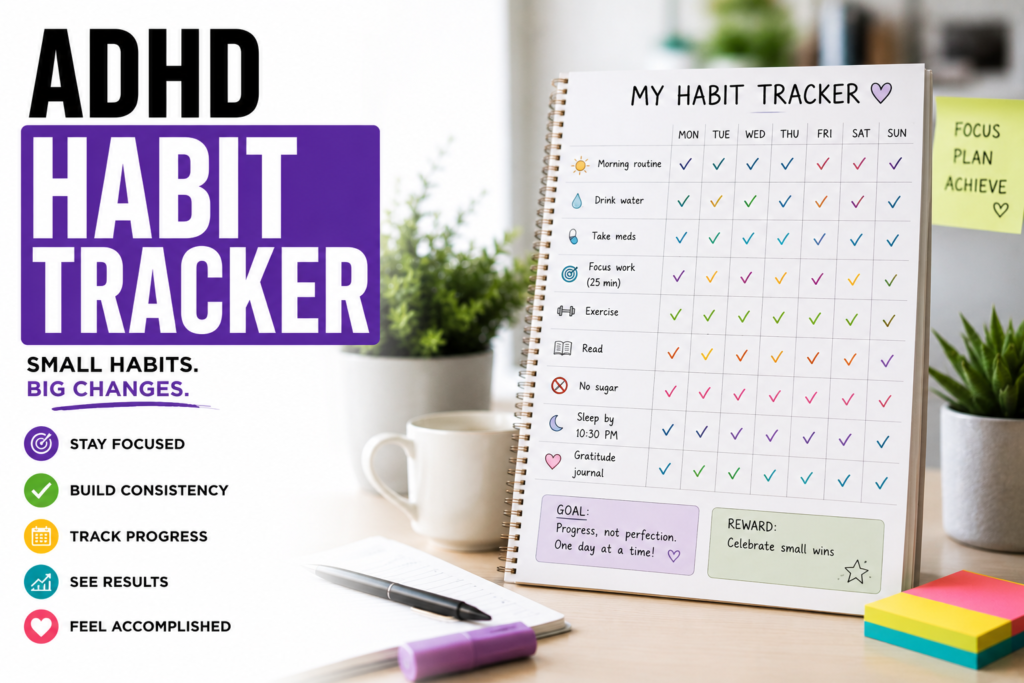
Use these structured worksheets to build your physical tracker. You can copy these formats onto paper or download the adhd habit tracker printable templates from our library.
Resource 1: The Weekly Frequency Tally Card
Use this simple card to track your weekly habit frequency. Place it on your fridge or desk.
| Habit (Micro-Version) | Weekly Target | Mon | Tue | Wed | Thu | Fri | Sat | Sun | Total |
|---|---|---|---|---|---|---|---|---|---|
| Put on shoes + walk 5 min | 3x / week | ✓ | ✓ | ✓ | 3 ✓ | ||||
| Sit + take 3 deep breaths | 4x / week | ✓ | ✓ | ✓ | ✓ | 4 ✓ | |||
| Write one journal sentence | 2x / week | ✓ | ✓ | 2 ✓ |
Resource 2: The Bounce-Back Log
Use this card to track how quickly you return to a habit after missing it. Over time, aim to reduce the bounce-back gap.
Bounce-Back Tracker:
1. Habit: ___________________________________________________
2. Last Completed Date: ______________ Missed Date(s): ______________
3. Bounce-Back Date: ______________ Gap (Days): ______________
4. Reflection: [ ] External cause (illness, travel) / [ ] Energy dip / [ ] Lost interest
5. Adjustment: ___________________________________________________
Expert Recommendations and Clinical Pathways
If chronic habit abandonment is impacting your physical health, mental health, or self-esteem, seek professional guidance to build systems alongside clinical support:
- ADHD Coaching: Certified coaches specialize in habit scaffolding, helping you define realistic micro-habits, set flexible frequency targets, and navigate the emotional impact of missed days. Look for certifications from ACO, PAAC, or ICF.
- Cognitive Behavioral Therapy (CBT): CBT adapted for ADHD helps dismantle the all-or-nothing thinking patterns and shame spirals that lead to tracker abandonment. It builds psychological resilience for long-term behavioral change.
- Occupational Therapy (OT): Occupational therapists can help you design physical environments, visual cues, and sensory anchors that automate parts of your habit routine, reducing the executive effort required.
- Regional Directory Listings:
- United States: Search local support networks through CHADD or the *Attention Deficit Disorder Association (ADDA)*.
- United Kingdom: Find local ADHD services through the NHS or consult The ADHD Foundation for coaching referrals.
- Canada: Connect with CADDAC to access adult ADHD webinars, support groups, and coaching directories.
- Australia: Contact ADHD Australia or search the AADPA professional database for specialists in your region.
Frequently Asked Questions
What is the best habit tracker for ADHD?
The best habit tracker for ADHD is simple, visual, and forgiving. It tracks no more than three habits at a time, uses weekly frequency goals instead of daily streaks, stays physically visible (on a fridge or wall), and celebrates partial progress rather than punishing missed days.
Why do I keep abandoning habit trackers?
You abandon trackers because traditional streak-based systems trigger shame when you miss a day. Additionally, the novelty of the tracking app or journal wears off after three to five days, and the executive effort required to maintain a complex tracker drains the cognitive resources needed for the habits themselves.
How many habits should I track with ADHD?
Track a maximum of one to three habits at a time. Start with one micro-habit and build confidence. Only add a second habit after the first has felt sustainable for at least four weeks. Tracking more than three simultaneously leads to executive overload and burnout.
What is a bounce-back metric?
A bounce-back metric measures how quickly you return to a habit after missing it. Instead of counting consecutive days (streaks), you measure the gap between a missed day and the day you resume. This reframes missed days as natural events and focuses on resilience rather than perfection.
How do I make habits stick with ADHD?
Make habits stick by defining them as 2-minute micro-actions, anchoring them to existing daily cues, tracking weekly frequency instead of daily streaks, rotating the expression of the habit to maintain novelty, and celebrating every completed session with a visible micro-reward.
Conclusion: Building Habits with Self-Compassion
Building habits with ADHD is not about pushing harder or downloading a better app. It is about understanding that your brain’s reward and motivation circuitry works differently. You need lower bars, flexible frequencies, visible trackers, and built-in forgiveness.
Be kind to yourself when you miss a day—or a week. A broken streak is not a broken person. Measure your progress by your bounce-back speed, not by your consecutive count. Celebrate the days you showed up, even if they were not every day, and build your systems around your capacity rather than your ambition.