ADHD Hyperfocus Explained – Practical ADHD Guide
It is 10:00 AM on a Saturday. You sit down at your computer with a simple goal: to quickly look up how to fix a dripping faucet before you start your weekend errands. You open a search engine. You click on a video. The video mentions a specific type of wrench you don’t own. You search for the wrench. You find a forum discussing the best tool brands for home repair.
You start reading a thread about restoring vintage hand tools. You watch a 45-minute documentary about the history of metallurgy.

You finally look up from your screen. The sun has moved to the other side of the room. It is 4:30 PM. You have not eaten lunch, you haven’t drank a drop of water, you haven’t gone to the bathroom, and the faucet is still dripping. You feel exhausted, mildly disoriented, and deeply frustrated with yourself.
This is not a lack of focus. It is precisely the opposite. It is an intense, unyielding, involuntary state of extreme concentration. Welcome to hyperfocus.
When most people think of Attention Deficit Hyperactivity Disorder (ADHD), they imagine an inability to pay attention. They picture a brain constantly distracted, flitting from one thought to the next like a butterfly. While distractibility is a core component of the ADHD experience, it is only half of the story. The paradox of ADHD is that the same brain that struggles to focus on a spreadsheet for five minutes can completely lose itself in a coding project, a video game, or a creative endeavor for twelve uninterrupted hours, blocking out the entire external world.
To have **adhd hyperfocus explained** properly, we must shift our understanding from “attention deficit” to “attention dysregulation.” The ADHD brain does not lack attention; it lacks the executive control to direct that attention intentionally, regulate its intensity, and disengage when necessary.
This comprehensive **adhd hyperfocus explained guide** provides an evidence-based framework for understanding, managing, and ultimately leveraging this intense psychological state. We will explore the neuroscience behind hyperfocus, examine how it impacts **ADHD productivity** and **ADHD organization**, and provide you with actionable **ADHD focus tips** to harness this powerful trait while mitigating its destructive consequences.
What is ADHD Hyperfocus? The Scientific Background
To understand hyperfocus, we must look beneath the behavioral symptoms and examine the neurochemistry of the ADHD brain. Hyperfocus is fundamentally a mechanism of dopamine dysregulation.
The Dopamine Chase and Reward Deficiency
The ADHD brain is characterized by a baseline deficiency in dopamine signaling—the neurotransmitter responsible for motivation, reward, and the regulation of attention. Because dopamine levels are chronically low, the ADHD brain exists in a state of constant, unconscious starvation for stimulation.
When a neurotypical brain engages in a mundane task (like filing taxes), it generates enough baseline dopamine to sustain attention. When an ADHD brain attempts the same task, the stimulation is too low to engage the attention network. The brain simply refuses to “grip” the task.
However, when an ADHD brain encounters a task that is novel, highly stimulating, urgent, or inherently fascinating, it triggers a massive release of dopamine. The starving brain finally gets the neurochemical reward it craves. It latches onto this source of dopamine with an iron grip. This is hyperfocus. The brain locks onto the stimulating activity and shuts down all other processing to maintain the dopamine supply.
Executive Function and the Braking System
**Executive function** refers to the cognitive management system located in the prefrontal cortex. It is responsible for planning, prioritizing, initiating tasks, shifting attention, and regulating impulses. In ADHD, this executive system is structurally underactive.
During hyperfocus, the weakened executive function cannot perform its critical “braking” role. A neurotypical person reading an interesting book will eventually register the signals of hunger or the realization that they have an appointment in 30 minutes. Their executive function overrides their interest, disengages their attention, and initiates a transition to the next necessary task.
The ADHD brain in hyperfocus fails to receive or process these external and internal cues. The executive braking system is offline. The person continues to focus not necessarily because they want to, but because they neurological lack the mechanism to stop.
Working Memory Collapse
**Working memory** is the brain’s short-term “RAM”—the ability to hold and manipulate information actively in mind. ADHD is strongly associated with working memory deficits. During a hyperfocus episode, the limited working memory capacity is entirely consumed by the object of fascination. All background monitoring tasks—tracking time, remembering prior intentions, processing bodily needs—are evicted from working memory, resulting in complete environmental detachment and severe “time blindness.”
Symptoms and Manifestations: How Hyperfocus Appears
Hyperfocus is distinct from regular “flow states” or deep concentration. It has specific phenomenological characteristics that distinguish it as an ADHD symptom.
| Characteristic | Description in Hyperfocus | Contrast with Typical “Flow” |
|---|---|---|
| Time Blindness | Complete loss of the perception of time passing. Hours feel like minutes. | In normal flow, a general awareness of time’s passage usually remains intact. |
| Sensory Blocking | Failure to perceive physical needs (hunger, thirst, need for the bathroom) or external sounds (someone calling your name). | Normal focus allows for interruptions from strong bodily signals or loud environmental cues. |
| Transition Inability | Experiencing intense emotional distress, irritability, or physical disorientation when forced to stop the activity. | Normal flow can be interrupted with mild annoyance, but transition is manageable. |
| Involuntary Initiation | Often falling into hyperfocus unintentionally, frequently on irrelevant or low-priority tasks (e.g., color-coding an email inbox instead of writing a report). | Flow is typically initiated intentionally toward a desired, goal-oriented task. |
| Post-Episode Exhaustion | Feeling neurologically depleted, drained, or “hungover” after the episode breaks. | Flow states often leave the individual feeling energized and satisfied. |
Real-World Hyperfocus Scenarios
Scenario A: The Destructive Hyperfocus (Mark’s Story)
Mark is a university student studying computer science. He has an important essay due for a history class on Friday. On Wednesday evening, he sits down to write it. As he opens his laptop, he notices a minor bug in a personal coding project he was working on weeks ago. He decides to “just fix it quickly” before starting the essay.
The bug is complex. Mark’s brain, seeking dopamine, locks onto the challenge. His environment fades away. He stops hearing his roommates. He ignores his phone buzzing.
When Mark finally closes the code editor, it is 6:00 AM on Thursday. He has solved the bug, but he is completely exhausted, he hasn’t slept, and the history essay is still unwritten. The hyperfocus felt productive in the moment, but it actively destroyed his academic priorities and physical wellbeing. This is destructive hyperfocus.
Scenario B: The Productive but Exhausting Hyperfocus (Elena’s Story)
Elena is a graphic designer. She struggles with **ADHD organization** and often procrastinates on client projects until the deadline is looming.
On the day a major branding package is due, the urgency finally provides enough dopamine to activate her brain. She enters a state of profound hyperfocus. For nine straight hours, she designs brilliantly, producing work that would normally take a week. She meets the deadline and the client is thrilled.
However, the cost is severe. Elena skipped all her meals, ignored her dog’s need to go outside, and canceled a dinner with her partner. The next day, she experiences an “ADHD hangover”—profound fatigue and brain fog that renders her incapable of doing any work at all. She relied on crisis-induced hyperfocus as a productivity strategy, which is ultimately unsustainable.
Scenario C: Managed and Leveraged Hyperfocus (David’s Story)
David is a data analyst who has learned to manage his ADHD. He knows his brain is prone to hyperfocusing on complex data sets. Instead of letting it happen randomly, he plans for it.
He uses the ADHD Time Management Planner to schedule a specific 3-hour block on Tuesday mornings for deep data analysis. Before he begins, he sets three loud, external alarms across the room to force physical movement when the time is up. He places a large jug of water and a protein snack on his desk.
When he begins work, he intentionally leans into the hyperfocus state. He accomplishes massive amounts of work. When the alarms go off three hours later, the physical act of getting up to turn them off breaks the hyperfocus trance. He drinks his water, transitions to a low-demand task, and finishes his day feeling accomplished rather than drained. This is managed hyperfocus.
The Hyperfocus Management Framework: Actionable Strategies
To successfully navigate life with an ADHD brain, you cannot simply try to stop hyperfocusing. Instead, you must build systems that prevent destructive hyperfocus, manage the physical toll of the state, and intentionally harness it for **ADHD productivity**.
Here is a comprehensive framework containing essential **adhd hyperfocus explained tips**.
Phase 1: Preventing Destructive Hyperfocus (The Guardrails)
Destructive hyperfocus occurs when your brain locks onto the wrong task at the wrong time. The goal is to build environmental friction that prevents the trance from beginning.
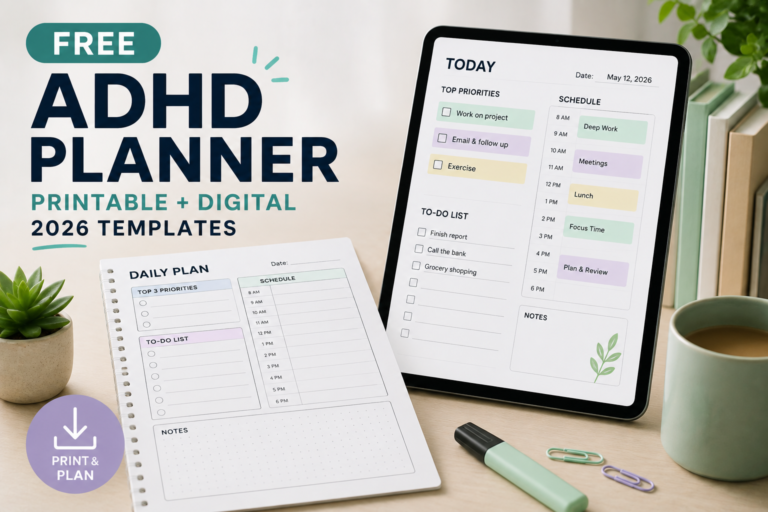
- The Pre-Engagement Check: Before starting any task, force a momentary pause. Ask yourself: “Is this the priority right now?” Use the ADHD Daily Planner to ensure your top priority is clearly externalized and visible. If the task you are about to start is not the priority, walk away from the environment for 60 seconds to break the initial engagement.
- Digital Friction: Most destructive hyperfocus occurs on screens (scrolling, gaming, research rabbit holes). Use website blockers and app limits to create artificial barriers. When a blocker interrupts your browsing, it provides the “bump” your executive function needs to re-engage.
- Beware the “Just Five Minutes” Trap: ADHD brains are notoriously poor at time estimation. The lie of “I will just look at this for five minutes” is the most common entry point into an unplanned 4-hour hyperfocus session. If a task is highly stimulating, treat it as dangerous to engage with unless you have blocked out significant time.
Phase 2: Managing the Environment During Hyperfocus
If you are intentionally engaging in a task that requires deep concentration, you must pre-plan your environment because you will lose the capacity to monitor it once hyperfocus begins.
- Pre-Hydration and Nutrition: You will not notice hunger or thirst while hyperfocused. Before starting, place a large water bottle and a high-protein, zero-prep snack (like nuts or a protein bar) immediately within your visual field. Make consumption a reflex rather than a decision.
- Externalize Your Timers: A quiet notification on your computer screen will not break a hyperfocus trance. You need jarring, external interventions. Set multiple alarms on a device located across the room, forcing you to stand up to turn them off. The physical movement is critical for resetting the neurological state.
- The “Transition Buffer”: Never schedule a high-demand meeting or a social engagement immediately after a planned deep-work session. Transitioning out of hyperfocus is cognitively painful. Schedule a 30-minute buffer of low-demand activity (like taking a walk or organizing your desk) to allow your brain to decompress.
Phase 3: Harnessing Hyperfocus for Productivity
When aimed correctly, hyperfocus is a tremendous asset. It allows for rapid skill acquisition, profound creativity, and the completion of massive amounts of work. The key is intentionality and **planning**.
- Identify Your Triggers: What induces hyperfocus for you? Is it urgency? Novelty? Problem-solving? Competition? Identify these triggers and artificially manufacture them for priority tasks. For example, if urgency triggers your focus, create artificial deadlines by committing to deliver a draft to a colleague 48 hours before the actual deadline.
- Batch Processing: Group all your low-stimulation, administrative tasks together and refuse to let yourself hyperfocus on them. Save your deep-focus energy for the high-value, complex tasks that actually require it. Use the ADHD Weekly Planner to designate specific “deep work” blocks where hyperfocus is actively encouraged.
- The “Capture” System: While hyperfocused on a priority task, your brain will frequently generate brilliant, urgent-feeling ideas for *other* tasks. Do not act on them. Keep a physical notepad next to your keyboard. Write the idea down and immediately return to the primary task. This “captures” the idea without derailing the focus.
Building Routines to Support Focus Regulation
Hyperfocus is exhausting. If your life lacks structure, you will oscillate between extreme, burnout-inducing hyperfocus and complete lethargy. Establishing consistent **routines** is the primary defense against this cycle.
The Startup and Shutdown Routines
Your brain needs clear signals to know when to engage and when to disengage.
- The Morning Startup: Instead of immediately opening your email and risking an accidental hyperfocus on irrelevant messages, build a 15-minute startup routine. Review your goals, set your priorities for the day, and intentionally choose your first task. Use the ADHD Routine Generator to formalize this process until it becomes automatic.
- The Evening Shutdown: The inability to disengage from work is a major problem for ADHD professionals. Create a hard shutdown routine: close all browser tabs, write down your starting point for tomorrow, and physically walk away from the workspace. This tells your brain the hyperfocus window is closed.
Habit Tracking for Baseline Health
Your ability to regulate attention is directly tied to your physical health. Sleep deprivation, poor nutrition, and lack of exercise severely worsen executive dysfunction, making destructive hyperfocus more likely and productive hyperfocus harder to achieve. Use the ADHD Habit Tracker to monitor three core biological pillars: achieving 7-8 hours of sleep, eating protein-rich meals, and getting 20 minutes of daily movement.
Printable Hyperfocus Management Checklist
Template 1: The Deep Work “Pre-Flight” Checklist
Before you intentionally enter a deep work session, run through this checklist to ensure you are supported and protected.
[ ] I have clearly identified the single specific task I am focusing on.
[ ] This task is an actual priority, not a distraction or a “rabbit hole.”
[ ] I have written the goal on a sticky note and placed it on my monitor.
Step 2: Environment & Biology
[ ] I have a large glass/bottle of water within arm’s reach.
[ ] I have a simple snack available.
[ ] I have used the bathroom.
Step 3: Boundaries & Alarms
[ ] I have set a hard stop time for this session (e.g., 90 minutes or 2 hours).
[ ] I have set an alarm across the room that requires me to stand up to turn it off.
[ ] My phone is on “Do Not Disturb” and placed out of visual range.
Step 4: Transition Plan
[ ] I know exactly what low-demand activity I will do when the alarm goes off (e.g., take a 10-minute walk, stretch, get coffee) to break the trance.
Expert Recommendations and ADHD Help
Managing hyperfocus is a complex skill that often requires external support and intervention. If you are struggling with chronic burnout, severe procrastination, or extreme difficulty shifting attention, consider seeking professional **ADHD help**.
- Cognitive Behavioral Therapy (CBT) for ADHD: CBT is highly effective for addressing the distorted thinking patterns that often accompany hyperfocus (e.g., “If I don’t finish this perfectly right now, it’s worthless”). A therapist can help you build stronger transition skills and emotional regulation techniques.
- ADHD Coaching: While therapy focuses on emotional and psychological health, an ADHD coach focuses on practical execution. A coach can help you design personalized **ADHD planning** systems, implement the checklists provided in this article, and hold you accountable for maintaining your boundaries around hyperfocus.
- Medication Management: For many adults, stimulant and non-stimulant medications are the most effective intervention for executive dysfunction. Proper medication does not eliminate hyperfocus, but it strengthens the prefrontal cortex, giving you the “brakes” needed to disengage from a task and the baseline dopamine needed to initiate low-stimulation tasks. Always consult with a psychiatrist or specialized medical provider.
Frequently Asked Questions
Is ADHD hyperfocus a superpower?
Calling hyperfocus a “superpower” is controversial within the ADHD community. While it can produce extraordinary bursts of **productivity** and deep expertise in specific areas, romanticizing it ignores the severe costs: physical exhaustion, neglected relationships, missed deadlines on uninteresting tasks, and chronic burnout. It is better understood as a powerful but dangerous tool that requires intense, intentional management to be beneficial.
How do I break out of a destructive hyperfocus state?
Internal willpower is rarely sufficient to break hyperfocus because the executive function needed to exert that willpower is offline. You must rely on external interruptions. Set loud alarms across the room. Use software that forcibly locks your screen. Ask a partner or colleague to physically interrupt you at a specific time. Change your physical environment—stand up, splash cold water on your face, or step outside.
What is the difference between ADHD hyperfocus and Autism special interests?
While there is overlap (and many individuals have both ADHD and Autism), they are distinct. Autism special interests are typically long-lasting, deep, and consistent passions that provide comfort and identity over months or years. ADHD hyperfocus is often intense but fleeting. An ADHD individual might hyperfocus intensely on learning to bake bread for three weeks, acquire all the equipment, and then lose all interest entirely when the novelty wears off.
Does ADHD medication stop hyperfocus?
Properly calibrated medication rarely “stops” the ability to hyperfocus entirely. Instead, it provides the baseline executive function needed to *choose* what to focus on and the ability to disengage when necessary. It restores the braking system. Many patients report that medication makes their focus feel less frantic and more intentional.
Conclusion: Mastering the Extremes of Attention
To have **adhd hyperfocus explained** is to understand that you are not dealing with a broken brain, but a highly specialized one that operates at the extremes of attention. You either have too little dopamine to engage, or you lock on with such intensity that the world disappears.
The goal of **ADHD organization** and management is not to force your brain to operate like a neurotypical one. That is a recipe for shame and failure. The goal is to build an external scaffolding that protects you from the destructive side of your neurobiology while allowing you to safely leverage its strengths.
By understanding the neurological drivers of hyperfocus, implementing strict pre-engagement checks, managing your physical environment during deep work, and utilizing robust planning tools, you can transform hyperfocus from an unpredictable liability into a managed asset.
Your attention is intense. Stop letting it dictate your life, and start building the systems to direct it where you want it to go.