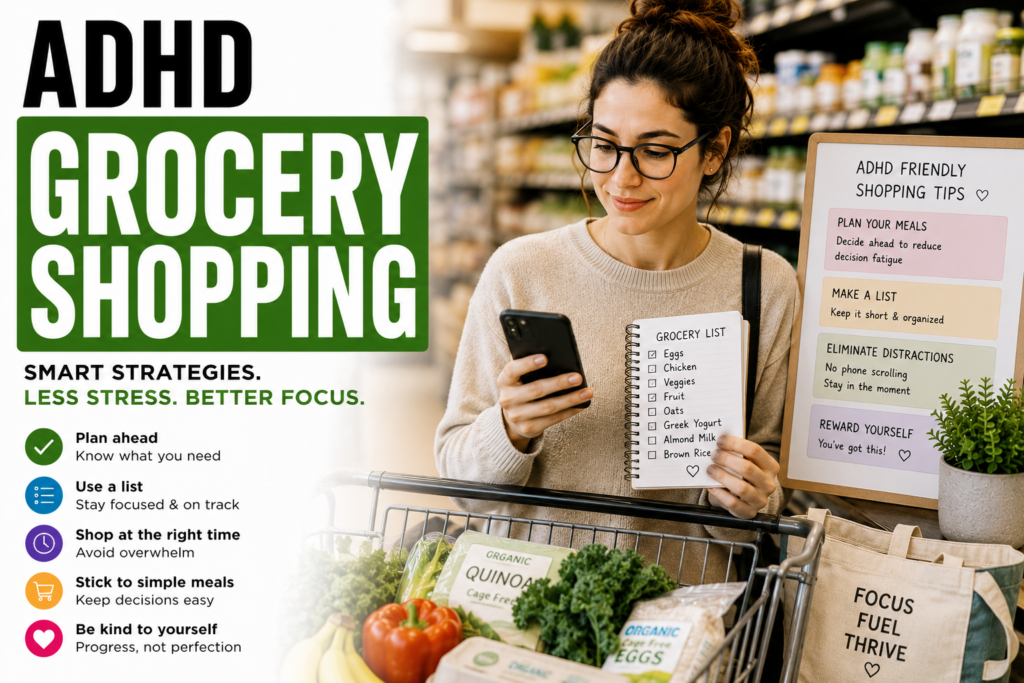
ADHD Grocery Shopping System: A Complete Guide to Stress-Free Shopping Every Week
You are standing in the cereal aisle of your local supermarket. You came in for six items. You have been here for forty minutes. Your cart contains twelve things you did not plan to buy and is conspicuously missing three of the items you actually needed. At some point you became completely absorbed in reading the back of a granola box, and then the fluorescent lights started feeling unbearable, and then a child near the dairy section started screaming, and now the idea of navigating four more aisles feels physically impossible.
You leave without the chicken breast, the bread, and the yogurt you came in for. On the way home, you order dinner online.
For adults with Attention Deficit Hyperactivity Disorder (ADHD), the grocery store is one of the most neurologically hostile environments in everyday life. It is a vast, high-stimulation space designed to capture and redirect attention—which is precisely the function the ADHD brain already struggles to regulate. Bright packaging, end-cap promotions, unexpected samples, sensory overload from lights, sounds, and smells, and hundreds of simultaneous decisions combine to create a perfect storm of executive dysfunction.
Yet grocery shopping is not optional. Consistent, effective **ADHD grocery shopping** is foundational to nutrition, **adhd meal planning**, financial stability, and daily wellbeing. When the grocery system breaks down, cooking breaks down, which means nutrition breaks down—directly worsening the neurological conditions that made shopping difficult in the first place.
This comprehensive guide provides an evidence-based, practical framework for building a reliable **ADHD grocery shopping** system. You will learn the neuroscience behind why supermarkets are so uniquely challenging for ADHD brains, discover a full suite of practical **grocery shopping tips for ADHD**, and gain access to a ready-to-use **shopping checklist ADHD** template. By implementing these neurodivergent-friendly systems, you can transform weekly shopping from a chaotic ordeal into a structured, predictable, and actually manageable routine.
Why Grocery Stores Are Neurologically Hard for ADHD Brains
Before building solutions, we must understand the specific executive challenges that the grocery store environment activates.
- Sensory Overload and Attentional Flooding: Modern supermarkets are engineered to maximise attention capture. Bright packaging, competing scents, background music, overhead announcements, and unpredictable human movement create a high-stimulation sensory environment. For the ADHD brain, which already lacks efficient sensory filtering, this environment can trigger rapid attentional flooding—where the brain attempts to process too many inputs simultaneously and begins to shut down executive functions defensively.
- Decision Proliferation: A typical supermarket contains between 30,000 and 50,000 unique products. Even a focused shopping trip requires dozens of micro-decisions: which brand, which size, which variety, whether to try the discounted alternative. Each of these decisions draws on prefrontal cortex resources. Without an externalized plan, the ADHD shopper exhausts their decision-making capacity within the first two aisles.
- Working Memory Loss Under Stimulation: The grocery list that felt manageable at home becomes unreliable under the cognitive load of in-store stimulation. The ADHD brain’s working memory—already limited—is further degraded by sensory overload. Items that were clearly remembered during list creation evaporate mid-store.
- Novelty Impulse and Hyperfocus Derailment: The supermarket’s constant presentation of novel, visually interesting products is a direct threat to ADHD purchasing discipline. A new product, an interesting promotional display, or a “limited edition” label activates the ADHD brain’s dopamine-driven novelty response, redirecting attention and purchasing behavior away from planned items.
- Time Blindness Mid-Shop: Without a structured route, ADHD shoppers frequently lose track of time inside the store. A trip planned for 20 minutes expands to an hour as hyperfocus on one section eliminates awareness of elapsed time—while simultaneously generating urgency and overwhelm.
Scientific Background: The ADHD Brain in Retail Environments
The 30% Rule with ADHD and Consumer Independence
Dr. Russell Barkley’s **30% rule with ADHD** states that individuals with ADHD operate approximately 30% behind neurotypical peers in executive age and self-regulation capacity. For a 32-year-old adult with ADHD, their executive management skills are closer in capacity to a 22-year-old’s.
In the context of grocery shopping, this gap is significant. Society assumes that adults autonomously manage their weekly food purchasing with minimal system support. But the 30% rule reveals that many ADHD adults are attempting to execute a grocery run—including list management, budget tracking, impulse control, route planning, and time estimation—using executive infrastructure that has not yet developed to full adult capacity without external scaffolding.
Understanding this is not about lowering standards; it is about designing support systems that match actual executive capacity rather than chronological age expectations.
ADHD and Impulse Purchasing: The Research
Multiple studies confirm that adults with ADHD demonstrate significantly higher rates of impulsive purchasing behavior compared to neurotypical controls. This is driven by the same dopamine dysregulation that affects task initiation and attention—the ADHD brain responds intensely to immediate reward stimuli (a new product, a promotional offer, a discount label) while poorly inhibiting the behavioral impulse to act on that stimulus.
This neurological tendency is further compounded by the temporal discounting described in financial ADHD research: the long-term benefit of sticking to a grocery budget feels abstract and distant, while the immediate pleasure of the impulse item feels vivid and compelling. Without structural barriers (a strict list, a budget card, a companion), the ADHD brain will consistently prioritize the immediate reward.
Real-World Grocery Scenarios
Scenario A: Shopping Without a System (Priya’s Story)
Priya is a 29-year-old teacher in Australia with ADHD. She shops at the supermarket two or three times a week—not by choice, but because she consistently forgets essential items, which forces return trips.
Her typical shop begins with good intentions. She walks in knowing she needs eggs, pasta, and some vegetables. But within ten minutes, she has been distracted by a display of new snack flavors, spent eight minutes in the biscuit aisle comparing brands, and completely forgotten whether she has pasta at home.
She leaves with £47 worth of groceries that do not form any coherent set of meals. By Thursday, she is out of core ingredients and makes another trip. By month’s end, her grocery spending is 40% over budget.
The problem is not Priya’s intelligence or her desire to eat well. It is the complete absence of a structural system that compensates for her working memory limitations and impulse control challenges.
Scenario B: Building a Shopping System (James’s Story)
James, a 44-year-old accountant in Canada with diagnosed ADHD, transformed his **ADHD grocery shopping** experience by implementing three changes.
First, he created a standing digital grocery list organized by supermarket aisle section. Every item his household regularly uses is already on the list; he simply unchecks what he needs each week rather than creating a list from memory.
Second, he introduced a strict “list only” rule: anything not on the list requires a mandatory 24-hour wait before purchasing. He allows himself one spontaneous item per trip as a “novelty allowance.”
Third, he shops at the same store, on the same day (Tuesday evening at 6:30 PM), and follows the same route through the store every single week. The predictability eliminates in-store decision fatigue about where to go next.
Within a month, his weekly shopping time decreased from 55 minutes to 28 minutes, his grocery bill decreased by $80 per month, and he stopped making mid-week emergency runs.
Scenario C: Managing Grocery Shopping in a Household
Sophia and her husband Ren both have ADHD. Their previous grocery arrangement—one person shops spontaneously when they notice they are out of something—produced chronic household food insecurity despite adequate income. They were always out of something critical, always buying duplicates of things they already had, and always overspending.
They implemented a household **shopping checklist ADHD** system. Using a shared app (AnyList), they maintain a standing list that both can update throughout the week. When either of them uses the last of something, they add it to the app immediately. On Saturday mornings, whoever has more energy does the shop using the shared list.
They also implemented category shopping bags—separate bags labeled “Proteins,” “Produce,” “Pantry,” and “Dairy”—so that loading the car and unpacking at home requires no decisions about where anything goes.
The shared system eliminated their duplicate purchases, reduced total grocery spending, and removed the weekly “who is shopping this week?” conflict entirely.
The ADHD Grocery Shopping Framework: A Step-by-Step System
The following framework applies the core principles of ADHD management—externalization, automation, routine anchoring, and sensory management—to the grocery shopping process.
Phase 1: The Standing List System (One-Time Foundation)
The most important change you can make to your **ADHD grocery shopping** process is replacing the weekly “what do we need?” mental exercise with a standing pre-built list.
- Build Your Master Grocery List: Walk through your kitchen once. Write down every item your household regularly consumes: every pantry staple, cleaning product, personal care item, and food ingredient. Organize this master list by supermarket section (Produce, Proteins, Dairy, Frozen, Pantry, Bakery, Household). This becomes your permanent reference document.
- Choose a Standing Digital Platform: Transfer your master list to a shared digital app: AnyList, OurGroceries, Instacart, or simply Apple Reminders or Google Keep. Items remain on the list permanently; you simply check or uncheck them each week rather than writing a new list from scratch.
- Implement the “Last One Rule”: When you use the last of any item, add it to your digital list immediately—before you close the cupboard or refrigerator. Do not rely on prospective memory to “remember to add it later.” The moment of depletion is the moment of list entry.
- Link to Meal Planning: Connect your grocery list directly to your weekly meal plan. Use the ADHD Daily Planner to pre-decide your meals for the week, then extract the ingredients needed for each meal directly onto your shopping list. This eliminates the “what should I buy to eat this week?” question entirely from the in-store experience.
Phase 2: The Pre-Shop Protocol (30 Minutes Before Leaving)
What you do before entering the store determines much of what happens inside it.
- Check the List, Not the Kitchen: Instead of mentally scanning your refrigerator for missing items (a working-memory-dependent task prone to ADHD failure), simply check your digital list. Your list already reflects what has been depleted through consistent “last one rule” entries.
- Set a Budget Card: Before leaving, withdraw your weekly grocery budget in cash or note the exact spending limit. Having a concrete number prevents the abstract “I’ll figure it out” approach that consistently leads to overspending.
- Eat Before You Go: Shopping while hungry dramatically increases impulse purchasing across all populations—but the effect is significantly amplified in ADHD due to the combination of depleted glucose for prefrontal function and heightened food reward sensitivity. Have a snack before every shop, without exception.
- Choose Your Time Window: ADHD grocery shopping is significantly easier at low-stimulation times. Early weekday mornings and weekday evenings (6–8 PM) are typically the quietest periods in most supermarkets across the US, UK, Canada, and Australia. Saturday afternoons are the worst possible time for the ADHD shopper—crowded, loud, and visually overwhelming.
- Prepare Sensory Tools: Pack your noise-canceling earbuds or headphones. Having familiar, calming audio (a podcast, an audiobook, a music playlist) playing during your shop dramatically reduces sensory overload and maintains a focused, forward-moving state through the store.
Phase 3: The In-Store System (Building a Consistent Route)
The grocery store is least disorienting when it is predictable. Build a fixed route and follow it every visit.
- Map Your Route Once: On your next visit to your regular supermarket, walk the store section by section and note the order of sections as they appear along a natural path. Reorganize your standing shopping list to match this physical order (Produce → Bakery → Dairy → Proteins → Frozen → Pantry). Every subsequent visit follows this same route, eliminating the “where do I go next?” in-store decision.
- Shop from List Only: Your list is your authority inside the store. Check items off as you place them in the cart. Do not add items to the cart without first checking the list. If you see something appealing that is not on the list, apply your personal “novelty rule” (maximum one unplanned item per trip, or a 24-hour wait before purchase).
- The “In and Out” Time Target: Set a target time before entering the store. For a standard weekly shop, 30–40 minutes is achievable. Set a timer on your phone. The timer creates a light urgency that combats mid-store hyperfocus and helps regulate time blindness.
- Use Headphones as an Attentional Anchor: Your audio content (podcast, music, audiobook) serves as an attentional anchor—it occupies the background processing channels of your brain that would otherwise be captured by store stimuli, leaving your foreground attention free to navigate the list.
Phase 4: The Online Grocery Alternative
For many ADHD adults, the most effective **grocery shopping tips for ADHD** involve removing the in-store experience entirely.
- Click-and-Collect or Delivery Services: Services like Instacart (US/Canada), Tesco Online (UK), Woolworths Online (Australia), and Walmart Grocery allow you to shop from your standing digital list in a distraction-free home environment. The elimination of in-store sensory overload and impulse triggers removes the primary sources of ADHD grocery shopping failure.
- Scheduled Weekly Order: Set a recurring weekly online grocery order for your standing staple items. This transforms grocery shopping from a recurring decision into a single setup task. You only actively shop for the variable weekly items (fresh produce, proteins for specific meal plan meals) and let the standing order handle everything else.
- The Routine Generator Integration: Use the ADHD Routine Generator to build your weekly grocery routine—whether in-store or online—as a fixed, scheduled event with specific trigger cues (e.g., every Sunday at 10:00 AM, after morning coffee, open the grocery app and submit the weekly order).
Printable ADHD Shopping Checklist
Template 1: The ADHD Standing Grocery List (Organized by Store Section)
Print this list, laminate it, and use a dry-erase marker to check items each week. Or use it as the template for your digital standing list.
[ ] Spinach / Salad leaves [ ] Broccoli [ ] Cherry tomatoes
[ ] Bell peppers [ ] Onions [ ] Garlic [ ] Carrots
[ ] Bananas [ ] Apples [ ] Berries (fresh/frozen) [ ] Lemons
[ ] ________________________ [ ] ________________________
🥩 PROTEINS
[ ] Chicken breast / thighs [ ] Eggs (dozen) [ ] Ground beef / turkey
[ ] Salmon / tuna (fresh or canned) [ ] Greek yogurt [ ] Cheese
[ ] Legumes (lentils / chickpeas / black beans) [ ] Tofu
[ ] ________________________ [ ] ________________________
🥛 DAIRY & REFRIGERATED
[ ] Milk [ ] Butter [ ] Cream cheese [ ] Sour cream
[ ] Orange juice [ ] ________________________
🍞 BAKERY
[ ] Bread / wraps / pittas [ ] Crackers [ ] ________________________
🧊 FROZEN
[ ] Frozen vegetables (stir-fry mix / peas / corn) [ ] Frozen berries
[ ] Frozen edamame [ ] ________________________
🏺 PANTRY STAPLES
[ ] Pasta [ ] Rice / quinoa [ ] Oats [ ] Tinned tomatoes
[ ] Olive oil [ ] Soy sauce / hot sauce [ ] Peanut butter
[ ] Nuts (almonds / walnuts) [ ] Dark chocolate [ ] Protein bars
[ ] Canned soup (emergency pantry) [ ] ________________________
🧴 HOUSEHOLD
[ ] Dish soap [ ] Paper towels [ ] Bin liners [ ] ________________________
💊 BRAIN SUPPORT ITEMS
[ ] Omega-3 supplement [ ] Magnesium supplement [ ] ________________________
This Week’s Variable Items (From Meal Plan):
[ ] ________________________ [ ] ________________________
[ ] ________________________ [ ] ________________________
Weekly Budget Target: $___________ Actual Spend: $___________
Template 2: The ADHD Pre-Shop Checklist
Run through this quick checklist before leaving for the store every week.
| Pre-Shop Step | Done? | Why It Matters |
|---|---|---|
| Reviewed digital standing list and added this week’s meal ingredients | [ ] | Externalizes memory; prevents forgotten items |
| Eaten a snack in the last 60 minutes | [ ] | Reduces hunger-driven impulse purchasing |
| Budget amount noted or cash withdrawn | [ ] | Creates a hard spending boundary |
| Headphones or earbuds packed | [ ] | Reduces sensory overload in-store |
| Shopping time set for low-stimulation window (not Saturday afternoon) | [ ] | Minimizes sensory overwhelm and crowd stress |
| In-store time target set (30–40 min) and phone timer ready | [ ] | Combats time blindness and hyperfocus derailment |
| Reusable bags in the car / by the door | [ ] | Eliminates in-store friction and forgotten bags |
Expert Recommendations and Clinical Guidance
If grocery shopping and household management are consistently causing significant stress, financial strain, or nutritional difficulty, professional support can accelerate recovery:
- Occupational Therapists (ADHD-Informed): Occupational therapists specializing in executive dysfunction can help you design compensatory strategies for daily living tasks including grocery management, kitchen organization, and meal preparation. Look for OTs with experience in adult neurodivergent populations.
- ADHD Coaching: A certified ADHD coach can help you implement your grocery system, hold you accountable for the standing list protocol, and troubleshoot specific breakdown points in your shopping routine.
- Grocery Delivery Services as a Clinical Accommodation: If in-store shopping consistently triggers sensory meltdowns or financial overspending, using a weekly delivery service is not a luxury—it is a legitimate executive accommodation. Frame it as a neurological support tool, not an indulgence.
Regional Support Resources
- United States: CHADD provides directories for adult ADHD specialists and occupational therapists.
- United Kingdom: The ADHD Foundation offers coaching referrals and neurodiversity resources through NHS and private pathways.
- Canada: CADDAC provides educational webinars and provincial ADHD specialist directories.
- Australia: ADHD Australia connects individuals with local specialists, occupational therapists, and peer support networks.
Frequently Asked Questions
Why is grocery shopping so difficult with ADHD?
Grocery stores are one of the most neurologically demanding environments in everyday life for ADHD adults. They combine extreme sensory stimulation, continuous high-volume decision-making, working memory demands (tracking a list while navigating), impulse purchase triggers, and time blindness challenges—simultaneously activating every core area of ADHD executive dysfunction at once.
What are the best grocery shopping tips for ADHD?
The most impactful **grocery shopping tips for ADHD** are: (1) use a standing digital list organized by store section, (2) eat before shopping every time, (3) use noise-canceling headphones in-store, (4) shop during low-stimulation time windows, (5) follow the same store route every visit, and (6) consider online ordering or click-and-collect as a legitimate neurological accommodation.
How do I stop impulse buying at the grocery store?
Apply a “list only” rule with a maximum one spontaneous item allowance per trip. For higher-value impulse items, implement a 24-hour wait before purchasing. Shopping with headphones reduces the brain’s exposure to in-store novelty stimuli that trigger impulsive responses. A hard cash budget or spending limit creates a physical boundary that is harder to override than an abstract mental rule.
Is online grocery shopping better for ADHD?
For many ADHD adults, yes. Online grocery shopping eliminates in-store sensory overload, removes impulse purchase triggers entirely, allows shopping from a calm home environment, and enables a standing weekly order for staple items. The primary trade-off is the inability to assess fresh produce quality before purchase and potential delivery fees—both of which are manageable limitations compared to the executive cost of a dysregulating in-store experience.
How do I use a shopping checklist with ADHD?
The most effective **shopping checklist ADHD** approach is a standing digital list that never starts from zero. Every household staple item is always on the list; you simply uncheck items as you use them and recheck them when restocking. Organize the list by store section order so you move through the store in a single forward pass without backtracking. Check items off immediately as you place them in the cart.
Conclusion: Grocery Shopping as a System, Not a Struggle
Consistent, stress-free **ADHD grocery shopping** is entirely achievable—but it requires treating the process as a system design challenge rather than a willpower challenge. Your ADHD brain is not failing at grocery shopping because it is deficient; it is failing because it is being asked to perform a multi-layer executive task in one of the most neurologically hostile retail environments in modern life, without any structural support.
The standing list eliminates the memory demand. The pre-shop protocol eliminates the sensory vulnerability. The fixed route eliminates the in-store decision fatigue. The time target eliminates time blindness. Each element addresses a specific executive dysfunction; together, they create a grocery experience that is predictable, efficient, and actually manageable.
Start this week with one step. Build your standing digital grocery list. That single action—thirty minutes of upfront work—will begin transforming every grocery trip you make for years to come.

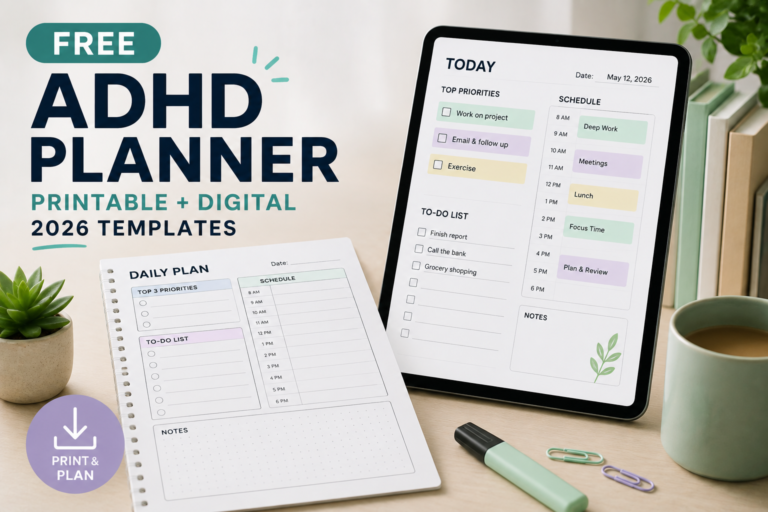
[…] said, if you’re often away from a printer, a simple app can work — see our comparison of an ADHD-friendly app approach for a similar digital-vs-paper […]