ADHD Brain Dump Method – Practical ADHD Guide to Clearing Mental Overwhelm
It is 2:00 PM on a Tuesday. You are sitting at your desk, staring at a blank document you need to finish. However, your brain is not processing the document. Instead, it is simultaneously shouting at you about the fact that your car registration expires next week, you need to buy a birthday present for your niece, you never replied to that email from your boss yesterday, you are out of milk, and you really should start a podcast.

You feel a profound sense of pressure building in your chest. The sheer volume of unstructured tasks, ideas, and anxieties swimming in your head is paralyzing. You try to focus on the document, but the fear that you will forget to buy the birthday present keeps yanking your attention away. You end up spending forty-five minutes scrolling on your phone to escape the uncomfortable sensation of mental gridlock, accomplishing absolutely nothing.
This state of profound mental paralysis is one of the most common and distressing experiences for adults with Attention Deficit Hyperactivity Disorder (ADHD). It is the feeling of a hard drive reaching 100% capacity and freezing.
When you hit this wall, you cannot simply “try harder” to focus. Your cognitive bandwidth is completely consumed by the effort of holding onto information. The only way out of this paralysis is to empty the hard drive. You need the **adhd brain dump method**.
This comprehensive **adhd brain dump method guide** will explain exactly why your neurodivergent brain gets gridlocked, the neuroscience behind cognitive overload, and how to execute a proper brain dump to restore your **working memory**. By mastering this core technique of **ADHD organization**, you can immediately reduce anxiety, reboot your **ADHD productivity**, and regain control over your day.
The Science: Why ADHD Brains Get Gridlocked
To understand why the **adhd brain dump method** works so effectively, we must first understand the specific neurological vulnerability it targets: working memory.
Working Memory: The Mental Whiteboard
Working memory is a core component of **executive function**. It is the brain’s short-term storage system—the mental “whiteboard” where you temporarily hold information while you process it or act upon it. Remembering a phone number long enough to dial it, or holding the steps of a recipe in mind while you chop vegetables, relies on working memory.
In a neurotypical brain, this whiteboard is relatively large and functions efficiently. Once a task is completed or securely stored elsewhere, it is wiped from the board, freeing up space.
In the ADHD brain, working memory capacity is structurally compromised. The whiteboard is much smaller. Worse, the ADHD brain struggles to prioritize what gets written on it. A critical work deadline and a random urge to research the history of Roman aqueducts are given equal priority on the whiteboard. When the board fills up—which happens very quickly—the brain experiences cognitive overload.
The Anxiety of Forgetting (The Zeigarnik Effect)
The Zeigarnik Effect is a psychological principle stating that people remember uncompleted or interrupted tasks better than completed tasks. The brain creates a low-level anxiety signal to remind you of unfinished business.
Because adults with ADHD have a lifetime of painful experiences associated with forgetting important things (missed deadlines, forgotten bills, broken promises), their brains are terrified of letting information slip off the mental whiteboard. The brain constantly loops through all uncompleted tasks (“Don’t forget the milk. Don’t forget the email. Don’t forget the car registration”) to prevent catastrophic failure.
This constant looping consumes massive amounts of metabolic energy. It destroys **focus** because the brain refuses to dedicate 100% of its resources to the task at hand; it is reserving 60% of its power just to hold onto the fear of forgetting.
The Dopamine Search and Mental Clutter
Because the ADHD brain is chronically under-stimulated (lacking baseline dopamine), it frequently generates novel, exciting ideas as a way to self-medicate. “I should start a business!” “I should redesign the kitchen!” These high-dopamine ideas flood the working memory, crowding out the low-stimulation, necessary tasks (like paying the electricity bill).
The **adhd brain dump method** is the externalization of this broken internal system. By physically removing the information from the biological whiteboard and placing it onto an external one (paper or screen), you immediately relieve the cognitive load, silence the Zeigarnik loop, and restore your capacity to act.
Symptoms of Cognitive Overload: When Do You Need a Brain Dump?
You do not need to do a brain dump every day, but you must recognize the specific physiological and psychological symptoms that indicate your working memory has crashed.
| Symptom | Description | The Neurological Driver |
|---|---|---|
| Task Paralysis | Sitting in front of work but physically unable to start. The brain feels like it is “buffering.” | Working memory is at 100% capacity; no bandwidth remains for task initiation. |
| “Pinballing” | Starting a task, remembering another task, switching to it, remembering a third, and finishing none. | Failure of the executive function “braking” system to suppress intrusive thoughts. |
| Physical Tightness | A feeling of shallow breathing, chest tightness, or a buzzing anxiety without a specific cause. | The physiological stress response to the Zeigarnik loop (the fear of forgetting). |
| Irritability | Snapping at partners or colleagues when interrupted. | An interruption threatens the fragile hold you have on the information currently in your working memory. |
| Faux Productivity | Suddenly deciding to deep-clean the baseboards instead of paying taxes. | The brain seeks a dopamine reward from a visible task to escape the invisible overwhelm of the complex task. |
Real-World Scenarios
Scenario A: The Spiral of Overwhelm (David’s Story)
David is a freelance writer. On Thursday morning, he realizes his main project is due Friday. He also remembers he needs to invoice a past client, book a dentist appointment, buy dog food, and text his mother back.
He sits at his laptop to write the project. Five minutes in, the fear of forgetting the invoice pops up. He opens his invoicing software. While there, he sees an unpaid bill and gets stressed about finances. He opens his banking app. He realizes he hasn’t checked the mail in three days. He goes to the mailbox.
By 3:00 PM, David is exhausted. The main project is untouched, the dog food isn’t bought, and the invoice isn’t sent. He feels like a failure. His working memory was so overloaded that he lost the ability to direct his attention, letting immediate anxieties hijack his entire day.
Scenario B: The Intervention (Maria’s Story)
Maria, a marketing director, hits the same wall. She has 40 unread emails, a presentation due at 3 PM, and her child’s school just called about a missing permission slip. She feels the familiar tightness in her chest and the urge to just close her laptop and walk away.
Instead of fighting the paralysis, Maria recognizes the symptom. She stops trying to work. She pulls out a blank piece of paper and a pen. For ten minutes, she aggressively writes down every single thing in her head. She writes down the presentation. The emails. The permission slip. The fact that her shoes are uncomfortable. The brilliant idea for a new ad campaign.
When the pen stops moving, she exhales. The tightness in her chest is gone. Her brain no longer has to hold the information; the paper is holding it. She looks at the paper, circles the presentation and the permission slip, pushes the rest of the list aside, and easily begins working.
The ADHD Brain Dump Framework: How to Execute the Method
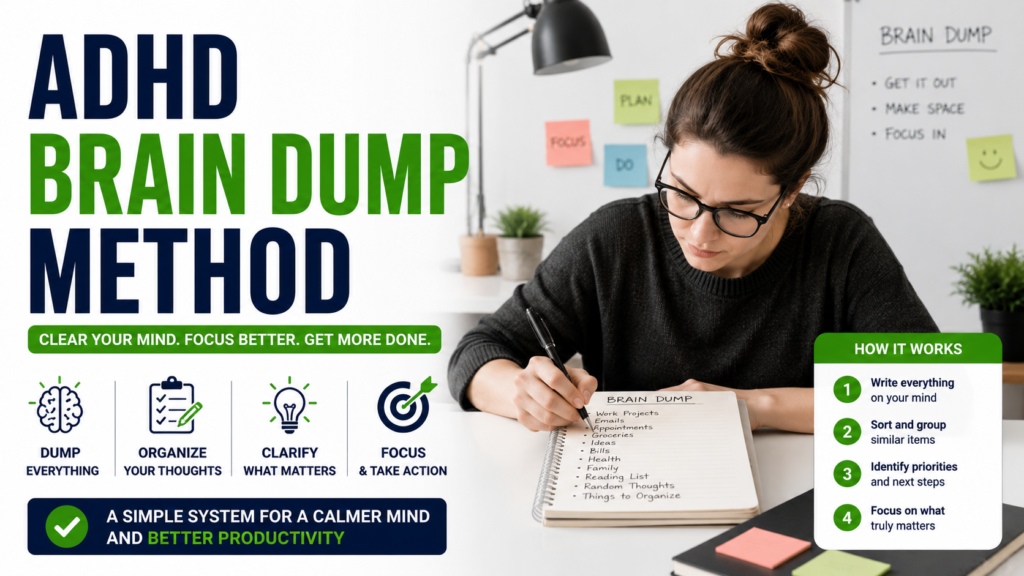
Many people fail at the brain dump because they try to organize the information while they are extracting it. This is a critical error. The ADHD brain cannot simultaneously extract and categorize information. The process must be strictly divided into three phases: Capture, Process, and Execute.
Here are the essential **adhd brain dump method tips** to build this into your life.
Phase 1: The Purge (Capture)
The goal of this phase is speed and volume. You are dumping the contents of your brain onto an external medium without judgment, order, or filter.
- The Medium: Always use an analog medium (paper and pen) or a completely blank, distraction-free digital document. Do not do a brain dump into your existing task manager or calendar. Seeing existing tasks will cause your working memory to crash again.
- The Rule of Zero Filtering: Write down everything. Work tasks, personal tasks, anxieties, brilliant ideas, random observations (“the fridge smells weird”), texts you need to send, long-term goals (“learn Spanish”). If it is occupying mental bandwidth, it goes on the paper.
- The Trigger List: If your brain goes blank (a common ADHD response to being asked “what’s on your mind?”), use a trigger list to dislodge hidden tasks. (See the printable template below).
- The Time Limit: Set a timer for 10-15 minutes. Stop when the timer goes off, or when your brain feels noticeably “lighter” and empty.
Phase 2: The Processing Phase (Categorization)
Now that the information is safely secured on paper, your working memory is clear. You now have the executive bandwidth required to categorize the mess. Do not attempt this phase until Phase 1 is entirely complete.
Take your messy list and sort every item into one of four categories:
- The “Trash”: Look for anxieties, repetitive thoughts, or ideas that seemed urgent in your head but look ridiculous on paper. Cross them out. The simple act of crossing them off signals to your brain that they are resolved.
- The “Do It Now” (Under 2 Minutes): Find the tiny tasks that take less than two minutes (signing the permission slip, replying “yes” to a text, putting a bill in the mail). Do them immediately, right now. Do not schedule them. Crossing these off provides a massive hit of dopamine and momentum.
- The “Incubator” (Someday/Maybe): Identify the high-dopamine ideas that are not urgent tasks (e.g., “Start a podcast,” “Redecorate the bathroom”). Move these items to a dedicated “Someday/Maybe” list. This validates the idea without letting it derail your actual **ADHD planning** for the week.
- The “Action Items”: What remains are the actual, concrete tasks that require your attention today or this week.
Phase 3: The Execution Phase (Integration)
You now have a clean list of actual action items. If you stop here, you will fail, because a long list of tasks is just as paralyzing as a messy brain.
- The Rule of Three: Look at your Action Items list. You cannot do all of them today. Pick a maximum of THREE tasks that absolutely must happen today.
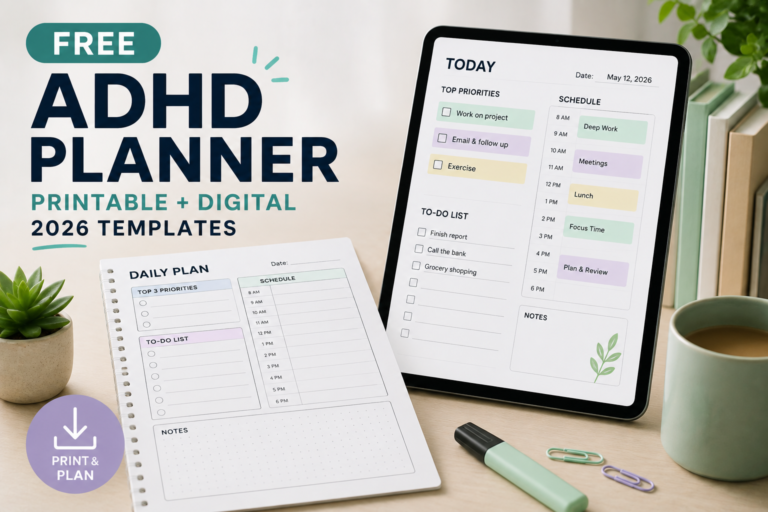
- Externalize the Plan: Move those three tasks into your primary trusted system. Use the ADHD Daily Planner to map out exactly when you will do them. Put the rest of the action items into your ADHD Weekly Planner for later in the week.
- Hide the Master List: Once you have extracted your three daily tasks, physically hide or close the master brain dump list. If you keep the giant list visible on your desk, your brain will become overwhelmed again. You must only look at the three tasks you have chosen for today.
Building the Brain Dump Habit
A brain dump can be used as an emergency intervention when you are overwhelmed, but it is far more powerful when used as a preventative **routine**.
The Weekly Sweep
The most successful strategy for **ADHD productivity** is to schedule a preventative brain dump once a week. Friday afternoon is often the best time. By doing a 20-minute brain dump on Friday at 4:00 PM, you clear your working memory of all the week’s residue. You can enter the weekend without the Zeigarnik Effect ruining your rest, and you have the raw material ready to plan the following week.
Use the ADHD Routine Generator to build this “Friday Sweep” into your non-negotiable weekly schedule.
The Nightly Mini-Dump
If you struggle with sleep because of racing thoughts, your working memory is trying to hold onto tomorrow’s tasks while you sleep. Keep a notepad by your bed. Do a 3-minute mini-dump every night before turning off the lights. Simply write down the 3-5 things screaming loudest in your head. It acts as a release valve for nocturnal anxiety.
Use the ADHD Habit Tracker to monitor how consistently you perform your nightly brain dump and correlate it with your sleep quality.
Printable Brain Dump Templates
Template 1: The ADHD Brain Dump Trigger List
When you know you need to brain dump but your mind goes blank, read through this trigger list to dislodge stuck information.
Emails I need to reply to? Projects stalled because I’m waiting on someone? Meetings I need to prepare for? Expenses to file? Someone I need to follow up with?
Home & Admin:
Bills due? Mail unopened? Appliances acting weird? Things to fix? Car maintenance? Insurance/Taxes? Subscriptions to cancel?
Family & Social:
Birthdays coming up? Texts I read but didn’t answer? Someone I feel guilty about not calling? School forms? Gifts to buy? Plans to confirm?
Health & Personal:
Appointments to book (doctor, dentist, therapy)? Prescriptions to refill? Toiletries running out? Clothes that need mending/dry cleaning? Exercise guilt?
The “Anxiety” Triggers:
What am I actively avoiding right now? What is making my chest tight? What am I dreading about tomorrow?
Template 2: The Processing Matrix
Draw this simple cross on a blank piece of paper to sort your brain dump list.
| Do It Now (Under 2 Mins) | Trash (Anxieties / Non-issues) |
|---|---|
| – Reply to Sarah – Pay water bill online – Sign school form |
– – |
| Action Items (Schedule) | Incubator (Someday/Maybe) |
| – Draft Q3 Report (move to Daily Planner) – Call plumber (move to Weekly Planner) – Buy groceries |
– Start a Youtube channel – Learn to bake sourdough – Redesign office |
Expert Recommendations and ADHD Help
If you find that the **adhd brain dump method** temporarily relieves anxiety, but you continually fail to execute the tasks you write down, the breakdown is happening in the transition from *capture* to *execution*. This is a common executive function failure point. Consider seeking structural **ADHD help**.
- ADHD Coaching: An ADHD coach excels at precisely this point of failure. They will not just tell you to “make a list.” A good coach will sit with you virtually while you do the brain dump, help you process the list without getting overwhelmed, and hold you accountable to executing the “Rule of Three.” Coaching provides the external executive function you lack internally.
- Body Doubling: If you cannot initiate the brain dump because of extreme overwhelm, use a technique called body doubling. Ask a friend, partner, or use a service like Focusmate to simply sit in the room (or on a video call) with you while you do the 15-minute brain dump. The social pressure provides the dopamine needed to initiate the task.
- Timeboxing the Execution: Once you have your three tasks, do not rely on an open-ended day to finish them. Use the ADHD Time Management Planner to assign each task a specific, rigid time block (e.g., “Draft report from 10:00 to 11:30”). Timeboxing creates artificial urgency, which the ADHD brain requires for action.
Frequently Asked Questions
Should I do my brain dump digitally or on paper?
For the vast majority of ADHD brains, analog (paper and pen) is vastly superior for the initial capture phase. Digital devices are fraught with distraction traps (notifications, the urge to open a browser). Furthermore, the physical, tactile act of writing engages the brain differently than typing, helping to process anxiety and slow down racing thoughts. You can move the processed tasks to a digital planner later.
How long should a brain dump take?
The capture phase should take no longer than 10 to 15 minutes. If you go longer, you risk falling into hyperfocus or transitioning from “dumping tasks” into “journaling about your anxieties,” which defeats the purpose of extracting actionable items. Set a hard timer.
What if my list is huge and overwhelming?
If your list has 80 items, congratulations—you have successfully extracted a massive cognitive load from your working memory. The list is supposed to be huge. That is why you were paralyzed. The size of the list proves why the method was necessary. Do not look at the whole list as your day’s work. Use the Processing Matrix to slash the list down, and strictly obey the Rule of Three for actual execution.
What is the difference between a brain dump and journaling?
Journaling is for emotional processing and self-reflection; it is narrative and exploratory. A brain dump is for **productivity** and cognitive offloading; it is aggressive, fragmented, and tactical. While you might write down an anxiety during a brain dump, you do not explore it—you just write it down to get it out of your head, then move on to the next item.
Conclusion: Freeing the Hard Drive
Your ADHD brain is a high-performance sports car with a tiny gas tank. It can go incredibly fast, but it runs out of fuel rapidly. Working memory is that fuel. Every unwritten task, unchecked email, and lingering anxiety is a leak in the gas tank.
When you hit the wall of overwhelm and paralysis, the solution is never to try to force the engine to run without fuel. The solution is to plug the leaks.
The **adhd brain dump method** is the most effective, immediate intervention for restoring cognitive bandwidth and serves as one of the most powerful **ADHD focus tips** available. By aggressively extracting every piece of data from your internal working memory and securing it on an external medium, you silence the neurological alarms of the Zeigarnik effect. You stop the pinballing. You give your executive function the breathing room it needs to look at the list, choose a priority, and actually execute.
The next time you feel the familiar tightness in your chest and the buffering of mental paralysis, stop trying to work. Grab a blank piece of paper. Set a timer for 10 minutes. Empty the hard drive.