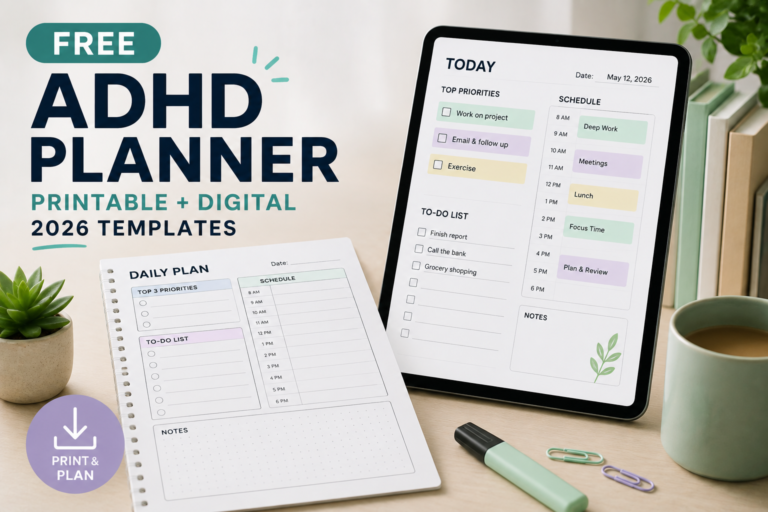
🎉 Free ADHD Daily Planner now available — Download it free →
ADHD Guide

ADHD Sunday Reset Routine: A Step-by-Step Weekly Checklist for Adults

ADHD Sunday Reset Routine Free Weekly Checklist

ADHD Sunday Reset Routine: Free Weekly Checklist to Beat the Sunday Scaries

It is 6:00 PM on Sunday. You have spent the entire weekend recovering from the exhaustion of the previous workweek, or perhaps hyperfocusing on a new hobby. Suddenly, the sun begins to set, and a familiar, heavy feeling settles in your chest. The “Sunday Scaries” have arrived. You know Monday is looming, bringing with it a tidal wave of emails, appointments, decisions, and demands. You feel profoundly unprepared. Your living space is a mess, your inbox is full, and you have no idea what you are going to eat for lunch tomorrow. The sheer volume of unstructured, undefined tasks required to “get ready for the week” paralyzes you, so instead of preparing, you spend the next four hours scrolling on your phone in a state of high-anxiety avoidance.
When Monday morning arrives, you start the week in a deficit. You are already behind, already overwhelmed, and already exhausted.
For adults with Attention Deficit Hyperactivity Disorder (ADHD), the transition from the unstructured time of the weekend to the highly structured demands of the workweek is neurologically jarring. The ADHD brain struggles immensely with task transitions, prospective memory (remembering future intentions), and executive function. When Monday hits without a prior structural intervention, the brain is instantly overloaded.
The solution is not to “try harder” on Monday morning. The solution is to build a bridge between the weekend and the week. You need a dedicated **adhd sunday reset routine**.
This comprehensive guide will explain the neuroscience behind why ADHD brains struggle so deeply with weekly transitions, provide you with an actionable, neurodivergent-friendly framework for resetting your life, and equip you with a free printable weekly checklist. By mastering your Sunday reset, you can eliminate Monday morning paralysis, dramatically improve your **productivity**, and reclaim control over your week.


The Science: Why ADHD Brains Dread Mondays

To understand why the **adhd sunday reset routine** is so critical, we must first understand why the start of a new week feels so neurologically hostile to the ADHD brain.

1. Severe Transition Friction

One of the core deficits in ADHD is difficulty with task shifting—the ability to cleanly disengage from one mental state and transition to another. Weekends and workweeks require fundamentally different operational modes. The weekend is typically low-demand, unstructured, and dopamine-driven. The workweek is high-demand, highly structured, and requires sustained executive control.
The ADHD brain lacks the internal “gears” to smoothly shift from weekend mode to work mode overnight. Without a structured transitional routine on Sunday to manually change the gears, Monday morning feels like hitting a brick wall at sixty miles per hour.

2. Working Memory Collapse

**Working memory** is the brain’s short-term storage space. When you enter a new week without a plan, your working memory attempts to hold every single requirement simultaneously: “I need to reply to the boss, I need to do laundry, I need to buy groceries, I have a dentist appointment on Thursday, I need to finish the quarterly report.”
Because ADHD working memory capacity is structurally smaller than in neurotypical brains, it crashes instantly under this load. The result is cognitive paralysis. You have so many things to remember that you cannot initiate any of them. The Sunday reset offloads this massive data set from your fragile working memory onto an external, trusted system.

3. Unmitigated Decision Fatigue

Every choice you make consumes metabolic energy in the prefrontal cortex. “What should I wear?” “What is for breakfast?” “Which task should I start first?”
Neurotypical brains can handle these micro-decisions automatically. The ADHD brain, however, burns an enormous amount of executive fuel on them. If you leave these micro-decisions for Monday morning, your executive function is depleted before you even arrive at your desk. A successful reset routine pre-makes all low-level decisions on Sunday, preserving your executive energy for the actual work of the week.


Symptoms of an Un-Reset Week

How do you know if you desperately need an **adhd sunday reset routine**? Look for the specific ways an unprepared week manifests in your behavior.

Symptom Description The Neurological Driver
Monday Morning Paralysis Sitting at your desk for the first two hours of Monday unable to start any meaningful work. Cognitive gridlock caused by a lack of clear, externalized priorities.
Impulsive Coping Ordering expensive takeout on Monday night because the thought of cooking is unbearable. Executive depletion. You spent all your prefrontal energy surviving the day; none remains for meal prep.
The “Oh No” Moments Realizing on Tuesday morning that you missed a critical Monday deadline or appointment. Failure of prospective memory (remembering future intentions) without external calendar review.
Sensory Overload at Home Feeling irrationally angry about a pile of mail on the counter or shoes by the door. Environmental visual clutter competing for limited attentional resources, increasing baseline stress.
The Weekend Hangover Feeling physically exhausted on Monday because Sunday night was spent engaging in revenge bedtime procrastination. Avoiding the transition to Monday by staying up late to reclaim autonomy, destroying biological rest.

Real-World Scenarios

Scenario A: The Chaos Monday (Elena’s Story)

Elena is a marketing manager. She hates Sundays. She spends Sunday afternoon dreading the week ahead, trying to distract herself by watching television. She goes to bed late, feeling anxious.
Monday morning arrives. Her alarm goes off. She hits snooze three times because she stayed up late avoiding Monday. When she finally gets up, she realizes she has no clean work pants. She spends ten minutes frantically ironing a wrinkled skirt. She runs to the kitchen—no clean travel mug for her coffee. She buys a latte on the way to work, arriving 15 minutes late, already stressed.
She opens her email and is hit by 45 unread messages. Because she didn’t plan her priorities, she spends the entire morning reacting to whatever email is at the top of the inbox. By 3:00 PM, she is exhausted, and she hasn’t touched her actual project work. Her entire week continues in this reactive, chaotic, exhausting pattern.

Scenario B: The Reset Monday (David’s Story)

David used to live like Elena until he implemented a strict **adhd sunday reset routine**.
On Sunday at 4:00 PM, David sets a timer for 90 minutes. He plays his favorite podcast. He clears his kitchen counters, runs a load of laundry, and takes out the trash. Then, he sits down with his planner. He does a quick brain dump of all his anxieties, reviews his calendar for the week, and chooses his top three priorities for Monday. Finally, he picks out his clothes for Monday and puts a portion of leftover chili into a container for Monday’s lunch.
By 5:30 PM, he is completely finished. The “Sunday Scaries” are gone, replaced by a calm certainty. He enjoys his Sunday evening guilt-free.
On Monday morning, he wakes up. His clothes are ready. His lunch is packed. His kitchen is clean. He arrives at work, ignores his inbox for the first hour, and immediately begins working on the priority he defined the day before. He is proactive, not reactive.


The ADHD Sunday Reset Framework: How to Execute the Method

A neurodivergent reset routine cannot be a five-hour marathon of deep cleaning and intense meal prep. If the routine is too demanding, your executive dysfunction will cause you to avoid it entirely.
The goal is “good enough.” The framework must be frictionless, bounded by time, and divided into distinct, manageable phases.

Phase 1: The Biological and Environmental Primer

Before you ask your brain to do administrative work, you must set the stage.

  • The Time Box: Set a hard limit. A standard reset should take 60 to 90 minutes total. Set an actual, visible timer. The timer creates artificial urgency, which provides the dopamine the ADHD brain needs to initiate the task.
  • The Audio Anchor: Do not reset in silence. Put on a fast-paced playlist, an engaging podcast, or an audiobook. The audio occupies the “bored” part of your brain (the Default Mode Network), preventing intrusive thoughts and allowing your body to move through chores on autopilot.
  • The Visual Sweep (15 Minutes): Do not deep clean. The goal is “visual quiet.” The ADHD brain is highly distracted by visual clutter. Take a laundry basket and walk through your main living areas. Put anything that doesn’t belong into the basket. Wipe down the kitchen counters. Take out the trash. A visually quiet environment immediately lowers cognitive load.

Phase 2: The Cognitive Reset (Emptying the Brain)

Now that your physical space is quiet, you must quiet your mental space. This is where you fix the working memory collapse.

  • The Brain Dump (10 Minutes): Take a blank piece of paper. Write down every single thing swirling in your head. Anxieties, tasks, emails to send, ideas, things to buy. Get it all out of your fragile biological memory and onto secure external paper.
  • The Calendar Audit (5 Minutes): Open your digital calendar. Look at Monday through Friday. What meetings do you have? Do you need to travel anywhere? Are there any deadlines? Knowing what is coming prevents the catastrophic “Oh No” moments on Tuesday.
  • The Priority Selection (5 Minutes): Look at your brain dump list. You cannot do it all. Select a maximum of three core priorities for Monday. Move those three items into your ADHD Daily Planner.
  • Park the Rest: Take the remaining items from your brain dump and schedule them into the future using your ADHD Weekly Planner. Once the items are safely stored, throw the messy brain dump paper away.

Phase 3: The Friction Removal (Preventing Monday Decision Fatigue)

This phase is an act of extreme kindness to your future Monday-morning self. You are removing the micro-decisions that deplete executive function.

  • The Outfit Decision: Check the weather for Monday. Choose your entire outfit, including socks and shoes. Lay it out. This removes a complex, multi-step decision from your Monday morning.
  • The Food Decision: The ADHD brain frequently skips lunch on Monday or orders expensive delivery because it cannot make a food decision. Decide right now what you are eating on Monday. If it is leftovers, pack them in a container. If it is a sandwich, make sure you have bread. Remove the decision.
  • The “Launch Pad”: Gather everything you need to leave the house—keys, wallet, laptop bag, ID badge, packed lunch—and put them all in one specific location near the door. You should not have to search for anything when trying to leave for work.

Building the Habit and Routines

A reset routine is only effective if you actually do it. For the ADHD brain, consistency is the hardest part. You must automate the initiation of the routine.

Anchoring the Routine

Do not rely on your memory to “decide” to do the reset on Sunday. Anchor it to an existing, non-negotiable event. For example: “I will start my reset immediately after I finish drinking my Sunday afternoon coffee,” or “I will start my reset the moment the Sunday afternoon football game ends.”
Use the ADHD Routine Generator to explicitly map out your specific triggers and steps until the sequence becomes a hardwired habit.

The Shutdown Sequence

Your Sunday reset must have a clear, definitive end. When the timer goes off, stop. Do not let the reset bleed into your Sunday evening, or your brain will begin to resent and avoid it. Once the reset is done, intentionally transition into deep relaxation. Order pizza, watch a movie, take a bath. You have earned the rest because your week is secure.


Printable ADHD Sunday Reset Checklist

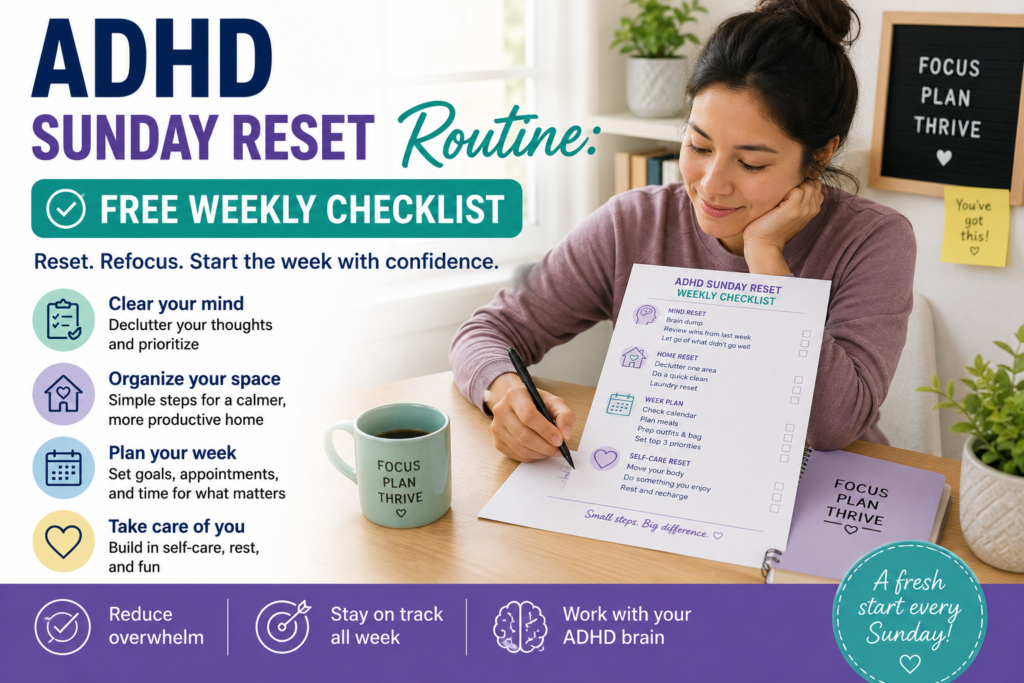
Template 1: The Free Weekly Checklist

Print this checklist, laminate it, or keep it on your refrigerator. Do not try to memorize the steps; externalize them.

🔄 The ADHD Sunday Reset RoutinePhase 1: Environment (20 Mins)
[ ] Start a 90-minute timer.
[ ] Put on podcast/music (audio anchor).
[ ] 10-Minute visual sweep (put away stray items, clear flat surfaces).
[ ] Take out trash & recycling.
[ ] Start one load of priority laundry (work clothes).Phase 2: Cognitive Clear-Out (20 Mins)
[ ] 10-Minute Brain Dump (write everything down).
[ ] Review Calendar for Mon-Fri (note meetings, deadlines).
[ ] Pick Top 3 Priorities for Monday.
[ ] Move those 3 priorities into the Daily Planner.
[ ] Park the rest of the tasks in the Weekly Planner.

Phase 3: Friction Removal (15 Mins)
[ ] Check Monday’s weather.
[ ] Lay out Monday’s complete outfit.
[ ] Prep Monday’s lunch/snacks and put in fridge.
[ ] Assemble the “Launch Pad” (keys, bag, wallet by the door).

Phase 4: Shutdown (5 Mins)
[ ] Move laundry to the dryer.
[ ] Turn off the timer.
[ ] Declare the reset complete and transition to rest.


Common Pitfalls and Expert Recommendations

Even with a checklist, the ADHD brain will inevitably encounter friction when trying to maintain this system. Here is how experts recommend handling the most common breakdown points.

  • The Perfectionism Trap: The most common reason ADHD adults abandon routines is all-or-nothing thinking. If you only have energy to do 10 minutes of the reset, just do the Calendar Audit and pick tomorrow’s clothes. A 10% reset is infinitely better than a 0% reset. Do not demand perfection.
  • Time Blindness During the Sweep: Without a timer, the “15-minute visual sweep” will turn into a three-hour hyperfocused deep-clean of your bathroom grout, leaving you exhausted and the rest of the reset unfinished. The timer is not a suggestion; it is a critical neurological boundary. When the 15 minutes are up, you must stop cleaning and move to the cognitive phase.
  • Ignoring the Importance of Planning and Organization: It is easy to assume that just cleaning your space is enough of a reset. However, without dedicated planning and structured organization, a clean kitchen will not save you from a missed deadline on Tuesday. The cognitive clear-out phase—where you externalize tasks and prioritize them—is the true engine of the reset. Proper organization of your upcoming week ensures that your executive function is reserved for execution rather than putting out fires.
  • Seeking Professional ADHD Help: If you find yourself completely paralyzed by anxiety every Sunday, to the point where you cannot initiate even a basic five-minute task, you may be dealing with severe executive dysfunction or comorbid anxiety. This is a clear signal to seek professional **ADHD help**. Cognitive Behavioral Therapy (CBT) or working with an ADHD coach can help you break the emotional avoidance barrier that prevents task initiation. They can provide specific strategies for planning your routines and building a sustainable system of organization that works with your neurobiology rather than against it.

Frequently Asked Questions

Does it have to be on Sunday?

No. The term **adhd sunday reset routine** is standard because Monday is the typical start of the workweek. If your work schedule is non-traditional (e.g., your “Monday” is actually Thursday), perform your reset on the day before your workweek begins. The biological principle is building a bridge before a major transition, regardless of the calendar day.

What time of day is best for a reset?

For ADHD brains, late afternoon (3:00 PM to 5:00 PM) is usually optimal. Doing it too early on Sunday ruins the feeling of having a weekend. Doing it too late (9:00 PM) invites Revenge Bedtime Procrastination, as your brain is too tired to execute executive functions and will likely choose to scroll on a phone instead, leading to disrupted sleep.

What if I completely forget to do it?

Do a “Monday Morning Micro-Reset.” If you arrive at Monday completely unprepared, do not dive straight into your inbox. Take 15 minutes immediately upon waking (or arriving at your desk). Do a 5-minute brain dump, pick 3 priorities, and fetch a glass of water. It is not as effective as a full Sunday reset, but it is enough to break the paralysis and get the engine started.

How do I make the routine stick long-term?

The ADHD brain struggles with long-term consistency because the initial novelty of a new system wears off rapidly. To combat this, you must track your consistency to provide visual dopamine hits. Use the ADHD Habit Tracker to check off each successful reset. Try to build a “streak.” Furthermore, frequently change your “Audio Anchor” (a new podcast, a new album) to inject novelty back into the routine without changing the core structural steps.


Conclusion: Reclaiming Your Weekends and Your Workweeks

The anxiety of the “Sunday Scaries” is not a personality flaw. It is your brain’s very logical response to staring down a massive, unstructured mountain of future demands with a compromised executive function system. Your brain is panicking because it knows it cannot hold all that information and make all those decisions simultaneously on Monday morning.
The **adhd sunday reset routine** is the structural scaffolding that supports your brain. By taking 60 to 90 minutes to visually quiet your environment, externalize your working memory onto paper, define your priorities, and pre-make your basic survival decisions, you remove the friction that causes Monday morning paralysis.
You transition from a state of constant reaction to a state of calm intention.
This Sunday, do not let the sunset dictate your anxiety. Set a timer. Put on a podcast. Clear the counters. Dump your brain onto a piece of paper. Pick your clothes for tomorrow. By dedicating just one hour to your future self, you can definitively break the cycle of exhaustion, boost your **productivity**, and finally start your week feeling capable, prepared, and in control.

🚀Ready to build your ultimate weekly system? A Sunday reset requires tools to capture the output. Use the ADHD Weekly Planner to park all the tasks you generate during your brain dump. Use the ADHD Daily Planner to securely hold your top three Monday priorities. If you struggle with time blindness during the reset, block out the precise time using the ADHD Time Management Planner, and ensure your reset becomes an unbreakable habit by using the ADHD Routine Generator and the ADHD Habit Tracker.
✍️ Author: saqlainmehar2@gmail.com 📅 Last reviewed: July 20, 2026 📋 Editorial Policy 📬 Suggest a Correction