ADHD Decision Fatigue: How to Stop Overwhelm and Make Choices with Confidence
You are standing in the middle of a grocery store aisle on a Tuesday evening. In your hand is a shopping list containing just three items, but you have been staring at the salad dressing section for fifteen minutes. There are forty-two different brands, flavors, and bottle sizes. Your mind is completely blank. You try to evaluate the options—organic vs. standard, vinaigrette vs. creamy, price per ounce—but your brain refuses to process the information. The cognitive engine is stalled. You feel a rising sense of irritability, a heavy fog behind your eyes, and a strong urge to leave the cart where it is and walk out of the store.
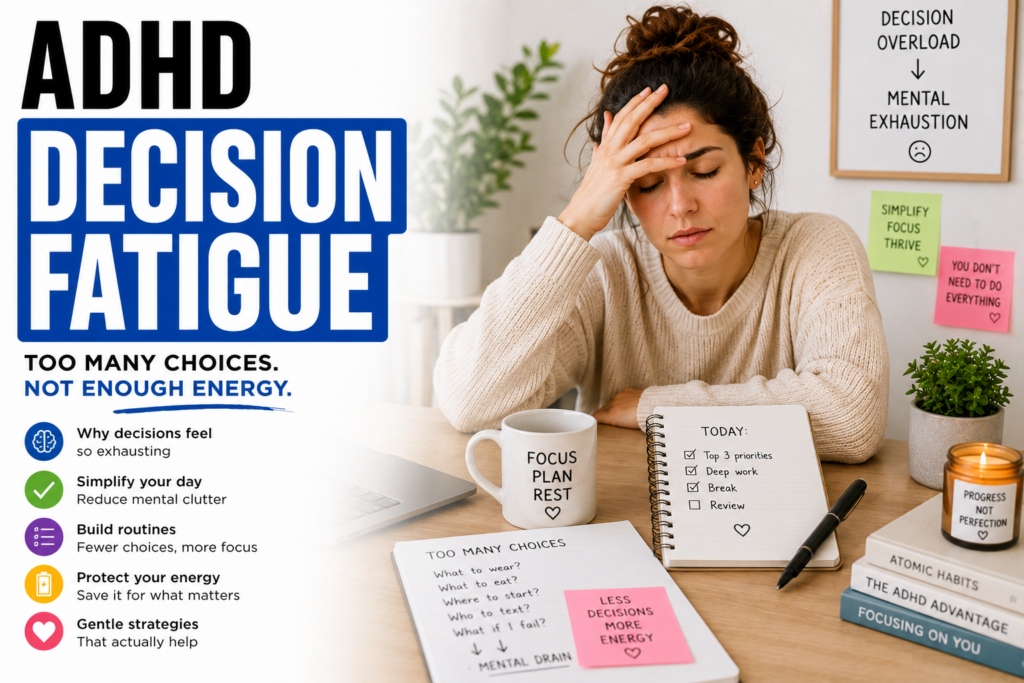
If you have Attention Deficit Hyperactivity Disorder (ADHD), this state of paralysis is not a sign of weakness or a lack of intellect. It is the physiological reality of **ADHD Decision Fatigue**.
Every day, the human brain makes thousands of decisions, from what to wear and eat to how to prioritize emails and respond to colleagues. For a neurotypical brain, small decisions are processed automatically in the background, consuming minimal energy. However, for the ADHD brain, the system that filters, prioritizes, and automates choices is compromised. Every decision—no matter how trivial—demands the same high level of active executive energy.
This comprehensive guide provides an evidence-based, clinical-grade overview of **decision fatigue in adults with adhd**. You will learn the science behind why your brain struggles with **decision making**, discover how this executive drain triggers **adhd overwhelm**, and gain access to an actionable, step-by-step framework detailing how to reduce **adhd decision fatigue** through structural automation and ADHD-friendly systems. By learning to externalize choices, you can protect your executive battery and start every day with clarity instead of paralysis.
What Causes Decision Fatigue in Adults with ADHD?
To learn how to manage this cognitive exhaustion, we must first address the foundational question: **What causes ADHD decision fatigue?**
Decision fatigue occurs when the quality of decisions made by an individual deteriorates after a long session of decision-making. For adults with ADHD, this exhaustion occurs much faster and more intensely due to three core neurological differences.
- A Lack of Automatic Salience Filtering: The ADHD brain struggles with “salience filtering”—the ability to automatically determine what is important and what can be ignored. When a neurotypical person decides what to wear, their brain filters out 90% of their closet immediately based on the weather or context. The ADHD brain, however, treats every item in the closet as an active, equal option, forcing the prefrontal cortex to manually evaluate dozens of choices before breakfast.
- Working Memory Overload: Decision-making requires holding multiple variables in your mind simultaneously, comparing their outcomes, and selecting the best path. Because ADHD is associated with a significantly reduced working memory capacity, the brain must work twice as hard to keep these variables from “slipping off” the mental whiteboard. This constant mental effort drains cognitive reserves within hours.
- Dopamine-Deficit Reward Valuation: Dopamine is the brain’s currency for estimating value and reward. When making a decision, the brain uses dopamine signals to predict the outcome of each choice. In an ADHD brain, these dopamine signals are flat and inconsistent, making it difficult to determine which option is “better.” The brain gets stuck in a loop of endless evaluation, unable to generate the biochemical spark needed to make a final selection.
Symptoms of ADHD Decision Fatigue: Recognizing the Warning Signs
When your executive battery is depleted by constant choice-making, the cognitive debris manifests in predictable behavioral patterns. Recognizing these symptoms of **adhd overwhelm** is the first step toward building protective systems.
| Symptom | What Is Happening Neurologically | How It Feels in Daily Life |
|---|---|---|
| Decisional Paralysis | The prefrontal cortex is depleted of active neurotransmitters, leaving it unable to execute a choice. | Staring at your inbox for an hour, unable to decide which of three urgent emails to reply to first. |
| Impulsive Defaulting | The brain bypasses the exhausted executive system and selects the path of least resistance or immediate gratification. | Agreeing to an expensive subscription you do not need, or buying fast food because planning dinner feels impossible. |
| Avoidance and Deferral | The brain associates decision-making with anxiety and pain, leading to chronic task avoidance. | Leaving unopened mail on the counter for weeks because deciding where to file it feels overwhelming. |
| Increased Irritability | The amygdala becomes hypersensitive as the prefrontal cortex loses its ability to regulate emotional responses. | Snapping at a family member who asks a simple question like, *”What do you want for dinner?”* |
| Severe Brain Fog | A protective shutdown of the executive system to prevent further cognitive energy expenditure. | A heavy, static-like feeling in your head; being unable to formulate clear sentences or read simple text. |
Scientific Background & Comparative Neurobiology
To manage decision-making struggles, we must examine the specific neurological dynamics of the ADHD brain and how they differ from neurotypical experiences.
The 30% Rule with ADHD and Decision Exhaustion
A crucial concept developed by ADHD pioneer Dr. Russell Barkley is the **30% rule with ADHD**. This developmental guideline states that individuals with ADHD generally lag behind their neurotypical peers by approximately 30% in executive functioning age and self-regulation capacities.
This means that a 30-year-old adult with ADHD possesses the chronological intelligence of their age, but their executive age (the capacity to organize, prioritize, initiate, and sustain choices) is closer to that of a 21-year-old.
In the context of **decision making**, the 30% rule explains why adults with ADHD experience profound exhaustion when managing the complex, unstructured choices of modern adult life. A 21-year-old’s executive system is not designed to manage a 30-year-old’s career priorities, financial choices, and relationship negotiations without external structure. When we expect ourselves to make choices based entirely on chronological age, we overload our executive capacity and trigger chronic **adhd overwhelm**. Recovery requires implementing external supports that respect and support your actual executive age.
ADHD Decision Fatigue vs. Normal Decision Fatigue
It is important to distinguish the specific patterns of neurodivergent choice exhaustion from standard cognitive fatigue.
- The Cumulative Timeline: For a neurotypical adult, decision fatigue is a slow, cumulative process that peaks in the late evening (which is why grocery stores place candy near checkout lines). For an adult with ADHD, decision fatigue can hit by 9:00 AM. The sheer cognitive cost of managing morning transitions (waking up, finding keys, packing lunch, choosing an outfit) can deplete executive reserves before the workday even begins.
- The Stakes Paradox: Neurotypical decision fatigue is proportional to the importance of the choice. In ADHD, the brain struggles to scale its energy expenditure. Choosing a font style for a spreadsheet can consume the same cognitive energy as deciding on a home purchase, leading to rapid, unpredictable system depletion.
- The Role of Novelty: Standard decision fatigue makes individuals crave routine. However, the ADHD brain’s dopamine deficit means that routine can sometimes trigger boredom and task paralysis. Recovering from ADHD decision fatigue requires a balance between structured automation (to protect energy) and low-stakes novelty (to maintain dopamine).
Real-World Decision Scenarios
Scenario A: Pushing Through Without Support (Marcus’s Story)
Marcus is a 29-year-old project manager with ADHD. He starts his day with a long, unstructured to-do list. Throughout the morning, he must make dozens of minor choices: which email to answer, what format to use for a report, and how to schedule his afternoon. By 2:00 PM, Marcus has entered a state of severe **adhd decision fatigue**.
When his manager asks him to choose between two project directions, Marcus’s mind freezes. He feels an intense wave of irritability.
He leaves the office to get a coffee, but at the cafe, he spends five minutes trying to choose a snack. Overwhelmed by the options, he leaves without buying anything.
He returns to his desk, but for the rest of the afternoon, he experiences complete task paralysis, unable to initiate any work. That evening, he orders fast food because deciding on a grocery list feels like climbing a mountain.
Scenario B: Streamlining Choices (David’s Story)
David, a 41-year-old graphic designer, recognized that decision-making was the primary source of his daily overwhelm.
He decided to implement a structured decision-reduction plan. First, he created a “morning uniform”—five identical pairs of dark trousers and grey shirts—eliminating the choice of what to wear. He established a fixed meal template, eating the same lunch Monday through Friday.
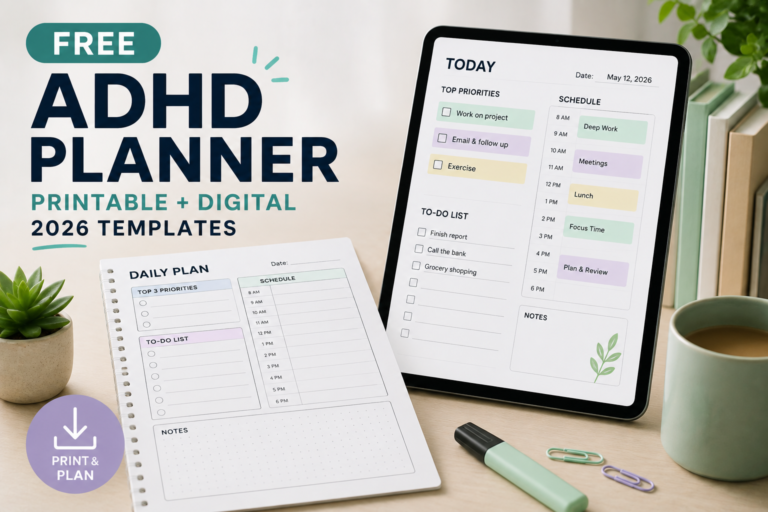
David also shifted his planning system. Instead of maintaining a large, open to-do list, he used the highly visual and structured layouts of the ADHD Daily Planner. Every Sunday evening, he pre-decided his three weekly priorities and mapped them to specific daily slots.
By automating low-stakes daily choices, David protected his prefrontal cortex’s battery. On Tuesday afternoon, when presented with a complex project direction, David had the cognitive energy required to make a clear, confident decision without entering a crash cycle.
Scenario C: The Partner Dynamics
Decisional conflicts are common in couples where one partner has ADHD. Lisa lives with her partner, Tom, who has ADHD.
Every evening, their conversations followed a frustrating pattern. Lisa would ask: *”What do you want for dinner?”* Tom, already depleted from his workday, would reply: *”I don’t care, whatever you want.”*
Lisa interpreted this as disinterest or laziness, while Tom felt defensive and overwhelmed.
After learning about the neurobiology of ADHD choice fatigue, they changed their approach. They agreed to a “rules-based selection” system. Instead of open-ended questions, Lisa would present Tom with exactly two options: *”Do you want pasta or tacos?”*
Additionally, they delegated decision-making categories. Tom was responsible for selecting the movie on weekends, while Lisa managed the dinner menu. By reducing the number of daily choices and limiting option scales, they eliminated relationship friction and reduced Tom’s evening overwhelm.
How to Deal with Decision Fatigue: The Actionable Framework
To recover from choices overload, you must stop trying to force your prefrontal cortex to process every option manually. The following four-phase framework details how to reduce **adhd decision fatigue** by automating daily routines and externalizing choices.
“`mermaid
graph TD
A[“Phase 1: Decision Elimination
(Automate Low-Stakes Choices)”] –> B[“Phase 2: Decisional Scaffolding
(Pre-Decide Tasks & Schedules)”]
B –> C[“Phase 3: Option Limitation
(Rule of Two & Structured Menus)”]
C –> D[“Phase 4: Cognitive Pacing
(Satisficing vs. Maximizing)”]
“`
Phase 1: Decision Elimination (Automating Low-Stakes Choices)
The goal of this phase is to remove low-value choices from your day entirely, preserving your executive energy for tasks that matter.
- Implement a Uniform System: Choose a simple, consistent outfit combination for your workweek. By eliminating the choice of what to wear, you start your morning with a full executive battery.
- Establish Fixed Meal Templates: Pre-determine your meals for the week. Eat the same breakfast and lunch during the workweek, and use a rotating 7-day dinner menu. This removes the question *”What should I eat?”* from your daily schedule.
- Automate Your Finances: Put all recurring bills on auto-pay. Set up automatic transfers for savings and investment accounts, reducing the need to make monthly financial choices.
Phase 2: Decisional Scaffolding (Pre-Deciding Your Days)
By separating the act of *planning* from the act of *doing*, you prevent the task paralysis that occurs when you try to prioritize on the fly.
- Pre-Decide Your Schedule: Do not start your workday deciding what to focus on. Use the ADHD Daily Planner to map out your priorities and time blocks the evening before. When you sit at your desk, your only task is to follow the plan, not create it.
- Create Structured Morning Routines: Build a fixed, step-by-step sequence for your morning. Use the ADHD Routine Generator to establish a low-friction routine that gets you out the door without requiring active decision-making.
- Externalize Priorities: Avoid maintaining a long, open-ended to-do list. Select a maximum of three priority outcomes for your day, and write them on a card where they are constantly visible.
Phase 3: Option Limitation (The Rule of Two)
The ADHD brain struggles with multi-option evaluation. You must artificially limit the scope of your choices.
- Apply the Rule of Two: When making a choice, immediately narrow the options down to exactly two. If you are choosing a restaurant, pick two places and delete the rest. Choose between those two options only.
- Set Time Limits for Low-Stakes Choices: Set a strict timer (e.g., 2 minutes) for minor decisions. If you cannot decide on a menu item or a notebook color before the timer rings, default to the first option or flip a coin.
- Create “If-Then” Rules: Establish automatic responses to recurring scenarios. For example: *”If I am invited to an event on a Friday night, then my answer is automatically no, because I need to rest my system.”*
Phase 4: Cognitive Pacing (Embracing “Satisficing”)
Perfectionism often drives ADHD choice paralysis. You must train your brain to accept “good enough.”
- Shift from Maximizing to Satisficing: “Maximizers” strive to make the absolute best choice by researching every option. “Satisficers” define their criteria first and select the first option that meets those standards. Practice being a satisficer: define what you need, find an option that fits, and make the purchase or decision immediately.
- Schedule Decisional Buffer Times: Do not schedule important meetings or decision-heavy projects in the late afternoon. Block out quiet times in your calendar where no active choices are required.
- Deconstruct Large Choices: When faced with an overwhelming decision, use the ADHD Task Breakdown Tool to split the choice into smaller, low-stakes questions, preventing task paralysis.
Clinical Pathways: Professional Support and Interventions
If choice paralysis is consistently impacting your career progress, relationships, or mental health, professional support can help you build sustainable systems:
- ADHD Coaching: Certified coaches specialize in helping you design decision-reduction systems, troubleshoot where routines break down, and build accountability structures.
- Cognitive Behavioral Therapy (CBT): Helps address the perfectionism, anxiety, and shame patterns that sabotage decision-making. It builds the cognitive flexibility needed to make choices without fear of failure.
- Professional Support Networks:
- United States: CHADD provides directories for adult ADHD support groups and specialists.
- United Kingdom: The ADHD Foundation offers coaching referrals and organizational workshops.
- Canada: CADDAC provides adult ADHD support groups and webinars across provinces.
- Australia: ADHD Australia connects individuals with local specialists and peer support networks.
Printable Decision Templates
Template 1: The Decisional Priority Matrix (The Rule of Two)
Use this visual template to quickly narrow down complex choices and make decisions without entering a paralysis loop.
⚖️ The ADHD Decision ScaffoldThe Decision to Make: __________________________________________________
1. Define the Standard (What is “Good Enough”?):
• Must cost under: $_________ | Must take under: _________ hours.
• Must satisfy this core need: _________________________________________
2. Apply the Rule of Two (Select exactly two options and discard the rest):
• Option A: _______________________________________________________
• Option B: _______________________________________________________
3. Compare and Select (Set a 2-minute timer):
• [ ] Option A meets the standard best because: __________________________
• [ ] Option B meets the standard best because: __________________________
4. Final Action (If stuck, flip a coin): Selected Option: ___________________
Template 2: The Weekly Automation Sheet
Fill out this sheet to eliminate recurring choices from your workweek.
| Day | Morning Uniform | Lunch Template | Core Priority (Max 1) | Evening Decompression Time |
|---|---|---|---|---|
| Monday | Outfit Option 1 | Chicken Salad Wrap | Draft project proposal | 7:30 PM — No screen time |
| Tuesday | Outfit Option 2 | Quinoa Protein Bowl | Team feedback meeting | 8:00 PM — Quiet reading |
| Wednesday | Outfit Option 3 | Turkey Sandwich | Budget sheet review | 7:00 PM — Warm bath |
| Thursday | Outfit Option 4 | Salmon Salad | Client presentation | 8:30 PM — Walk outdoors |
| Friday | Outfit Option 5 | Vegetable Soup | Weekly close-out | 6:30 PM — Cozy gaming |
Frequently Asked Questions
What is ADHD decision fatigue?
ADHD decision fatigue is the rapid cognitive and physical exhaustion that adults with ADHD experience from making choices. It stems from executive dysfunction in the prefrontal cortex, which struggles to filter out irrelevant options and prioritize information, forcing the brain to process every choice manually.
How do I stop decision fatigue?
To stop decision fatigue, you must automate low-stakes choices (e.g., using uniforms, meal templates, auto-pay bills), pre-decide your schedule using tools like the ADHD Daily Planner, limit your options to exactly two, set strict time limits for minor choices, and practice “satisficing” (choosing the first option that meets your standards).
Why does decision making feel so hard with ADHD?
Decision-making is difficult with ADHD because of working memory deficits and dysregulation in the dopamine reward system. The ADHD brain struggles to estimate the future value of different choices, leading to endless loops of evaluation, cognitive overload, and eventual task paralysis.
What is the 30% rule with ADHD?
The 30% rule with ADHD, formulated by Dr. Russell Barkley, states that individuals with ADHD lag behind their neurotypical peers by about 30% in executive age and self-regulation skills. Understanding this gap is essential for preventing decision fatigue by adjusting expectations to match your actual executive capacity.
How do I deal with ADHD overwhelm?
To deal with ADHD overwhelm, immediately stop trying to process choices. Step away from your environment, reduce sensory stimulation (e.g., wear noise-canceling headphones, dim the lights), drink a glass of water, and externalize your tasks using a visual planner.
Conclusion: Protecting Your Executive Battery
Managing ADHD decision fatigue is not about becoming a faster decision-maker or forcing yourself to analyze more data. It is about recognizing that your executive brain operates on a limited battery. To protect that battery, you must build external systems that automate the background noise of life.
Start small. This week, select just one category of decisions to automate. Pre-decide your lunch menu, pick a weekly uniform, or use a visual planner to organize your day. Every choice you eliminate from your routine represents saved cognitive energy—energy you can use to focus on what truly matters to you.