ADHD Workplace Accommodations: The Complete Guide to Workplace Support and Executive Success
You are sitting at your desk in a bustling, open-plan office. Around you, a colleague is typing loudly, two managers are discussing a project three desks away, and the hum of the air conditioning fills the background. You have a critical report due by 5:00 PM, but you have spent the last two hours staring at the same paragraph, unable to make sense of the data. Every time you try to focus, a new noise pulls your attention away. You feel your stress levels rising, your heart racing, and a familiar sense of panic setting in. You know you are capable of doing the work, but your current environment makes it feel impossible.
For many adults with Attention Deficit Hyperactivity Disorder (ADHD), the modern workplace is a minefield of executive challenges. Standard office environments, back-to-back meetings, and unstructured workflows are often hostile to the neurodivergent brain. When you struggle to keep up, it is easy to assume it is a personal failing. However, the reality is that your brain simply requires different structural supports to function at its best.
Under national labor laws in the United States, the United Kingdom, Canada, and Australia, employers are legally required to provide reasonable adjustments to support neurodivergent employees. Implementing **ADHD Workplace Accommodations** is not a matter of asking for special treatment; it is about leveling the playing field so you can perform your duties without constant executive exhaustion.
This comprehensive guide provides an evidence-based, clinical-grade overview of **adhd accommodations at work**. You will learn the legal frameworks governing neurodivergent rights in major English-speaking regions, discover a wide range of practical **adhd workplace accommodations examples**, and gain access to an actionable, step-by-step framework for requesting **workplace support adhd** systems from your employer without fear or shame. By utilizing these specialized tools and advocacy strategies, you can transition from survival mode to professional thriving.
The Science of ADHD in the Workplace: Why Support is Necessary
To understand why accommodations are required, we must examine the specific neurological dynamics of the ADHD brain in a professional setting. ADHD is not a behavioral problem or a lack of motivation; it is a structural and chemical difference in the brain’s self-regulation networks.
Executive Dysfunction and the Prefrontal Cortex
The prefrontal cortex (PFC) is the brain’s executive control center. It manages functions such as working memory, task prioritization, focus regulation, time estimation, and impulse control. In an ADHD brain, the PFC receives insufficient levels of the neurotransmitters dopamine and norepinephrine. This chemical deficit compromises the brain’s ability to:
- Filter out irrelevant environmental stimuli (background noise, visual movement).
- Estimate how long a task will take (leading to chronic time blindness).
- Initiate tasks that do not offer immediate interest or reward.
- Transition smoothly between different projects or tasks.
In a typical office setting, these neurological differences manifest as missed deadlines, disorganized workspaces, difficulty starting projects, and rapid sensory overload.
The 30% Rule with ADHD and Professional Expectations
A critical framework developed by ADHD expert Dr. Russell Barkley is the **30% rule with ADHD**. This developmental guideline states that individuals with ADHD lag behind their neurotypical peers by approximately 30% in executive age and self-regulation capacities.
For example, a 30-year-old professional with ADHD possesses the intellect, creativity, and technical skills of their age, but their executive age (the capacity to organize, self-monitor, manage time, and handle frustration) is closer to that of a 21-year-old.
In a career context, this developmental gap explains why a highly intelligent employee might draft brilliant strategic plans but consistently fail to submit expense reports on time, keep an organized inbox, or remember meeting details. Standard workplaces assume that chronological age matches executive capacity. When this assumption fails, the neurodivergent professional experiences chronic stress, performance reviews, and eventual burnout. Accommodations act as external executive scaffolds, bridging the gap between an individual’s technical intelligence and their executive age.
Why Accommodations Matter: Masking vs. Productivity
Without formal accommodations, many adults with ADHD resort to “masking”—expending immense cognitive and emotional energy to appear organized and neurotypical. Common masking behaviors at work include:
- Working late or during weekends in secret to catch up on tasks.
- Double-checking emails and documents repeatedly out of intense anxiety over detail errors.
- Constantly policing body movements (suppressing fidgeting) to appear attentive in meetings.
- Saying “yes” to every request out of fear that boundary-setting will expose their struggles.
While masking can temporarily preserve a professional reputation, it is biochemically unsustainable. It keeps the nervous system in a state of high-alert survival, leading to chronic physical exhaustion, spikes in rejection sensitive dysphoria (RSD), and eventual career burnout.
Transitioning to a workplace support system allows you to redirect your energy from *hiding* your difficulties to *solving* them, resulting in higher productivity, fewer errors, and a sustainable career path.
Comprehensive ADHD Workplace Accommodations Examples
When requesting adjustments, specificity is key. Employers often want to help but do not know what supports are effective. The following list provides practical **adhd workplace accommodations examples** categorized by the executive challenges they address.
### 1. Focus and Sensory Management (Reducing Distractions)
Open-plan offices are major sources of sensory and cognitive overload for the ADHD brain. Adjusting these elements represents some of the most common adhd accommodations at work, aiming to protect attention.
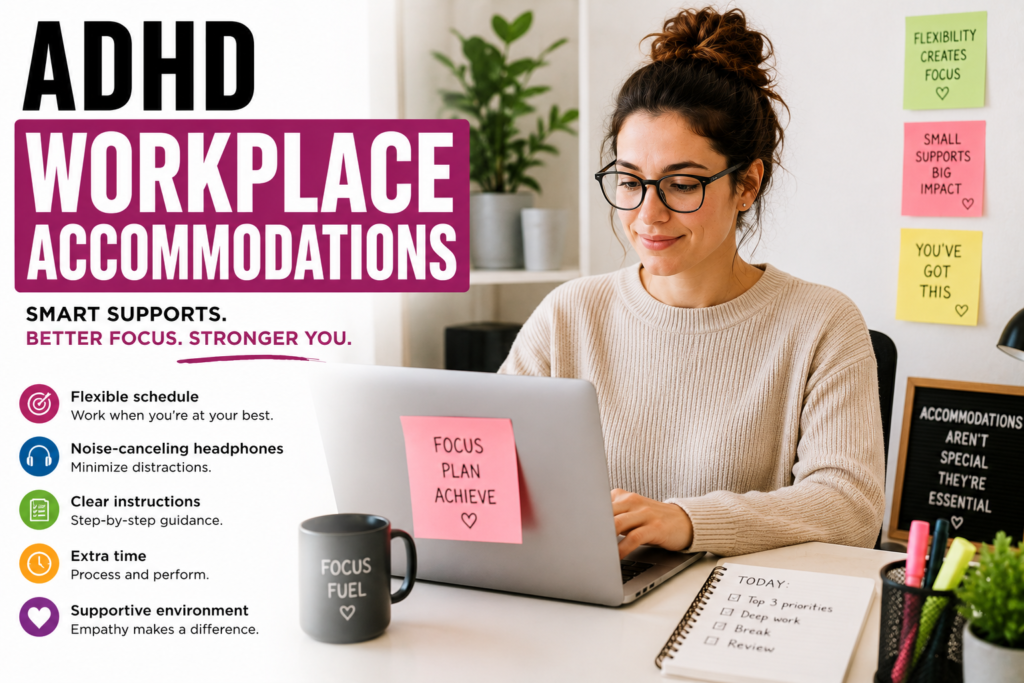
- Noise-Canceling Technology: Permission to wear noise-canceling headphones or earplugs during independent work hours.
- Dedicated Quiet Workspaces: Access to a private office, an empty meeting room, or a designated quiet zone for tasks requiring deep focus.
- Desk Location Adjustments: Placing your desk in a low-traffic area, such as away from the kitchen, restrooms, elevator, or main walkways, and facing a wall rather than an open hallway.
- Visual Barriers: Utilizing desk partitions, cubicle dividers, or privacy screens to block out distracting visual movement.
- Lighting Controls: Replacing harsh fluorescent bulbs at your workspace with natural-spectrum lighting or warm desk lamps to reduce sensory irritation.
### 2. Time Management and Flexible Scheduling
Time blindness and task initiation struggles make rigid schedules difficult for the ADHD brain to manage. Adjustments in this area help align working hours with cognitive peaks.
- Flexible Start and End Times: A flexible window (e.g., starting between 8:00 AM and 10:00 AM) to accommodate morning executive delays or sleep dysregulation.
- Hybrid or Remote Work Options: Working from home 2–3 days per week to minimize commute stress and control environmental distractions.
- Core Working Hours: Establishing a standard window (e.g., 10:00 AM to 3:00 PM) where all team meetings must occur, leaving early mornings and late afternoons free for uninterrupted deep work.
- Structured Micro-Breaks: Permission to take short, scheduled breaks (e.g., 5 minutes every hour) to move, stretch, or hydrate, helping reset focus and prevent cognitive fatigue.
### 3. Task Organization and Memory Scaffolding
Working memory deficits make it difficult for the ADHD brain to track spoken instructions, multi-step projects, and shifting priorities. Scaffolding supports externalize information.
- Written Follow-Ups: Requiring that all spoken instructions, verbal requests, and meeting action items be followed up in writing via email or a project management tool.
- Meeting Recordings and Transcripts: Permission to record meetings or use AI transcription services (e.g., Otter.ai) to ensure no critical details are lost during note-taking.
- Structured Task Templates: Providing clear, written templates, rubrics, or examples of completed work to clarify expectations for new projects.
- Visual Project Trackers: Using shared visual boards (such as Trello, Asana, or physical Kanban boards) to track progress and priorities rather than relying on status emails.
- Daily Priorities Review: A brief, 10-minute check-in with a manager at the start of each day or week to confirm and order priority tasks.
### 4. Interactive and Environmental Support
Some adjustments involve collaborative check-ins and physical tools that help maintain motivation and accountability.
- Body Doubling: Working alongside a colleague or team member during quiet sessions, either in person or via video, to maintain focus and reduce task paralysis.
- Fidget and Movement Tools: Permission to use silent fidget tools, under-desk pedal devices, or standing desks to satisfy the body’s need for movement without distracting others.
- Job Restructuring: Exchanging minor, non-essential job tasks that clash with executive weaknesses (e.g., formatting spreadsheets or filing expense reports) for tasks that align with your strengths (e.g., presentations, creative brainstorms).
Legal Rights and Frameworks by Region
Your right to workplace support is protected by law. Understanding the legislation in your country is essential for communicating with HR and managers.
### 1. United States: The Americans with Disabilities Act (ADA)
In the US, ADHD is recognized as a protected disability under the Americans with Disabilities Act Amendments Act (ADAAA) if it substantially limits one or more major life activities (including learning, concentrating, thinking, and working).
* Employer Coverage: Applies to all private employers with 15 or more employees, as well as state and local government agencies.
* Key Requirement: Employers must provide “reasonable accommodations” to qualified employees, unless doing so imposes an “undue hardship” (significant difficulty or expense) on the business.
* Support Resource: The Job Accommodation Network (JAN) provides free, expert guidance on ADA accommodations.
### 2. United Kingdom: The Equality Act 2010
In the UK, ADHD qualifies as a disability under the Equality Act 2010 if it has a substantial and long-term adverse effect on your ability to carry out normal day-to-day activities.
* Key Requirement: Employers have a legal “duty to make reasonable adjustments.” This duty is proactive—employers must take steps to remove barriers that put disabled employees at a disadvantage.
* Support Resource: The **Access to Work** scheme is a government-funded program that provides grants to cover the costs of practical workplace support, such as ADHD coaching, specialist equipment, or travel expenses.
### 3. Canada: Employment Equity Act & Provincial Human Rights Codes
In Canada, protection from discrimination and the right to accommodation are governed by both federal and provincial human rights codes.
* Employer Coverage: The federal Employment Equity Act covers federally regulated sectors (banks, telecommunications, transportation). Provincial Human Rights Codes (such as the Ontario Human Rights Code) cover all other businesses.
* Key Requirement: Employers have a legal “Duty to Accommodate” neurodivergent employees to the point of “undue hardship.” This requires a collaborative, individualized assessment process between the employer, employee, and medical professionals.
### 4. Australia: Disability Discrimination Act 1992 (DDA)
In Australia, ADHD is covered under the Disability Discrimination Act 1992 (DDA).
* Key Requirement: Employers must make “reasonable adjustments” to assist employees with disabilities to perform their duties, unless it causes “unjustifiable hardship” to the employer.
* Support Resource: JobAccess is an Australian government initiative that provides free information, advice, and financial support for workplace adjustments.
How to Request ADHD Workplace Accommodations: A Step-by-Step Framework
Requesting adjustments can feel intimidating, but using a structured approach helps protect your professional reputation and ensures a collaborative outcome.
“`mermaid
graph TD
A[“Phase 1: The Self-Audit
(Identify Triggers & Strengths)”] –> B[“Phase 2: Define Disclosure Strategy
(Full Disclosure vs. Functional Request)”]
B –> C[“Phase 3: Prepare the Request
(Match Challenges with Solutions)”]
C –> D[“Phase 4: The Collaborative Meeting
(HR & Manager Dialogue)”]
D –> E[“Phase 5: Implementation & Review
(Monitor & Adjust Scaffolds)”]
“`
### Phase 1: The Self-Audit
Before speaking to your employer, you must identify your specific executive challenges and what supports will help resolve them.
- Track Your Triggers: For one week, note when you feel most distracted, overwhelmed, or stuck. Is it after long meetings? In open-plan settings? When receiving verbal instructions?
- Focus on Strengths: Identify where you excel. Accommodations should not just address weaknesses; they should clear obstacles so you can spend more time doing your best work.
### Phase 2: Define Your Disclosure Strategy
You do not always need to disclose your formal diagnosis to receive support. You have two primary options:
- The Functional Request (No Diagnosis Named): You request adjustments by focusing entirely on your working style and productivity. For example: *”I find that I am much more productive when I can use noise-canceling headphones to block out background noise during independent work hours.”* This is an excellent, low-risk strategy for early-stage support.
- The Formal Disclosure (Naming ADHD): You formally disclose your diagnosis to HR to initiate the legal accommodation process. This is necessary if you need significant adjustments (like private offices or flexible core hours) or if you need legal protection due to performance concerns.
### Phase 3: Prepare Your Request Document
Draft a simple, professional document that structures your request. Frame every adjustment as a solution that increases your value to the company. Use this structure:
* The Challenge: Describe the executive difficulty objectively (e.g., *”Open office noise impacts my focus”*).
* The Proposed Accommodation: Offer a specific, low-cost solution (e.g., *”Permission to wear noise-canceling headphones during independent writing”*).
* The Business Benefit: Explain how this adjustment improves productivity and quality of work (e.g., *”This will reduce errors and speed up report turnaround times”*).
### Phase 4: The Collaborative Meeting
Schedule a meeting with your direct manager or HR representative.
- Maintain a Collaborative Tone: Frame the conversation as a partnership. Use phrases like: *”I want to ensure I am delivering my best work, and I have identified a few adjustments that will help me work more efficiently.”*
- Be Prepared for Negotiation: Employers may suggest alternative adjustments. Be open to trying their suggestions, but request a trial period (e.g., 30 days) to evaluate if the alternatives are effective.
### Phase 5: Implementation and Review
Accommodations are not static; they should adapt to your changing workload.
- Schedule a Follow-Up: Set a date (e.g., 6 weeks out) to review how the adjustments are working with your manager.
- Document Everything: Keep written records of your requests, meetings, and agreed-upon adjustments in case of future performance reviews or management changes.
Real-World Workplace Scenarios
Scenario A: The Unaccommodated Struggle (Elena’s Story)
Elena is an executive assistant at a busy accounting firm. She struggles with auditory processing and working memory, which makes tracking her manager’s verbal instructions difficult.
Because she has not requested support, she relies on her memory. She consistently forgets minor details from meetings, misinterprets verbal tasks, and spends her evenings in a state of high anxiety, trying to double-check her calendar.
Her manager notices the missed details and schedules a formal performance review.
Because Elena has no formal accommodations or written record of her struggles, the review focuses entirely on performance issues, leading to a highly stressful work environment and eventual resignation.
Scenario B: Implementing Adjustments (Liam’s Story)
Liam is a project manager with ADHD. He struggles with time blindness and task initiation, frequently starting projects late and scrambling to meet deadlines.
Liam decides to implement workplace supports. Instead of disclosing his formal diagnosis immediately, he uses a functional request strategy with his manager.
He requests three specific adjustments: (1) all project deadlines must be broken into smaller milestone dates, (2) his manager must send key instructions via Slack rather than verbally, and (3) he will use the visual layouts of the ADHD Daily Planner to track his daily priorities, sharing his board with his manager weekly.
His manager agrees to these low-cost adjustments. Within a month, Liam’s milestone completion rate increases by 40%, his deadline anxiety decreases, and his manager praises his improved organization.
Scenario C: The Manager’s Proactive Guide
Marcus is a department lead. He notices that one of his graphic designers, Chloe, is highly creative but struggles to stay focused in their open-plan office. She frequently misses details in verbal briefings and appears overwhelmed during team meetings.
Instead of waiting for a performance issue to arise, Marcus schedules a collaborative check-in.
He says: *”Chloe, your creative work is outstanding. I noticed you seem to find the open office distracting. I want to make sure you have the environment you need to focus. Would you like to try using noise-canceling headphones, or would you prefer to work from the quiet conference room during your design blocks?”*
Marcus also agrees to send all client feedback in writing via Trello. Chloe feels supported, her focus improves, and the team meets its project deadlines ahead of schedule.
Integrating ADHD-Friendly Systems at Work
While workplace accommodations provide the external framework, you must also implement internal systems to manage your daily tasks.
- Establish Energy-Aligned Routines: Align your working hours with your cognitive peaks. Use the ADHD Routine Generator to design daily schedules that balance high-demand project blocks with sensory recovery times.
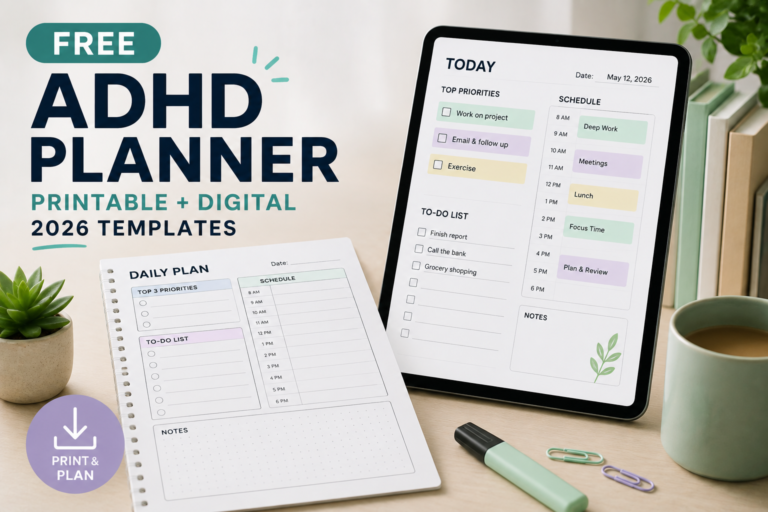
- Externalize Your Memory: Do not rely on your brain to hold project details. Use the visual and simplified layouts of the ADHD Daily Planner to keep your priorities visible, preventing the time blindness that leads to missed deadlines.
- Deconstruct Overwhelming Projects: Task paralysis often occurs when a project feels too large or vague. Use the ADHD Task Breakdown Tool to split complex assignments into clear, low-friction micro-tasks.
Printable Workplace Accommodations Templates
Template 1: Formal Accommodation Request Email (ADA / Equality Act)
Copy, customize, and send this template to your HR representative or manager to initiate the formal accommodation process.
✉️ Accommodation Request TemplateSubject: Confidential Request for Reasonable Accommodations — [Your Name]
Dear [HR Contact or Manager Name],
I am writing to formally request reasonable workplace accommodations under the [ADA / Equality Act 2010 / Human Rights Code / Disability Discrimination Act]. I value my role at [Company Name] and want to ensure I continue to perform my duties to the best of my ability.
I have a formal diagnosis of Attention Deficit Hyperactivity Disorder (ADHD). This condition impacts my executive functioning, specifically my [working memory / auditory filtering / time estimation]. To help manage these challenges and maintain high productivity, I would like to request the following reasonable adjustments:
1. [Adjustment 1, e.g., Written Follow-Ups]: Receiving key instructions and meeting action items in writing via email or Slack to ensure accuracy.
2. [Adjustment 2, e.g., Focus Support]: Permission to use noise-canceling headphones during independent work hours to reduce environmental distractions.
I would like to schedule a brief meeting next week to discuss these adjustments and how we can implement them collaboratively. Thank you for your time and support.
Sincerely,
[Your Name]
[Your Job Title]
Template 2: Accommodations Tracking Sheet
Use this sheet to monitor the implementation and effectiveness of your workplace adjustments.
| Accommodation | Date Requested | Status (Approved/Trial/Denied) | Review Date | Effectiveness Notes (Impact on Work) |
|---|---|---|---|---|
| Written meeting recaps | ____ / ____ / ____ | [ ] Approved | [ ] Trial | ____ / ____ / ____ | Helped reduce detail errors by 90%. |
| Noise-canceling headphones | ____ / ____ / ____ | [ ] Approved | [ ] Trial | ____ / ____ / ____ | Essential for blocking open office noise. |
| Work-from-home (2 days) | ____ / ____ / ____ | [ ] Approved | [ ] Trial | ____ / ____ / ____ | Significant decrease in weekly fatigue. |