ADHD Meal Planning Guide: Simple Systems for Stress-Free Eating Every Day
It is 6:30 in the evening. You have just finished work, and you are standing in front of an open refrigerator. Inside, there is a bag of spinach you bought with good intentions last Monday, three condiments, half a block of cheese, and some leftover rice from the weekend. Your brain cycles through every possible meal combination, but each option feels too complicated, too boring, or requires ingredients you do not have. Twenty minutes later, you are ordering takeout again—simultaneously relieved and ashamed, already dreading tomorrow’s version of the same problem.
For adults with Attention Deficit Hyperactivity Disorder (ADHD), this is not a failure of willpower or domestic competence. It is the predictable outcome of launching every single day without a structured food system. The ADHD brain struggles with prospective memory—the ability to remember to do something in the future—task initiation, impulse control, and time estimation. Together, these challenges make meal planning and preparation one of the most consistently difficult areas of daily life for neurodivergent individuals.
Yet food is not optional. **ADHD nutrition** directly impacts brain chemistry. What you eat—and when—has a measurable effect on dopamine availability, executive function, and sustained focus throughout the day. Skipping meals, eating impulsively, and relying on ultra-processed convenience foods perpetuate the very neurological conditions that make **ADHD meal planning** feel impossible in the first place.
This comprehensive guide provides an evidence-based, clinical-grade framework for **meal planning for adults with ADHD**. You will learn the neuroscience behind why your brain struggles with food decisions, discover a practical, low-friction system for **meal prep ADHD** routines, and gain access to an actionable weekly template and printable checklist. By implementing these **ADHD meal planning** strategies, you can reduce daily decision fatigue, stabilize your energy, and finally stop defaulting to expensive, nutrition-poor takeout options.
Why ADHD Brains Struggle with Meal Planning: The Neurological Reality
Before building a system, we must understand why meal planning feels so uniquely difficult for the neurodivergent brain. Several core executive function deficits combine to create what clinicians call “kitchen paralysis.”
- Prospective Memory Failure: Prospective memory is the ability to remember an intention at the right future moment—for example, remembering to defrost chicken at 5:00 AM so it is ready to cook at 6:00 PM. The ADHD brain handles prospective memory poorly, which means that even carefully planned meals are frequently derailed by forgotten ingredients, unfrozen proteins, or missed preparation windows.
- Task Initiation Paralysis: The ADHD brain requires a strong dopamine signal to initiate tasks that feel repetitive, effortful, or low-stimulation. Cooking a meal from scratch every evening falls squarely into this category. Even when you are hungry and have all the ingredients, the activation energy required to begin chopping, measuring, and cooking can feel insurmountable.
- Decision Fatigue: By the time evening arrives, an ADHD adult has typically spent the entire day burning through limited executive resources making workplace decisions, managing sensory input, and filtering environmental distractions. By dinnertime, the prefrontal cortex lacks the bandwidth to plan and execute a complex meal—resulting in impulsive ordering, binge eating, or meal skipping.
- Working Memory Overload: Executing a recipe requires holding multiple time-sequenced steps in your mind simultaneously. The ADHD brain’s limited working memory makes this cognitively exhausting. You forget that water is boiling while you chop vegetables, lose your place in a recipe, or burn a pan while distracted by a notification.
- Time Blindness: Accurately estimating how long cooking will take is extremely difficult for the ADHD brain. A meal that “should” take 20 minutes expands to 45 minutes because you underestimated prep time, leading to chronic late meals and a strong preference for immediate, pre-packaged alternatives.
ADHD Nutrition and Brain Chemistry: Why What You Eat Matters
Understanding **ADHD nutrition** is essential because food directly affects the very neurotransmitters that ADHD medication and lifestyle strategies aim to regulate.
Dopamine Synthesis and Protein
Dopamine—the neurotransmitter most central to ADHD—is synthesized from amino acids found in dietary protein. Tyrosine and phenylalanine, found in foods like eggs, lean meats, fish, legumes, and dairy, are the direct biochemical precursors to dopamine production. When an ADHD adult skips breakfast or replaces protein-rich meals with sugary, carbohydrate-heavy snacks, they deprive the brain of its raw dopamine-building materials, worsening focus, motivation, and emotional regulation throughout the day.
Blood Sugar Stability and Executive Function
The prefrontal cortex—already compromised by ADHD—is highly sensitive to fluctuations in blood glucose. A spike-and-crash blood sugar cycle, common in diets high in ultra-processed foods and refined carbohydrates, intensifies the symptoms of ADHD dramatically. When blood sugar drops sharply, executive function collapses, emotional dysregulation spikes, and focus becomes nearly impossible. For adults with ADHD, maintaining stable blood sugar is not just healthy eating advice; it is a neurological performance strategy.
Omega-3 Fatty Acids and Attention
Multiple peer-reviewed studies have found that omega-3 fatty acid supplementation—particularly EPA and DHA—can modestly but measurably improve attention, hyperactivity, and impulsivity in individuals with ADHD. Omega-3s are found in fatty fish (salmon, sardines, mackerel), walnuts, chia seeds, and flaxseeds. Including these foods as regular components of an **ADHD meal planning** system supports brain function independently of medication.
The 30% Rule with ADHD and Nutrition Complexity
Dr. Russell Barkley’s **30% rule with ADHD** states that individuals with ADHD lag behind neurotypical peers by approximately 30% in their executive functioning age. This means the executive demands of adult meal planning—budgeting, prospective scheduling, multi-step cooking, nutritional decision-making—are being managed by a system closer in capacity to that of a teenager than a functional adult peer.
Recognizing this gap is not about lowering expectations. It is about designing a food system that matches your actual executive capacity rather than the idealized one society expects. ADHD-friendly meal planning systems are not about becoming a gourmet home chef; they are about removing executive barriers to consistent, adequate nutrition.
Real-World Meal Planning Scenarios
Scenario A: The Repeated Takeout Spiral (Priya’s Story)
Priya is a 32-year-old nurse with ADHD. She often finishes long shifts deeply fatigued, her executive system depleted. She has a genuine desire to eat well, and she buys groceries regularly—but the groceries often go to waste.
Every evening involves the same mental loop: she opens the refrigerator, cannot decide what to make, considers several options, feels overwhelmed by the prospect of cooking while exhausted, and defaults to ordering delivery.
By Thursday, the vegetables she bought on Sunday are wilted. By Friday, she has spent £85 on takeout for the week. She feels guilty and out of control, which only deepens her avoidance of cooking.
Because she has no ADHD-compatible food system, every evening becomes an on-the-spot decision that her depleted brain cannot execute.
Scenario B: The System That Changed Everything (Marcus’s Story)
Marcus, a 38-year-old software developer in Canada, struggled with the same cycle. After learning about ADHD-specific meal planning strategies, he implemented a dramatically simplified system.
Every Sunday, he spent 45 minutes on a single **meal prep ADHD** session. He batch-cooked a large pot of grains, roasted two trays of mixed vegetables, and prepared two proteins. He stored everything in clearly labeled containers in the refrigerator. On weekday evenings, “cooking dinner” became opening three containers and assembling a bowl in under five minutes.
He also introduced a fixed weekly rotation with only five dinner options—one for each weekday. Monday was always pasta, Tuesday always stir-fry, Wednesday always grain bowls from the batch cook, Thursday always tacos, and Friday always a sheet-pan meal. The cognitive demand of choosing dinner became zero.
Within three weeks, his grocery bill dropped significantly, his energy stabilized during afternoon work hours (because he was no longer skipping lunch), and he reported feeling less overwhelmed each evening.
Scenario C: Meal Planning as a Family
Emma and her partner Jake both have ADHD. Their household had previously struggled with last-minute “what’s for dinner” conflicts that often escalated into arguments—not because they disagreed on food, but because both of their brains reached the evening exhausted and incapable of making decisions.
They implemented a joint Sunday planning habit. Each person nominated two meals for the week from a shared rotating list of fifteen family favorites, and Jake handled grocery shopping using a standing digital list they maintained together. Emma managed Tuesday and Thursday cooking while Jake covered Monday and Wednesday. Friday was designated as a deliberate “no-cook night” with assembled meals (charcuterie, sandwiches, or leftover bowls).
By distributing both the decision-making and the execution, they eliminated the cognitive overload that was causing daily friction.
The ADHD Meal Planning Framework: A Step-by-Step System
The following four-phase framework for **meal planning for adults with ADHD** is designed to progressively reduce decision fatigue, eliminate prospective memory demands, and make consistent healthy eating accessible.
Phase 1: Build Your Master Meal List (One-Time Setup)
This is the most important foundational step in the entire system. Instead of deciding what to eat each week from scratch, you will build a fixed library of meals to rotate through.
- Create a Master Meals Document: List between 15 and 25 meals that you genuinely enjoy, can reliably prepare, and that match your nutritional goals. Keep this list stored somewhere visible—a whiteboard, a pinned note in your phone, or a printed card on the refrigerator.
- Categorize by Effort Level: Divide your master list into three effort categories:
- Tier 1 (5–10 minutes): Zero-cook or minimal-assembly meals. Grain bowls, sandwiches, scrambled eggs, yogurt parfaits, pre-made soup.
- Tier 2 (15–25 minutes): Simple one-pan or one-pot meals. Stir-fries, pasta with jarred sauce, tacos, sheet-pan vegetables with protein.
- Tier 3 (30–60 minutes): Batch-cook meals prepared on weekends. Soups, stews, casseroles, roasted chickens.
- Assign Effort Tiers to Days: Match your meal tiers to your energy levels. Monday and Thursday are often high-demand work days; assign Tier 1 meals. Sunday is typically lower demand; use this time for Tier 3 batch cooking.
Phase 2: The Sunday Planning Session (30–45 Minutes Weekly)
The Sunday planning session is the engine of the entire system. It takes 30–45 minutes and eliminates all weeknight meal decisions before they arise.
- Select From the Master List: Choose seven meals from your Master Meals Document—one for each day. Do not generate new ideas from scratch. Simply choose from the pre-approved list.
- Generate a Single Grocery List: Cross-reference your selected meals with what is already in your pantry. Write a consolidated grocery list, organized by store section (produce, proteins, grains, dairy). A well-organized list reduces in-store decision fatigue and prevents impulse purchases.
- Schedule the Batch Cook: If any of your selected meals involve Tier 3 batch cooking, block out a specific 45-minute window on Sunday for this preparation. Treat it as a non-negotiable appointment on your calendar.
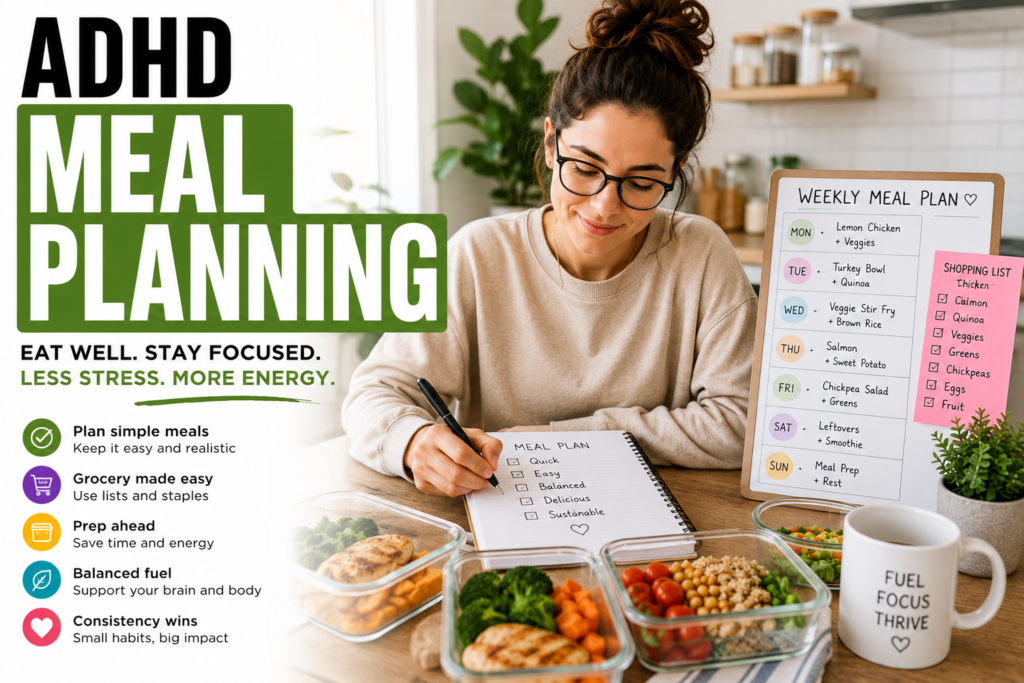
- Use the ADHD Daily Planner: Map your seven selected meals onto specific days of your planner. When your brain asks *”What is for dinner tonight?”* the answer is already externalized and visible. You do not need to think—just execute.
Phase 3: Friction-Reducing Kitchen Setup (Environmental Design)
Your kitchen environment directly determines how easy or difficult it is to initiate cooking. An ADHD-unfriendly kitchen creates invisible executive barriers; an ADHD-friendly kitchen removes them.
- The “Open Refrigerator” Rule: Pre-wash, chop, and store vegetables in transparent containers at eye level in the refrigerator immediately after grocery shopping. If the vegetables are already cut and visible, the executive barrier to using them is dramatically reduced.
- The Snack Basket: Keep a designated basket on the counter containing ADHD-supportive snacks that require zero preparation: nuts, string cheese, whole fruit, protein bars, dark chocolate. When hunger strikes suddenly (as it often does for ADHD brains that forget meals), this basket prevents impulsive, nutrition-poor choices.
- Mise en Place for Weekday Cooking: For your Tier 2 weekday meals, practice “mise en place”—preparing and measuring all ingredients before you begin cooking. This eliminates the mid-recipe working memory demands that cause ADHD cooking disasters.
- Visual Recipe Cards: Replace complex multi-paragraph recipes with simplified visual recipe cards containing only the core steps. Pin these to a visible spot in the kitchen to prevent mid-cooking “what comes next?” paralysis.
Phase 4: Maintenance and Recovery (Staying Consistent)
Even with a strong system, the ADHD brain will have weeks where everything falls apart. This phase is about recovery rather than perfection.
- The Emergency Pantry Protocol: Stock a designated “emergency shelf” in your pantry with five to seven zero-planning meals: canned soup, instant noodles, tinned fish, rice cakes, peanut butter. These are your backup when the system collapses. Having them pre-approved eliminates the shame of skipping the plan and prevents defaulting to expensive takeout.
- The 2-Day Reset: If you miss an entire week of planning, do not try to rebuild the entire system at once. Simply restart the next Sunday with a single step: choose three meals from your Master List and buy three things at the grocery store. Minimal input, maximum recovery.
- Build Routines with the ADHD Routine Generator: Embed your Sunday planning session and batch cook into a consistent, triggered weekly routine. Over time, the routine reduces the executive effort needed to initiate the planning process to near zero.
Printable ADHD Meal Planning Templates
Template 1: The Weekly ADHD Meal Map
| Day | Breakfast | Lunch | Dinner | Effort Tier | Prep Notes |
|---|---|---|---|---|---|
| Monday | Greek yogurt + berries | Batch grain bowl (Sunday prep) | Pasta with marinara + salad | Tier 1 / Tier 1 / Tier 2 | Boil pasta 15 mins |
| Tuesday | Eggs + toast | Turkey sandwich + apple | Sheet-pan chicken + veg | Tier 1 / Tier 1 / Tier 2 | Preheat oven at 6 PM |
| Wednesday | Overnight oats (prep Tuesday) | Batch grain bowl (Sunday prep) | Tacos (ground beef + shells) | Tier 1 / Tier 1 / Tier 2 | Defrost beef by 5 PM |
| Thursday | Protein smoothie | Lentil soup (batch-cooked) | Scrambled eggs + toast (Tier 1) | Tier 1 / Tier 3 / Tier 1 | High-demand day — use easiest meals |
| Friday | Greek yogurt + granola | Leftover tacos | No-cook assembly night: cheese, crackers, hummus | Tier 1 / Tier 1 / Tier 1 | Zero cooking required |
| Saturday | Relaxed brunch (eggs or pancakes) | Leftover grain bowl | Flexible — choose from Master List | Variable | Use up refrigerator items |
| Sunday | Simple cereal + milk | Soup + bread | Roast chicken + batch-cook grains | Tier 3 (batch cook day) | 45-min batch prep session at 4 PM |
Template 2: The ADHD-Friendly Standing Grocery Checklist
Use this standing list as a template each week. Cross out what you already have and add specific meal ingredients as needed.
[ ] Eggs [ ] Chicken breast / thighs [ ] Ground beef / turkey
[ ] Canned tuna / salmon [ ] Greek yogurt [ ] Cheese
[ ] Legumes (lentils, chickpeas, black beans)Grains & Starches:
[ ] Pasta [ ] Rice / quinoa [ ] Bread / wraps
[ ] Oats [ ] Crackers [ ] Potatoes / sweet potatoes
Vegetables (choose 4–5 per week):
[ ] Spinach / mixed greens [ ] Broccoli [ ] Bell peppers
[ ] Cherry tomatoes [ ] Zucchini [ ] Frozen stir-fry mix (backup)
Fruits:
[ ] Bananas [ ] Berries (fresh or frozen) [ ] Apples [ ] Oranges
ADHD Brain Support Items:
[ ] Walnuts / almonds [ ] Dark chocolate (70%+)
[ ] Chia seeds / flaxseeds [ ] Omega-3 supplement (if no oily fish this week)
Emergency Pantry Top-Up:
[ ] Canned soup [ ] Instant noodles [ ] Peanut butter [ ] Protein bars
Expert Recommendations and Clinical Guidance
If eating patterns are significantly impacting your health, weight management, or mental wellbeing, consider seeking professional support:
- Registered Dietitians (ADHD-Informed): An ADHD-aware dietitian can help you design a personalized nutrition plan that accounts for your specific medication schedule, sensory food preferences, and executive function challenges. Look for dietitians with experience in neurodivergent eating patterns.
- ADHD Coaching: A certified ADHD coach can help you implement and troubleshoot a meal planning system, build grocery routines, and maintain accountability for batch-cooking habits. Look for coaches certified by ACO, PAAC, or ICF with ADHD specialization.
- Occupational Therapy: Occupational therapists specializing in executive dysfunction can help redesign your kitchen environment and develop compensatory strategies for prospective memory and time-blindness challenges.
Regional Support Organizations
- United States: CHADD offers professional directories and resources for adult ADHD support including nutritional counseling referrals.
- United Kingdom: The ADHD Foundation provides resources and coaching directories through NHS and private pathways.
- Canada: CADDAC offers webinars, coaching directories, and adult ADHD support groups across provinces.
- Australia: ADHD Australia connects individuals with specialists, peer support networks, and occupational therapy resources.
Frequently Asked Questions
How do I start meal planning with ADHD?
Start with the Master Meal List. Spend 20 minutes writing down 15–20 meals you genuinely enjoy and can prepare. From that list, pre-select meals for the coming week on Sunday, generate a grocery list, and externalize your meal plan to a visible planner. Do not try to do all four framework phases simultaneously—start with Phase 1 and Phase 2 only.
What foods are best for ADHD focus and energy?
The most supportive foods for the ADHD brain are high-quality proteins (eggs, fish, legumes, lean meats) that supply dopamine precursors, complex carbohydrates (oats, sweet potatoes, legumes) that maintain stable blood sugar, omega-3-rich foods (salmon, walnuts, chia seeds) that support neurotransmitter function, and colorful vegetables and fruits that provide antioxidants for brain health.
How do I do meal prep with ADHD when cooking feels overwhelming?
Reduce the definition of “meal prep” to its smallest possible version. Your batch cook does not need to be an elaborate multi-recipe session. Start by simply cooking one extra serving of dinner to use as tomorrow’s lunch. When that habit is consistent, add batch-cooking one grain on Sunday. Build the system incrementally to prevent overwhelm.
Does ADHD medication affect appetite and meal planning?
Yes. Stimulant medications (like Adderall, Ritalin, or Vyvanse) commonly suppress appetite during peak medication hours, leading to missed meals and end-of-day hunger spikes. This can be managed by eating a high-protein breakfast before medication activates, keeping Tier 1 snacks accessible during the day, and scheduling dinner at a consistent time when medication levels are declining and appetite returns.
What if I have ADHD sensory food aversions?
Sensory food aversions are common in neurodivergent individuals. If certain textures, smells, or temperatures feel intolerable, build your Master Meal List exclusively from foods that are sensory-safe for you. A shorter list of accepted meals that you can reliably eat is far more nutritionally effective than a diverse list that triggers avoidance. Work with a dietitian to ensure nutritional adequacy within your sensory comfort zone.
Conclusion: Nourishing Your Brain on Your Own Terms
ADHD meal planning is not about achieving the perfectly balanced, home-cooked dinner every night. It is about building an external scaffold that makes consistent, adequate nutrition the path of least resistance rather than the path of maximum effort.
By creating a Master Meal List that removes nightly decision-making, implementing a simple Sunday planning and batch-cook session, designing an ADHD-friendly kitchen environment, and maintaining an emergency pantry for the inevitable hard weeks, you can move from chronic takeout shame to sustainable, manageable eating.
Start with one step this week. Write your Master Meal List. That is enough. Every meal you plan in advance is one fewer decision your exhausted brain must make at 6:30 in the evening—and one more unit of executive energy preserved for the things that matter most.