Best ADHD Organization Tools for Adults (2026 Comparison)
ADHD organization tools only earn a place in your life if they survive contact with a bad week — and most of them don’t. This guide compares the ADHD organizer apps, paper planners, and physical systems that adults with ADHD actually keep using past month one, with honest pros, cons, and who each one genuinely fits.
On this page:
What Makes an ADHD Organization Tool Actually Work
Most organization advice is written for neurotypical brains and then relabeled “ADHD-friendly.” A genuine ADHD organizational tool has to account for three things that standard productivity systems ignore: inconsistent working memory, variable motivation, and time blindness. A system that assumes you’ll check it every morning at 7 a.m. isn’t an ADHD tool — it’s a neurotypical tool that happens to also exist.
The tools that hold up long-term share a few traits: they reduce the number of decisions you have to make, they don’t punish you for missing a day, and they give you an external cue (a notification, a visible object, a scheduled call) rather than relying on your memory to bring the task back to mind.

How We Compared These ADHD Organization Tools
This comparison draws on ADHD coaching frameworks, occupational therapy guidance on executive function supports, and firsthand testing by contributors who live with ADHD. We evaluated every tool on four criteria: setup friction (how long until it’s usable), forgiveness (what happens after a missed day), external cueing (does it prompt you, or wait for you to remember it), and cost. We did not accept paid placements, and every tool below was actually used for at least two weeks before review.
For broader context on where these tools fit into a full daily structure, see our guide to organization planning for ADHD, and for lower-cost DIY approaches, our ADHD organization ideas roundup.
Quick Comparison Table
| Tool | Type | Best For | Price | Setup Effort |
|---|---|---|---|---|
| Tiimo | App | Visual daily structure | Free / ~$8 mo | Low |
| Todoist | App | Task capture & reminders | Free / ~$4 mo | Low |
| Focusmate | App (body doubling) | Starting hard tasks | Free / ~$5 mo | Low |
| Notion | App | Building a custom system | Free / ~$10 mo | High |
| The Full Focus Planner | Paper planner | Structured daily/weekly view | ~$45 | Medium |
| Passion Planner | Paper planner | Flexible, low-pressure layout | ~$30 | Low |
| Clear labeled bins | Physical system | Reducing clutter decisions | ~$20–60 | Medium (one-time) |
| Launch pad / everything station | Physical system | Keys, bags, daily essentials | ~$15–40 | Low |
ADHD Organization Apps
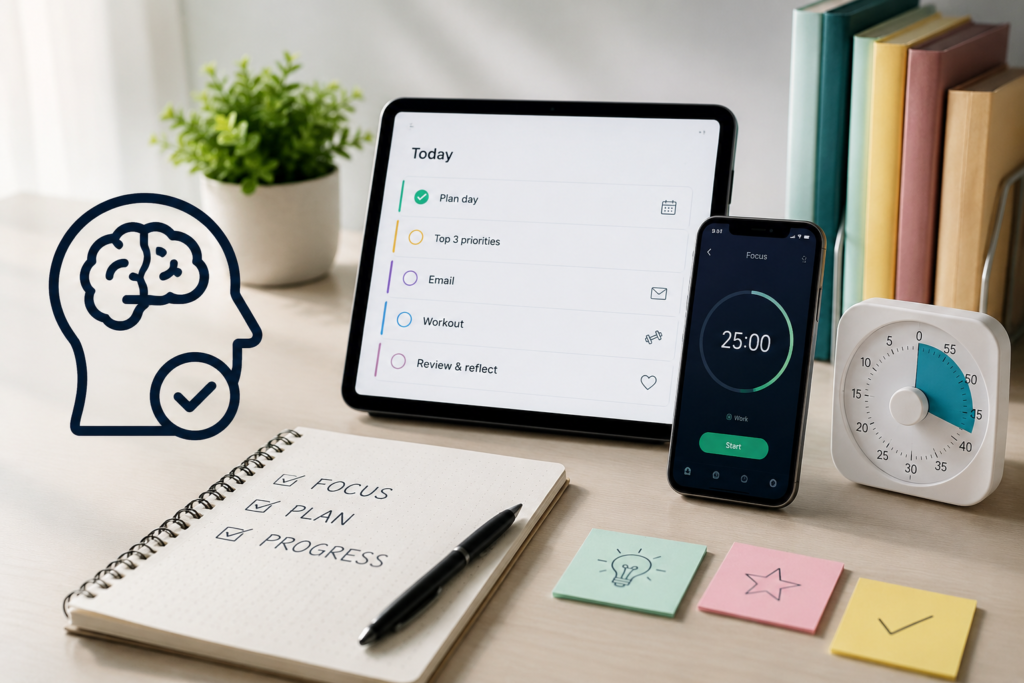
Apps are the most common starting point for organization tools for ADHD adults because they can push notifications instead of waiting to be remembered. The tradeoff is that they only work while the phone stays unmuted and the app stays installed.
Tiimo — Best Visual Daily Planner App
Tiimo turns your day into a color-coded visual timeline instead of a plain list, which suits the many ADHD adults who process time better as blocks of color than as numbers on a clock.
Pros
Visual timeline reduces time blindness; gentle, customizable reminders; widgets keep the day visible without opening the app.
Cons
Free tier is limited; some users find the visual style busy at first.
Who it fits: Adults who lose track of time during tasks and need to see the day rather than read it as a list.
Todoist — Best for Simple, Reliable Task Capture
Todoist’s main strength is that adding a task takes seconds, which matters more than any advanced feature when the real barrier is remembering to capture the thought before it disappears.
Pros
Fast task entry from any device; natural-language due dates; recurring task templates cut setup time.
Cons
No built-in body doubling or time-blocking; can silently become a graveyard of overdue tasks if reminders are ignored.
Who it fits: Adults whose core issue is forgetting tasks exist, not starting them.
Focusmate — Best for Task Initiation, Not Just Capture
Focusmate pairs you with a stranger on video for a scheduled 25 or 50-minute work session. It doesn’t organize your list at all — it solves the separate, often bigger problem of ADHD task-initiation paralysis by adding social accountability.
Pros
External accountability works even when willpower doesn’t; scheduled sessions create real deadlines; free tier covers 3 sessions/week.
Cons
Requires being on camera; doesn’t replace a task list, only pairs with one.
Who it fits: Adults who know exactly what to do but can’t make themselves start.
Notion — Best for Adults Who Want a Fully Custom System
Notion can become anything — a habit tracker, a project board, a home inventory — which is exactly why it’s a poor first tool for most ADHD adults. It rewards ongoing setup effort that competes directly with the executive function it’s meant to support.
Pros
Infinite flexibility; free templates exist for nearly every ADHD use case; one app can replace several.
Cons
High setup and maintenance cost; easy to spend more time customizing than doing tasks.
Who it fits: Adults who already have a stable baseline system and want to consolidate tools, not people starting from zero.
Paper Planners for ADHD
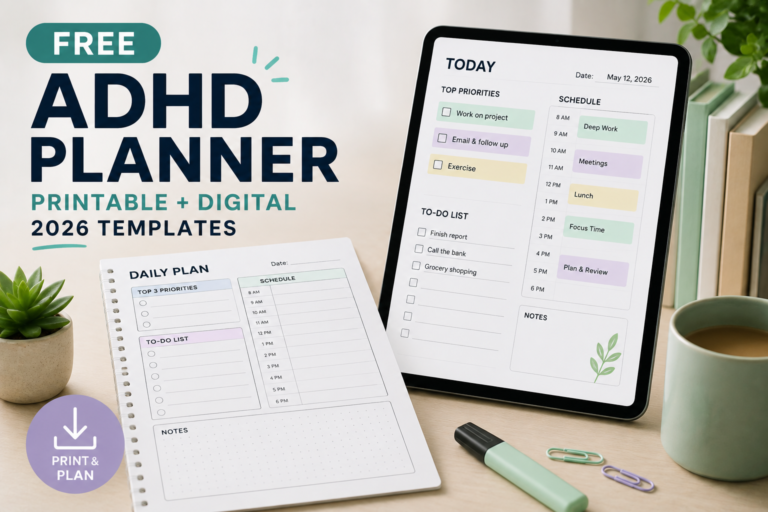
A physical ADHD organizer has one advantage no app can fully replicate: it can’t be silenced, closed, or buried in a notification pile. If it sits open on your desk, it stays visible whether or not you remember to check it.
Full Focus Planner — Best for Structured Daily Planning
This planner forces a daily top-three-priorities format, which works well for ADHD adults who tend to write ten-item to-do lists and complete none of them. The structure does the prioritizing for you.
Pros
Built-in daily/weekly/quarterly structure; forces prioritization instead of endless lists.
Cons
Rigid format can feel punishing on low-capacity days; premium price point.
Passion Planner — Best Low-Pressure Layout
Passion Planner’s open, undated layout removes the guilt of “falling behind” on dated pages, which matters for ADHD adults whose planner use is realistically inconsistent.
Pros
Undated pages mean no penalty for skipped weeks; flexible enough for both work and personal tracking.
Cons
Blank flexibility can be overwhelming for adults who need more built-in structure.
Physical Organization Systems
Not every organization problem is a scheduling problem. Clutter, lost keys, and last-minute scrambles are usually solved faster by a physical system than by any digital ADHD organisation tool.
Clear Labeled Bins — Best for Reducing Decision Fatigue
Clear bins remove the “which drawer was it in” search step entirely, and labels remove the decision of where something goes back. Together they cut two of the biggest friction points in ADHD clutter.
Who it fits: Adults whose main struggle is visual clutter and lost items rather than scheduling.
Launch Pad / Everything Station — Best for Daily Essentials
A single dedicated spot by the door for keys, wallet, bag, and anything that needs to leave the house tomorrow eliminates the frantic pre-departure search that eats up ADHD mornings. This pairs well with a broader ADHD cleaning schedule so the station itself doesn’t become clutter.
How to Choose the Right ADHD Organization Tool for You
Instead of picking the most popular tool, match the tool to the specific breakdown point in your day:
- You forget tasks exist → an app with push notifications (Todoist, Tiimo).
- You remember tasks but can’t start them → a body-doubling tool (Focusmate).
- You lose track of time while working → a visual timeline app (Tiimo) or a habit tracker.
- Your planner needs to survive being ignored for a week → an undated paper planner (Passion Planner).
- Clutter, not scheduling, is the real issue → clear bins and a launch pad.
Most adults with ADHD end up combining two tools from different categories rather than relying on one. That’s not a failure of the system — it’s a reflection of the fact that “organization” covers several unrelated executive function skills at once. For a full toolkit view, browse our complete ADHD tools hub.
External research backs this multi-system approach: the CHADD organization and the Attention Deficit Disorder Association both recommend pairing an external reminder system with a physical decluttering step rather than relying on either alone, and the National Institute of Mental Health notes that executive function supports work best when they reduce, rather than add to, daily cognitive load.
FAQ: ADHD Organization Tools
What is the best ADHD organization tool for adults?
There’s no single best ADHD organization tool for everyone — it depends on whether your struggle is remembering tasks, starting them, or managing physical clutter. Match the tool to the specific breakdown point using the guide above.
Do ADHD organization apps actually work, or is it just another thing to forget to check?
They work best when they push information to you instead of waiting for you to open them. Prioritize apps with automatic reminders and recurring templates over ones that require daily manual setup.
Are paper planners or digital apps better for ADHD?
Paper stays visible without needing to be opened; digital apps can send active alerts but rely on you checking your phone. Many adults do best combining both.
What should I look for if I’ve abandoned other organization systems before?
Look for the lowest possible setup and maintenance cost — a tool that takes under five minutes to start and doesn’t punish missed days is far more likely to stick.