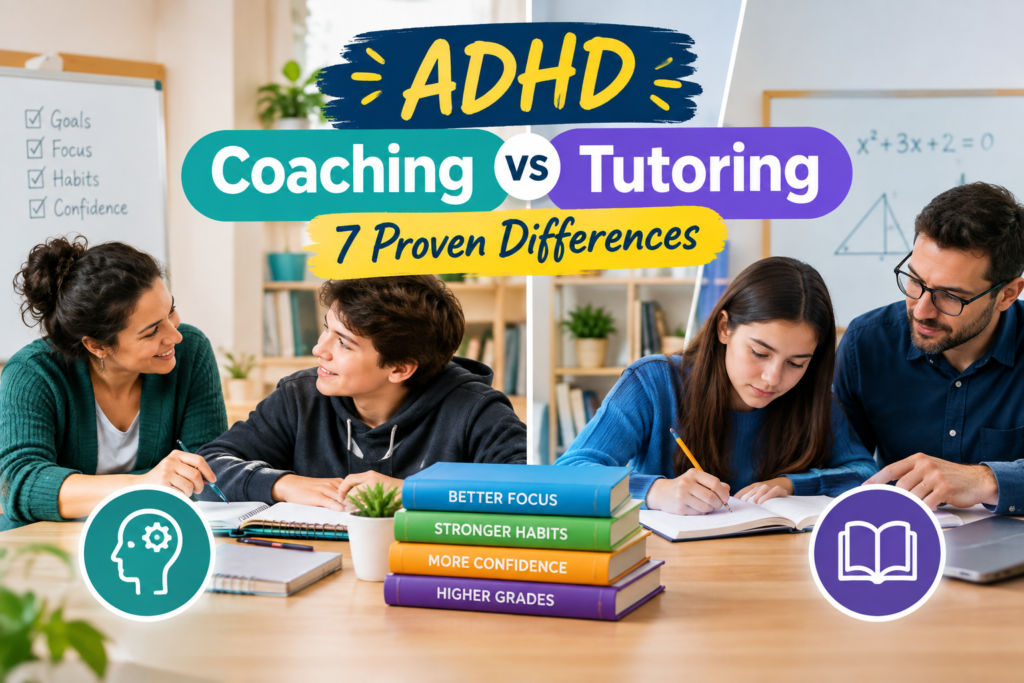
ADHD Academic Coaching vs Tutoring: 7 Proven Differences That Unlock Better Grades
ADHD academic coaching is the missing layer between “I understand the material” and “I actually turned it in on time.” Tutoring teaches the subject. Coaching builds the systems that get the subject done — the calendar, the launch ritual, the email you finally send, the paper you finally start.
If you have ever aced a practice test and then failed to submit the assignment, you already know the gap. This guide breaks down exactly what each service does, what a first session looks like hour by hour, what it costs in the US, and how to tell which one you actually need.
Quick Answer
If you can do the work but can’t start it, you need ADHD academic coaching. If you can start the work but can’t do it, you need tutoring. Tutoring is subject-specific and content-driven. ADHD academic coaching is process-specific and behavior-driven. Many students need both — but they solve completely different problems.

What Is ADHD Academic Coaching?
ADHD academic coaching is a structured, one-to-one support model that builds executive function skills: initiation, planning, time awareness, working memory offloading, emotional regulation around tasks, and follow-through. It does not reteach calculus. It teaches you how to reliably sit down, open the calculus, and finish it before midnight.
A coach typically works with you on:
- Task initiation — breaking a 10-page paper into a first sentence you can actually write
- Time awareness — estimating how long things take and calibrating against reality
- External memory — one trusted capture system instead of seven sticky notes
- Prioritization — deciding what matters when everything feels equally urgent
- Self-advocacy — emailing a professor, requesting accommodations, negotiating deadlines
- Accountability — weekly check-ins that create gentle external structure
Coaching is forward-looking and skill-based. It assumes the content knowledge is there or will be there, and that the bottleneck is the operating system running the student. If you want the underlying neuroscience, our breakdown of ADHD executive dysfunction explained covers why the gap between knowing and doing is neurological, not moral.
What Tutoring Actually Does
Tutoring is content remediation. A tutor knows chemistry, or statistics, or Spanish grammar, and they close a knowledge gap. Sessions are usually tied to a specific course, a specific exam, or a specific assignment.
Good tutoring looks like this: you bring a problem set, you work through problems together, the tutor explains the concept a second way, you leave understanding the material better. Progress is measured in comprehension and grades on content-based assessments.
Tutoring is essential when the gap is knowledge. It is nearly useless when the gap is activation. A student who understands every concept but never opens the textbook will not be fixed by a third explanation of the same concept.
ADHD Academic Coaching vs Tutoring: Side-by-Side Comparison
| Dimension | ADHD Academic Coaching | Tutoring |
|---|---|---|
| Primary goal | Build systems, habits, and follow-through | Build subject knowledge and skills |
| Typical focus | Executive function: initiation, planning, time, memory | Content: formulas, concepts, problem types |
| Session content | Review the week, audit what broke, redesign the system | Work problems, review homework, prep for exams |
| Materials needed | Planner, calendar, task list, grade portal | Textbook, syllabus, past exams, problem sets |
| Measures success by | On-time submissions, reduced avoidance, self-reported control | Test scores, grades, comprehension checks |
| Who delivers it | ADHD coach, executive function specialist, learning specialist | Subject-matter expert (often a grad student or teacher) |
| Typical cost (US) | $60–$150/hr private; often free via campus disability services | $30–$80/hr; frequently free at campus tutoring centers |
| Session length | 30–60 min weekly, plus brief check-ins | 45–90 min, often 2x per week near exams |
| Best for | “I know it but I can’t start it” | “I start it but I don’t understand it” |
| Works well combined? | Yes — coaching builds the delivery system, tutoring fills the content gap | |
The 7 Differences That Matter Most
1. Coaching fixes the pipeline, tutoring fixes the product
A tutor improves the quality of the work. A coach improves whether the work arrives at all. Most ADHD students lose more points to late zeros than to wrong answers.
2. Coaching is diagnosis-heavy
The first few ADHD academic coaching sessions are largely forensic. Where did the week break down? Was it initiation, transitions, time estimation, or emotional avoidance? The intervention depends entirely on the diagnosis.
3. Tutoring is content-specific; coaching is content-agnostic
A coach can help you build a system for organic chemistry and a system for a history thesis in the same month. A chemistry tutor cannot help with the thesis.
4. Coaching depends on you doing work between sessions
Coaching without implementation is just a nice conversation. Expect to try a system, fail at it, and bring the failure back to the session for redesign. That loop is the coaching.
5. Tutoring scales with difficulty; coaching scales with self-management
As courses get harder, you need more tutoring hours. As self-management improves, you need fewer coaching hours. Good coaching is designed to make itself unnecessary.
6. Coaching addresses the emotional layer
Shame, task paralysis, and perfectionism are often the real blockers. A coach is trained to work with avoidance without moralizing. See our breakdown of ADHD task paralysis for why “just start” is not a strategy.
7. They use different data
Tutors track quiz scores. Coaches track on-time completion rates, number of avoidance days, and whether you checked your calendar. If your coach isn’t tracking behavior data, they’re guessing.
What a First ADHD Academic Coaching Session Looks Like, Hour by Hour
Most reputable coaches run a 60–90 minute intake. Here is what a well-run 90-minute first session typically covers.
Minutes 0–15: Intake and goal setting
You’ll be asked what’s actually going wrong — not “I’m bad at school,” but “I have four missing assignments in two classes and I haven’t opened the portal in nine days.” The coach clarifies the presenting problem and what success would look like in eight weeks.
Minutes 15–40: Systems audit
You’ll walk through your current setup: where assignments live, how you remember deadlines, what your calendar looks like, whether your phone is a tool or a slot machine. The coach maps where information leaks out of your system.
Minutes 40–70: Building one system, not five
Good coaches resist the urge to rebuild your entire life in one session. You’ll usually leave with one change: a single capture tool, a weekly planning block, or a 10-minute “open the portal” ritual. One system that survives beats five that collapse by Thursday.
Minutes 70–90: Scheduling and accountability contract
You’ll set the next session, agree on what you’ll try, and define how you’ll report back. Many coaches use a short mid-week text or form check-in. This external accountability is often the single most effective ingredient.
What you will not do in session one: review algebra. That’s a different appointment.

What ADHD Academic Coaching Costs in the US
Prices vary widely by region, credentials, and whether the coach is a certified specialist or a general academic coach.
| Option | Typical Cost | Notes |
|---|---|---|
| Private ADHD academic coaching (general) | $60–$100/hr | Often remote; may or may not hold ADHD-specific certification |
| Certified ADHD / executive function coach | $100–$150/hr | Higher in major metros; often requires a package commitment |
| Monthly coaching packages | $400–$1,200/month | Usually 4 sessions plus between-session check-ins |
| University disability / accessibility office | Free | Availability varies; may be group-based or peer-delivered |
| Campus academic success center | Free | Often general study-skills coaching rather than ADHD-specific |
| Insurance coverage | Rare | Coaching is usually not a billable medical service; therapy may be |
Budget reality check: if you are paying $120/hour, eight sessions is roughly $960. That is often less than the cost of repeating a course — and considerably less than a fifth year of tuition.
How to Find a Coach: Campus vs. Private
Start with your campus disability office
In the US, students with documented ADHD are entitled to reasonable accommodations under the ADA, and many institutions offer academic coaching as a related service. Contact the office of Disability Services, Accessibility Services, or the Disability Resource Center (naming varies by school). Ask specifically:
- Do you offer executive function or ADHD-specific coaching, or only general study-skills help?
- Is it one-to-one or group-based?
- How many sessions per semester am I eligible for?
- Is there a waitlist, and how long is it?
Accommodations and coaching are separate: accommodations remove barriers (extra time, reduced-distraction testing), coaching builds skills. You generally want both. For workplace equivalents, see our guide to ADHD workplace accommodations.
Then look privately
If campus resources are thin or waitlisted, private coaching fills the gap. When vetting a coach, ask:
- What training or certification do you hold in ADHD coaching specifically?
- Do you work with executive function skills, or mainly accountability?
- What does a typical eight-week arc look like?
- How do you measure progress?
- Do you coordinate with my school’s disability office or my clinician?
Reputable directories and organizations include CHADD, ADDitude Magazine, and the International Coaching Federation for general credentialing standards. For disability rights and accommodation frameworks, the ADA information portal is the authoritative starting point.
Red flags: guaranteed grade improvements, no intake process, no measurement of progress, and coaches who position themselves as a replacement for therapy or medication management.
Self-Assessment: Coaching or Tutoring?
Answer honestly. There are no wrong answers, only wrong service matches.
| If this sounds like you… | You likely need… |
|---|---|
| I understand the material but run out of time or never start | ADHD academic coaching |
| I study hard and still get the answers wrong | Tutoring |
| I lose points to late work more than to incorrect work | ADHD academic coaching |
| I can’t follow the lectures or the textbook | Tutoring |
| I have four planners and use none of them | ADHD academic coaching |
| I do fine in one subject and fail another | Tutoring (for that subject) |
| I do badly across all subjects regardless of difficulty | ADHD academic coaching |
| I avoid emailing professors even when I know I should | ADHD academic coaching |
The one-line rule: if you can do the work but can’t start it, you need coaching, not tutoring.
When Neither Is the Answer: When You Need a Clinician
Coaching is a skill-building service, not a medical one. It is the wrong tool when:
- You are experiencing significant depression, anxiety, or suicidal thoughts. These require a licensed mental health professional, not a coach.
- Your sleep is severely disrupted. Chronic sleep deprivation mimics and worsens ADHD symptoms. Start with a physician. See our notes on practical ADHD sleep problems.
- You have never been evaluated. If you suspect ADHD but have no diagnosis, start with a psychologist or psychiatrist. Coaching assumes a diagnosis and a treatment plan.
- Your medication is not optimized. Coaching works best alongside effective treatment, not instead of it.
- There is a substance use issue. This needs clinical care first.
The best outcomes usually come from a team: clinician for diagnosis and medication, therapist for emotional processing, ADHD academic coaching for systems and follow-through, and tutoring for content gaps. These are complements, not competitors.
Frequently Asked Questions
Is ADHD academic coaching the same as therapy?
No. Therapy addresses emotional and psychological health, often processing the past. ADHD academic coaching addresses present-day skills and systems: planning, initiation, time management, and follow-through. Many people use both at once.
Can ADHD academic coaching replace tutoring?
No. Coaching will not teach you organic chemistry. If you have a content gap, you need tutoring. If you have a delivery gap, you need coaching. Most struggling students have some of both.
How long does ADHD academic coaching take to work?
Most students see measurable change in on-time completion within four to six weeks. Durable habit change typically takes one to two semesters of consistent weekly sessions, with sessions tapering as systems stabilize.
Is ADHD academic coaching covered by insurance?
Rarely. Coaching is generally not a billable medical service in the US. Some families use flexible spending accounts or student accessibility funding where available. Campus-based coaching through a disability office is typically free.
How much does ADHD academic coaching cost?
Privately, expect $60–$150 per hour in the US, with certified executive function specialists at the higher end. Monthly packages commonly run $400–$1,200. University disability services often provide it at no cost.
How do I find ADHD academic coaching near me?
Start with your university’s disability or accessibility office, then your academic success center. If those are unavailable or waitlisted, search private coaches through CHADD, ADDitude, and ADHD coach credentialing bodies, and ask about remote options — most coaching works well over video.
The Bottom Line
ADHD academic coaching and tutoring solve two different problems that happen to look identical on a transcript. Tutoring closes a knowledge gap. Coaching closes a follow-through gap. If your grades are suffering because work never gets finished, no amount of subject expertise will fix it — and if your grades are suffering because the content doesn’t make sense, no planner system will either.
Diagnose the gap first. Then buy the right support. Most students who struggle with ADHD need a system and a subject expert — but in that order.