ADHD Bedtime Routine for Adults: A Simple Wind-Down System
It is 11:30 PM. You know you should be asleep. You know you have to wake up early tomorrow. You know that if you don’t sleep now, tomorrow will be a miserable, foggy struggle. Yet, you are lying in bed, bathed in the blue light of your phone, endlessly scrolling through short-form videos, reading Wikipedia articles about obscure historical events, or hyperfocusing on a hobby you suddenly remembered. Your body is exhausted, but your brain is accelerating. You are trapped in the cycle of “Revenge Bedtime Procrastination,” and it is destroying your next-day functioning.
For adults with Attention Deficit Hyperactivity Disorder (ADHD), sleep is rarely a peaceful transition; it is a battleground. The neurodivergent brain does not naturally decelerate. Without a highly structured, intentional **adhd bedtime routine for adults**, the transition from wakefulness to sleep becomes a chaotic struggle against your own neurobiology.
This is not a matter of simply “putting the phone away.” It is a matter of understanding how executive dysfunction, dopamine dysregulation, and sensory processing differences sabotage sleep, and then building a targeted system to bypass those hurdles.
This comprehensive guide will explain the science behind why ADHD brains fight sleep, provide an actionable, neurodivergent-friendly wind-down framework, and equip you with a printable checklist. By mastering your evening transition, you can reclaim your rest, dramatically improve your baseline **productivity**, and stop waking up feeling like you are already behind.
The Science: Why ADHD Brains Fight Sleep
Before we can fix the problem, we must understand the mechanics of it. Why is it so impossibly hard for an ADHD adult to just “go to bed”?
1. Revenge Bedtime Procrastination and Dopamine Chasing
The ADHD brain is chronically under-stimulated, constantly seeking dopamine to reach a functional baseline. During the workweek, you spend an enormous amount of executive function “masking”—forcing yourself to focus on unstimulating tasks, sitting still in meetings, and suppressing your natural impulses.
By the time night falls, your executive function is completely depleted. You have spent the entire day doing what other people want you to do. The night feels like the only time you have autonomy. “Revenge Bedtime Procrastination” occurs when you refuse to go to sleep because you are desperately trying to reclaim personal time and chase dopamine (through video games, social media, or snacking) to compensate for a highly restrictive day.
2. Delayed Circadian Rhythm
Research indicates that a high percentage of adults with ADHD suffer from Delayed Sleep-Wake Phase Disorder (DSWPD). The internal biological clock of an ADHD brain is often shifted two to three hours later than neurotypical brains. While society demands you wake up at 7:00 AM, your brain biologically believes 2:00 AM is the correct time to go to sleep. You are fighting millions of years of evolutionary biology, requiring a specialized routine to coax the brain into an earlier shutdown.
3. The Working Memory Spin Cycle
**Working memory** is the brain’s short-term workbench. In an ADHD brain, this workbench is chaotic and unregulated. The moment your head hits the pillow and external distractions cease, the Default Mode Network takes over. Without a podcast, a screen, or a conversation to anchor your attention, your working memory starts rapidly cycling through every anxiety, every forgotten task, every awkward social interaction from 2014, and every item you need to buy at the grocery store. This cognitive hyperarousal floods the body with cortisol (the stress hormone), making sleep biologically impossible.
4. Transition Friction
Going to bed is not one step. It is a complex sequence of tasks: stop what you are doing, go to the bathroom, brush teeth, wash face, change clothes, turn off lights, get in bed. For an ADHD brain that struggles with task initiation and transitions, this multi-step sequence feels like climbing a mountain. It is easier to just sit on the couch and scroll than to initiate the 10-step sequence required to actually get into bed.
Symptoms of an Unstructured Night
How do you know if your current nighttime habits are failing you? Look for these specific ADHD-related symptoms of a broken wind-down sequence.
| Symptom | Description | The Neurological Driver |
|---|---|---|
| The Couch Trap | Falling asleep on the couch at 9 PM, waking up at 1 AM, and then being unable to fall back asleep in bed. | Extreme transition friction. Moving from the couch to the bed requires too much executive function when tired. |
| The 3 AM Panic | Waking up in the middle of the night terrified because you remembered an important deadline for tomorrow. | Failure to externalize working memory before bed, leading to subconscious anxiety. |
| Morning Brain Fog | Waking up feeling hungover despite not drinking, completely unable to form a coherent thought for two hours. | Sleep architecture disruption. You aren’t getting enough Deep Sleep or REM sleep because of late-night hyperarousal. |
| Medication Rebound Crash | Feeling intensely irritable, hungry, and restless right around 8:00 PM. | ADHD stimulant medication wearing off, causing a sudden drop in dopamine and executive control. |
| The Endless Scroll | Telling yourself “just five more minutes” on TikTok, only to look at the clock and realize three hours have passed. | Time blindness combined with the intermittent variable dopamine rewards of social media algorithms. |
Real-World Scenarios
Scenario A: The Exhaustion Spiral (Marcus’s Story)
Marcus is a software engineer. His workday requires intense, draining **focus**. When he logs off at 6:00 PM, his executive function is entirely empty. He eats dinner while watching YouTube. At 10:00 PM, he knows he should go to bed, but the thought of getting up to brush his teeth feels overwhelmingly difficult. He decides to play “one quick game” on his console to relax.
Because of his ADHD time blindness, he doesn’t realize it is 2:00 AM until his eyes start burning. He finally drags himself to bed, but his brain is highly stimulated by the fast-paced game. He lies awake until 3:30 AM, his mind racing. He wakes up at 7:30 AM, exhausted, grumpy, and completely reliant on caffeine to survive the morning. His **planning** for the day is ruined because he has no cognitive energy.
Scenario B: The Intentional Wind-Down (Sarah’s Story)
Sarah used to live like Marcus, until she realized her lack of sleep was destroying her daily **organization** and emotional regulation. She built a strict **adhd bedtime routine for adults**.
At 9:30 PM, an alarm goes off on Sarah’s phone. This is her “Shutdown Sequence” trigger. She immediately closes her laptop and puts her phone on a charger in the kitchen—not the bedroom. She does a quick 5-minute brain dump on a notepad to clear her working memory of tomorrow’s tasks.
She then goes to the bathroom, brushes her teeth, and washes her face. By 9:45 PM, she is in pajamas. She turns off the harsh overhead lights and turns on a dim, amber-colored lamp. She reads a physical fiction book (not a screen) for 30 minutes. The low-stimulation activity combined with the dim light signals to her brain that dopamine-chasing time is over. By 10:30 PM, she is naturally sleepy. She turns off the lamp and falls asleep within fifteen minutes. She wakes up refreshed, her executive function fully restored for the day ahead.
The Actionable Framework: The ADHD Bedtime Wind-Down System
An effective neurodivergent bedtime routine cannot rely on willpower. By 10:00 PM, your willpower is gone. The system must rely on environmental design, friction reduction, and biological hacking.
This system is divided into four distinct phases, executed over 60 to 90 minutes.
Phase 1: The Frictionless Transition (Do the hard stuff early)
The biggest trap for ADHD adults is waiting until they are tired to get ready for bed. When you are tired, your executive function is at zero, meaning you cannot initiate the complex task of “getting ready.” You must separate the *preparation* for bed from the *act* of going to bed.
- The Pre-Emptive Strike: Do not wait until 11:00 PM to brush your teeth. Brush your teeth and wash your face immediately after dinner, at 7:30 PM, while you still have momentum from the day.
- Pajamas Early: Change into your sleep clothes the moment you are done with any outside-the-house obligations. If you are in pajamas at 8:00 PM, you have removed the physical barrier to getting into bed later.
- The Launch Pad: Set out your clothes for tomorrow and pack your work bag now. Do not leave these decisions for the morning, and do not leave them for 11:30 PM. Remove all morning friction tonight.
Phase 2: The Dopamine Disconnect (Lowering Stimulation)
You cannot go from a high-dopamine activity (like an intense video game or TikTok) straight to sleep. The brain needs a deceleration ramp.
- The Screen Boundary: Set a hard alarm for 60 minutes before your target sleep time. When this alarm sounds, all interactive screens (phones, tablets, gaming consoles) must be turned off. Interactive screens provide variable dopamine rewards, which keep the brain hyper-engaged.
- Passive vs. Active Entertainment: If you cannot tolerate silence (a common ADHD trait), switch from active entertainment (scrolling) to passive entertainment. Watching a familiar, comforting TV show (one you have seen before) from across the room is significantly better than scrolling on a phone six inches from your face. The lack of novelty in a familiar show prevents dopamine spikes.
- The Alternative Anchor: Have a low-dopamine, tactile activity ready. Adult coloring books, knitting, jigsaw puzzles, or reading a physical book. These provide enough mild stimulation to keep the ADHD brain from seeking out the phone, but are boring enough to allow sleepiness to set in.
Phase 3: The Cognitive Dump (Clearing Working Memory)
You must empty the brain before you ask it to rest. If you leave tasks in your head, the brain will try to remind you of them at 3:00 AM.
- The Nightly Purge: Keep a notepad on your nightstand. Before you turn out the lights, write down everything bothering you. Tasks for tomorrow, emails to send, random anxieties. Do not try to organize the list; just get the data out of your biological RAM and onto paper.
- Secure the Data: Once the brain dump is complete, tear the sheet off and place it on top of your phone or laptop for the morning. Tell your brain: “The information is safe. You do not need to hold onto it anymore.”
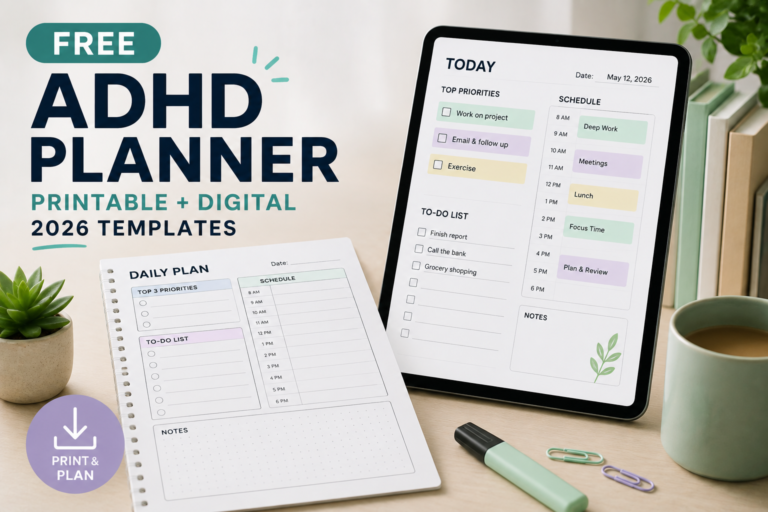
- Tomorrow’s Anchor: Decide on exactly ONE priority for tomorrow morning. Write it down in your ADHD Daily Planner. Knowing exactly how you will start tomorrow drastically reduces nighttime anxiety.
Phase 4: The Sensory Soothe (Environmental Cues)
ADHD brains are highly sensitive to their environment. Use sensory inputs to trick your biology into producing melatonin.
- Light Manipulation: Light is the strongest signal to your circadian rhythm. Two hours before bed, turn off all bright overhead lights. Use only dim, warm-colored lamps (amber or red light). This mimics a sunset and triggers the brain to release melatonin.
- Temperature Drop: Your core body temperature must drop by 1-2 degrees Fahrenheit to initiate sleep. Keep your bedroom cool (around 65°F / 18°C). Alternatively, take a hot shower an hour before bed; the rapid cooling of your body when you step out of the shower artificially triggers this temperature drop, inducing sleepiness.
- Audio Masking: Complete silence can be deafening to an ADHD brain, allowing tinnitus or intrusive thoughts to echo. Use a white noise machine, a fan, or play a “sleep story” or brown noise softly in the background. This provides a steady, non-distracting audio anchor for the brain to latch onto while falling asleep.
Printable ADHD Bedtime Checklist
Template 1: The Wind-Down System
Print this checklist and keep it visible in your living room or bathroom. Do not rely on your memory to execute the sequence.
[ ] Brush teeth and wash face.
[ ] Change into sleepwear/pajamas.
[ ] Lay out tomorrow’s clothes.
[ ] Pack tomorrow’s bag/lunch.
Phase 2: Deceleration (60 Mins Before Bed)
[ ] Alarm goes off: Turn off all interactive screens (Phone/Tablet/Games).
[ ] Dim the lights (turn off overheads, use warm lamps).
[ ] Switch to low-dopamine activity (reading, puzzle, familiar TV show).
[ ] Lower the thermostat or open a window to cool the bedroom.
Phase 3: The Final Shutdown (15 Mins Before Bed)
[ ] Move to the bedroom.
[ ] Do a 5-minute Brain Dump on paper (write down all worries/tasks).
[ ] Pick the #1 priority for tomorrow.
[ ] Turn on white noise/brown noise.
[ ] Turn out the lights.
Common Pitfalls and Expert Recommendations
Even the best routine can fail if you do not anticipate the unique hurdles of the ADHD neurotype. Here is how experts suggest overcoming the common failure points.
- The “Revenge Bedtime” Trap: If you find yourself consistently engaging in revenge bedtime procrastination, the problem isn’t your nighttime routine; the problem is your daytime routine. You are not building enough breaks, autonomy, or dopamine into your workday. You must schedule intentional downtime during the day using the ADHD Time Management Planner so you don’t feel desperate for “me time” at 1:00 AM.
- Medication Timing: Discuss your medication schedule with your prescribing doctor. Sometimes, a stimulant taken too late in the day destroys sleep. Conversely, some ADHD adults experience a severe dopamine crash in the evening, making their hyperactivity worse at bedtime; in these cases, some doctors prescribe a very tiny “booster” dose of medication in the late afternoon to smooth the transition and calm the brain enough to sleep. Only do this under strict medical supervision.
- The Phone in the Bedroom: This is a non-negotiable rule for severe ADHD insomnia. Your phone cannot be your alarm clock, and it cannot be on your nightstand. The temptation for a quick dopamine hit is too strong for an exhausted prefrontal cortex to resist. Buy a cheap, standalone digital alarm clock. Plug your phone in across the room, or ideally, in the kitchen. If you must use your phone for white noise, put it out of arm’s reach so you cannot physically grab it without getting out of bed.
- The All-or-Nothing Fallacy: If you miss your 9:30 PM shutdown alarm, do not say “Well, the routine is ruined, I might as well stay up until 3 AM.” That is ADHD all-or-nothing thinking. If it is midnight, you can still do the 5-minute version: Brush teeth, brain dump, lights out. A partial routine is infinitely better than no routine.
Frequently Asked Questions
How long will it take for this to work?
Your circadian rhythm is stubborn. If you have been going to sleep at 2:00 AM for years, you cannot suddenly force yourself to sleep at 10:30 PM. Move your routine back by only 15 minutes every three days. It typically takes 2 to 4 weeks for an ADHD brain to fully adapt to a new circadian schedule and stop fighting the routine. Consistency is key. Use the ADHD Habit Tracker to monitor your progress.
What if I do the routine, get in bed, and still can’t sleep?
Do not stay in bed for more than 20 minutes if you are wide awake and anxious. Staying in bed while frustrated trains your brain to associate the bed with stress. Get up. Keep the lights extremely dim. Go sit in a chair and read a boring physical book or listen to a non-engaging podcast until you feel heavy-eyed. Only then return to bed. Your bed must be for sleep and intimacy only.
Should I take melatonin?
Many ADHD adults have delayed natural melatonin onset and benefit from supplementation. However, most people take too much, too late. Experts often recommend a very low dose (0.5mg to 1mg, not the massive 10mg pills often sold) taken two hours before your desired bedtime, not right as you get into bed. Always consult with your healthcare provider before starting any new supplement, especially if you are taking ADHD medications.
What if the routine feels too boring?
The ADHD brain hates boredom, but sleep *requires* boredom. The transition from high stimulation to sleep must involve a decrease in dopamine. If you find the routine agonizingly boring, you are likely dropping your stimulation levels too quickly. Use “bridge activities”—things that are engaging but not addictive. Listening to an audiobook while doing a jigsaw puzzle is a great bridge between playing a high-intensity video game and lying in the dark.
Conclusion: Reclaiming Your Rest
Sleep deprivation is the ultimate amplifier of ADHD symptoms. When you do not sleep, your executive function crumbles, your emotional regulation vanishes, and your working memory becomes completely unreliable. You spend the next day surviving on caffeine and adrenaline, which only guarantees another terrible night of sleep.
The **adhd bedtime routine for adults** is how you break this destructive cycle. It is an acknowledgment that your neurodivergent brain needs a deliberate, structured landing gear to safely return to earth after a chaotic day.
By separating the hard task of getting ready from the act of sleeping, aggressively lowering your dopamine inputs, externalizing your swirling thoughts onto paper, and using sensory cues to trigger melatonin, you stop fighting your biology and start working with it.
Tonight, do not wait until you are exhausted to begin. Set an alarm for 60 minutes before you want to sleep. Brush your teeth early. Turn off the harsh lights. Dump your brain onto a notepad. By committing to this simple wind-down system, you are not just improving your sleep—you are protecting your peace, your **productivity**, and your capacity to handle whatever tomorrow brings.