There is no single homework schedule that suits every child with ADHD. Age, task difficulty, school demands, tiredness, access needs and family circumstances all matter. The five steps below are a flexible framework, not a clinically tested programme or a promise of conflict-free evenings.
This guide is for parents and carers of school-age children and teenagers. Involve your child in decisions and coordinate with their school when homework repeatedly becomes difficult.
First identify where homework gets stuck
| What happens? | What to check | Useful next step |
|---|---|---|
| Your child cannot say what was assigned. | Whether instructions, materials and submission details are available. | Check the agreed assignment source and contact the teacher if information is missing. |
| They know the task but cannot begin. | Whether the first action is clear and manageable. | Choose one small action and offer a limited choice about how to start. |
| They attempt the work but do not understand it. | Whether there is a knowledge, language or instruction gap. | Clarify the task or seek teaching support rather than extending the work session. |
| They start but repeatedly lose their place. | Task length, distractions and whether a visible stopping point would help. | Try a smaller section, a place marker or an agreed break. |
| The work is finished but not handed in. | The upload, folder or classroom hand-in process. | Add submission or packing to the routine. |
| Homework regularly ends in significant distress. | Workload, skill demands, health concerns and existing support. | Pause the struggle and arrange a discussion with the school and relevant professionals. |
Step 1: Agree on a realistic start
Choose a starting time or cue that fits your child’s day. Some children want a break after school; others find it easier to begin before changing activities. Avoid treating either pattern as a universal rule.
Check ordinary needs first: food, a drink, the toilet, rest and a comfortable place to work. Offer a suitable snack if needed, following any dietary requirements. No special food or exercise sequence is required to “activate” homework.
Give advance notice of a transition where helpful: “After your snack, we’ll check what is due.” Keep the cue predictable without turning a delayed start into a character judgement.
Offer a limited choice: “Would you like to check reading or maths first?” Younger children may need more guidance; teenagers should have meaningful input into the arrangement.
Step 2: Confirm the task and prepare the space
Check the assignment before asking your child to work independently. Identify:
- What needs to be done.
- When it is due.
- Which materials or instructions are needed.
- How it must be submitted.
- Whether the teacher has provided any adjustments or alternative instructions.
Ask your child to explain the first instruction in their own words. This can reveal a misunderstanding before a long work session begins.
Keep necessary supplies accessible and reduce distractions that interfere with this child’s work. A kitchen table may suit one child; a quieter space may suit another.
Headphones, background sound, movement and fidgets are optional. Try one change at a time and notice whether it helps the child work or adds another distraction. You do not need to buy equipment before trying the routine.
Step 3: Choose one manageable work section
Turn a broad instruction into an action your child can recognise. For example:
- “Read the paragraph and underline the unfamiliar words.”
- “Try the first problem and show how you approached it.”
- “Open the writing document and list three ideas.”
Choose a section that fits the task and child. There is no universal ADHD attention limit of 10, 15 or 25 minutes.
If using a timer, explain its purpose: it marks a check-in or work period, not a deadline for producing correct answers. A task-based stopping point may be easier than a clock for some children.
You can sit nearby if your child finds that helpful. Agree whether they want quiet company, an occasional prompt or help checking instructions. Avoid completing the work for them or correcting every response as it happens.
For teenagers, agree on check-ins rather than assuming continuous supervision is welcome. Support can be reduced gradually when the student can manage a step independently.
Step 4: Use breaks and feedback deliberately
Agree on breaks before frustration becomes intense. A break might involve stretching, getting water or another accessible activity that is easy to finish.
Choose the timing through observation. A child who is working comfortably may prefer to finish a short section; a child becoming fatigued may need a break sooner. Avoid interrupting solely because an arbitrary interval has elapsed.
Make the return clear: “After the break, we’ll open the next question.” A reminder or visible note may help.
Give specific feedback about actions within the child’s control: “You checked the instruction when you were unsure,” or “You came back and tried the first step.” This is more informative than only praising correct answers.
If using an incentive, agree on a small, achievable behaviour in advance. Do not make food, rest, affection or essential support conditional on perfect work. Ask the school or a qualified professional for help if you need a structured behaviour-support plan.
Step 5: Check submission and leave a return point
Completion includes getting the work to its destination. Use a short closing check:
- Is the work saved and named appropriately?
- Does the assignment require an upload or a physical hand-in?
- If uploaded, is there a confirmation?
- If on paper, is it in the correct folder or bag?
- If unfinished, is the stopping point and next action recorded?
- Does the teacher need an update?
Keep the close brief. It is an opportunity to secure the work, not review every difficulty from the evening.
A checklist can reduce reliance on remembering the steps. It does not, by itself, demonstrate an improvement in working-memory capacity.
Worked example: a short maths session
Illustrative example: A child has a worksheet containing several similar problems. They understand the topic but become overwhelmed when looking at the whole page.
| Stage | What the parent and child do |
|---|---|
| Check | Read the instructions and confirm what is due and how it will be handed in. |
| Prepare | Gather the pencil and required materials. Mark the current question without losing the original instructions. |
| Begin | Agree to attempt the first small section. The parent stays nearby if requested. |
| Review | Check whether the child understands the method. If not, stop treating the difficulty as a motivation problem. |
| Break or continue | Choose a brief break or another section based on how the child is managing. |
| Close | Put completed work in the hand-in folder and note any unresolved question for the teacher. |
Breaking the work into sections does not automatically mean reducing the required assignment. Discuss changes to workload or submission expectations with the teacher.
Agree on what to do when homework takes too long
Ask the teacher how long the assignment is expected to take and what to do when your child reaches that point without finishing. Agree on a stopping or communication plan rather than inventing one during a difficult evening.
Record useful facts: approximate working time, breaks, the section attempted, help required and where understanding broke down. Avoid interpreting unfinished work as proof that your child did not try.
If distress escalates, prioritise settling the situation. A discussion about consequences or next week’s routine can wait until everyone is able to participate.
Troubleshooting the routine
| Difficulty | Response to try |
|---|---|
| “I don’t know what to do.” | Ask which instruction is unclear. Check the assignment source before giving more encouragement. |
| Your child repeatedly leaves to find supplies. | Prepare a small supply container or check materials at the start. |
| Breaks become difficult to end. | Choose an easier-to-stop activity and agree on the return cue before leaving the task. |
| Your presence causes more conflict. | Try sitting farther away or using agreed check-ins. Discuss the arrangement when calm. |
| One subject is consistently much harder. | Ask the teacher about understanding, prerequisite skills and possible learning or language needs. |
| Work is accurate but very slow. | Share examples with the school and ask about workload, access needs and appropriate adjustments. |
| Completed work keeps going missing. | Practise the hand-in or upload process separately from doing the assignment. |
| Planning itself becomes exhausting. | Use only the assignment, first action, break plan and submission check. |
A homework plan you can copy
Assignment and due date:
__________________________________________________
What the instruction means:
__________________________________________________
Materials needed:
__________________________________________________
First action:
__________________________________________________
Work section and check-in point:
__________________________________________________
Break and return cue:
__________________________________________________
Help wanted from an adult:
__________________________________________________
Submission method:
__________________________________________________
If unfinished:
__________________________________________________
When to involve the school
Contact the teacher when instructions are repeatedly missing, work consistently exceeds the expected time, a subject remains difficult or homework regularly affects wellbeing and sleep.
Possible discussion points include clearer written instructions, smaller work sections, support recording assignments, appropriate breaks and a reliable submission process. Agree which changes the school will provide and when to review them.
United States
The CDC’s school-support guidance explains that eligible students may receive support through an IEP under IDEA or a Section 504 plan. These are different arrangements; an ADHD diagnosis does not automatically establish eligibility for either.
Ask the school’s relevant support team about assessment and individual needs. Workplace accommodations are not a substitute for school-specific procedures.
England and other European education systems
In England, GOV.UK advises speaking with the teacher or SENCO about special educational needs support.
Elsewhere in the UK and Europe, roles, terminology and procedures differ. Ask the school who coordinates additional learning support and which local process applies. Do not assume that US IEP or Section 504 rules apply.
Example message to the teacher
“We are finding that homework is regularly taking longer than expected. The main difficulty seems to be understanding the written instructions and getting started. Could you confirm the expected working time and what we should do if the work remains unfinished? We would also like to discuss one or two supports and a date to review them.”
What research supports—and what it does not
A randomised clinical trial involving 75 children aged 5–12 found benefits for homework completion and accuracy from a homework-focused behavioural programme involving parent training and a daily report card.
That supports considering structured behavioural help for homework difficulties. It does not validate this article’s exact five-step sequence, establish a universal work interval or prove claims about snacks, sounds or “dopamine resets.”
The CHADD homework guidance also offers practical ideas for recording assignments and organising materials. Apply suggestions according to the child’s needs rather than treating every technique as compulsory.
When healthcare support may also be needed
Persistent homework difficulties may involve more than the home routine. The CDC’s clinical guidance highlights assessment for coexisting concerns, including learning, language, anxiety and sleep difficulties.
If you notice significant changes in mood, sleep, appetite or functioning, discuss them with your child’s healthcare professional. If problems appear related to medication timing or side effects, contact the prescriber; do not change treatment to fit homework without their guidance.
Parents and carers also need practical support. A difficult evening is not proof that you caused the problem or failed to stay calm enough.
Start with one change
Choose the part of the routine that causes the most difficulty: understanding the assignment, beginning, continuing or submitting. Agree on one adjustment with your child and review what happens over several homework occasions.
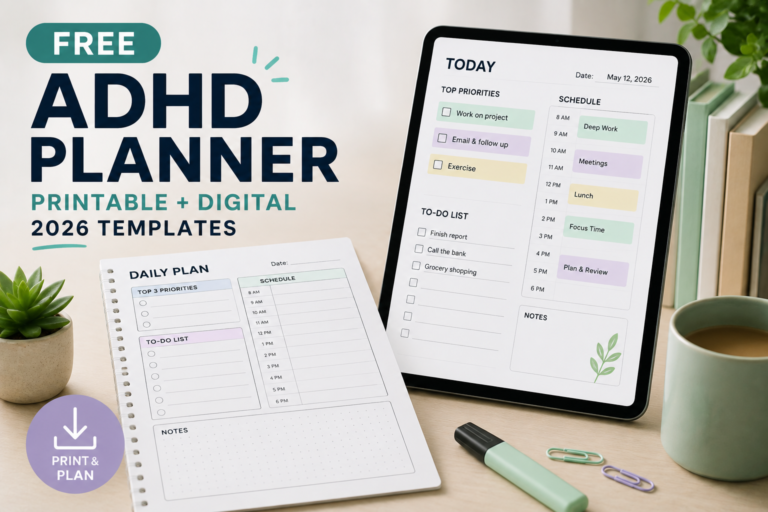
For recording the plan, use our simple planner templates. For an explanation of supportive company while working, see our body-doubling guide; adapt any arrangement to the child’s age and preferences.